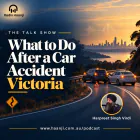









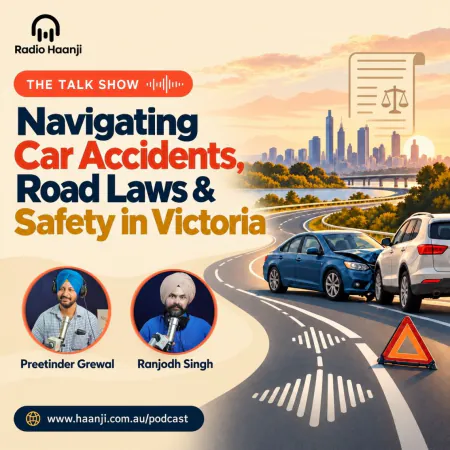















































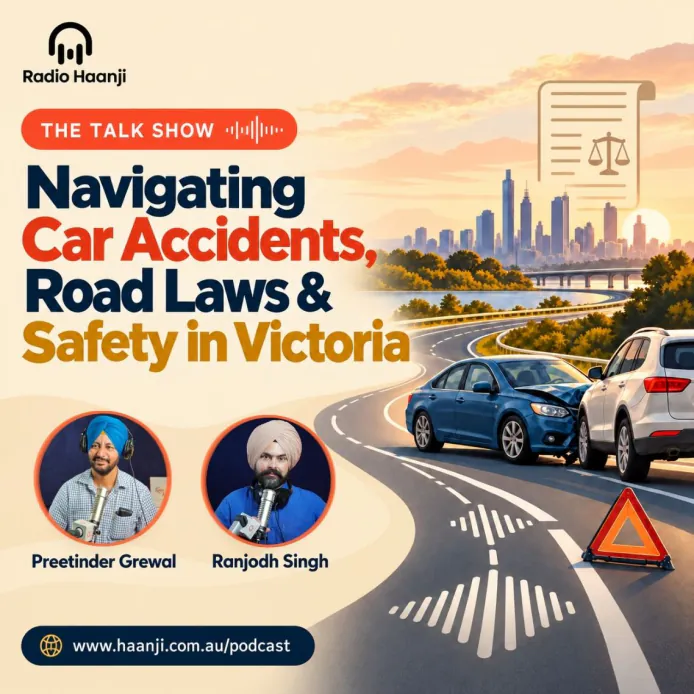
Navigating Car Accidents, Road Laws & Safety in Victoria - Preetinder Grewal & Ranjodh Singh
Host:-
 Preetinder Grewal
 Ranjodh Singh
Learn what to do after a car accident in Victoria. Discover legal duties, police reporting rules, and insurance pitfalls from Radio Haanji's The Talk Show.
What to Do After a Car Accident in Victoria: Legal Duties and Safety Guide
A sudden collision on the road can instantly trigger disorientation, anxiety, and conflict. Knowing exactly what to do after a car accident in Victoria protects your safety, ensures compliance with statutory obligations, and shields you from prolonged financial liabilities. On The Talk Show, broadcast on Radio Haanji 1674 AM, hosts Preetinder Grewal and Ranjodh Singh explored the critical legal, procedural, and safety requirements every motorist must navigate following a crash, joined by frontline insights from Harpreet Singh Virdi of Victoria Police.
Many drivers hold persistent misconceptions about exchanging licenses, making roadside apologies, or negotiating private cash settlements. When legal technicalities collide with adrenaline, simple errors can escalate civil incidents into criminal investigations or void comprehensive insurance coverage. Understanding how Victorian law handles collisions, when police attendance is required, and what road data indicates about crash trends is essential for every motorist.
Where to Listen
The Talk Show is hosted by Preetinder Grewal and Ranjodh Singh, broadcasting on Radio Haanji 1674 AM. You can tune in live or catch full recorded broadcasts across your preferred streaming services:
Episode Highlights
-
Immediate Scene Protocol and Driver Safety: The hosts outlined the legal necessity to stop immediately and render assistance, stressing scene de-escalation over public arguments regarding fault.
-
Statutory Disclosure Requirements: Exploring the exact information drivers must trade under Victorian road law, clarifying persistent myths regarding phone numbers and driving licences.
-
Emergency Triage and Police Intervention: Clarifying the operational criteria that determine whether an incident requires Triple Zero (000) or non-urgent handling via the Police Assistance Line.
-
The Pitfalls of Private Settlements: Real-world accounts from callers highlighted how informal roadside handshakes and deferred mechanic repairs routinely fall apart into unpaid bills and damaged credit histories.
-
Vehicle Compliance and Policy Cancellation: Insights shared by Victoria Police's Harpreet Singh Virdi confirmed how uncertified suspension modifications and illegal front window tinting void claims under Australian Design Rules.
-
Road Safety Factors and Fatality Trends: Analysis of national and state road crash figures, linking critical risk factors—such as fatigue, speeding, and impairment—to disproportionate trauma statistics.
What Details Are Drivers Legally Required to Exchange in Victoria?
Under Victorian law, drivers involved in a motor vehicle collision are legally required to stop and provide their name, address, and vehicle registration number to other parties or property owners involved. If the driver is not the registered owner of the vehicle, the registered owner's name and address must also be supplied.
Motorists are often shocked to learn that providing a phone number or handing over a driver licence card is not a statutory obligation under Victorian road safety legislation. While motorists may mutually agree to photograph physical licences or exchange phone numbers for convenience, refusing to share personal phone numbers or licences does not constitute a traffic offence, provided that full names, residential addresses, and vehicle registration details are disclosed. If the driver fails or refuses to provide these required details, it constitutes a legal breach, and the other party should take photographic evidence of the vehicle and its registration plate and report the incident directly to the nearest police station.
Collecting scene-level documentation is equally essential for civil and insurance clarity. Taking wide-angle photographs of the intersection, skid marks, road conditions, and individual vehicular impact zones helps insurance assessors establish context without relying on conflicting verbal accounts. Leaving the scene without stopping and rendering assistance is an offence classified as a hit-and-run, which carries severe penalties.
When Are You Legally Required to Call Victoria Police to a Crash?
Victoria Police must be contacted immediately via Triple Zero (000) if anyone is injured or killed, if a party fails to stop and exchange required details, or if disabled vehicles create an active hazard to other road users. Non-hazardous property-damage crashes where details are exchanged do not require emergency police attendance.
When police attend a collision scene, officers evaluate vehicular impact physics, assess physical injuries, and conduct mandatory breath testing alongside drug screening. Where an attending officer forms an opinion that a motorist’s behaviour is impaired despite a negative alcohol reading, an impaired assessment protocol is conducted, which may involve transport to a medical facility or police facility for clinical blood testing.
For minor property collisions where traffic flow is maintained and all motorists are cooperative and uninjured, calling emergency services is unnecessary. Non-emergency reports, suspicious driving patterns, or historical collisions can be recorded by dialing the Police Assistance Line on 131 444 or submitting an online report through Crime Stoppers. When erratic driving or hit-and-run incidents occur, gathering registration numbers, vehicle makes, and dashcam footage allows investigating officers to locate the registered vehicle owner through official databases.
Can Saying Sorry or Making Private Deals Hurt Your Insurance Claim?
A roadside apology can be interpreted by opposing parties and legal assessors as an unintended admission of fault, complicating liability determinations. Making informal "cash-in-hand" settlement deals frequently leaves victims out of pocket when the at-fault driver reneges on private promises to pay for repairs.
During the broadcast, several callers shared real-world experiences illustrating the hazards of avoiding formal insurance pipelines. Motorists often negotiate private settlements at the scene to evade paying insurance excesses or incurring premium increases. However, after verbal promises to repair cosmetic blemishes or bumper damage privately, at-fault parties frequently block phone numbers, change residential addresses, or dispute the repair quotes provided by independent panel beaters.
Attempting to resolve damage informally can also create legal and financial complications. If an insurer becomes aware that a driver accepted delayed private liability, subsequent claims can be delayed, disputed, or declined. Fault assessment is a formal technical calculation executed by insurers and police investigators based on physical damage, road rules, and verified evidence—not emotional roadside debates. Motorists must remain calm, confirm everyone's safety, collect factual data, and defer all financial liability decisions directly to their policy provider.
How Do Illegal Modifications and Dark Tints Impact Vehicle Claims?
Vehicles with extreme modifications that breach Australian Design Rules—such as oversized tyres protruding beyond the wheel arches, excessive suspension lifts, or unapproved front window tints—can be deemed unroadworthy. In the event of a collision, insurers may void coverage entirely, leaving the driver personally liable for all damages.
Harpreet Singh Virdi of Victoria Police explained that vehicle modifications, particularly on four-wheel drives, utility vehicles, and performance cars, are heavily scrutinised following collisions. When vehicle modifications do not comply with engineering standards, attending officers issue formal defect notices. Beyond state road penalties, insurance assessors examine mechanical roadworthiness. If unapproved mechanical alterations or excessive window tinting reduce visibility or impact stability, the insurer can reject the claim on the grounds that the vehicle was operating outside legal safety standards.
To safeguard both legal standing and financial coverage, motorists must consult certified roadworthy assessors before undertaking structural, tyre, or suspension alterations. Window tint percentages must also comply strictly with state transport guidelines, as excessively dark aftermarket films—especially on front windscreens—significantly elevate crash risks and provide insurers with grounds to deny collision claims.
National and State Road Trauma Statistics
Road trauma across Australian roadways continues to claim hundreds of lives annually, driven by persistent behavioural risks and driver inattention. National and state safety metrics highlighted on the broadcast reveal the scale of road trauma across various jurisdictions:
-
Annual National Fatalities: Approximately 1,300 to 1,400 people lose their lives annually on Australian roads, with a national fatality rate of 4.7 deaths per 100,000 population.
-
Cumulative Toll: Between January and August of the analyzed recording year, 882 people lost their lives in motor vehicle crashes nationwide.
-
Jurisdictional Breakdown: State breakdowns showed New South Wales recording the highest number of fatalities (over 350), followed by Queensland (316) and Victoria (257).
-
Road User Vulnerability: Drivers represent the single largest casualty cohort with 581 deaths, followed by 264 motorcyclists, approximately 200 vehicle passengers, 187 pedestrians, and 60 cyclists.
-
Gender Disparity: Men account for approximately 74% of all fatal crash victims (977 males compared to 336 females).
-
Primary Crash Factors: Inappropriate speeding, drug and alcohol intoxication, lack of sleep and driver fatigue, mobile phone distraction, and failure to wear seatbelts remain the primary contributors to serious injuries and fatalities.
Key Takeaways
-
Motorists involved in a crash in Victoria must stop immediately, render all possible assistance, and provide their name, address, and vehicle registration details.
-
Victorian law does not mandate the exchange of phone numbers or driver licence cards; failure to provide name, address, and vehicle registration is what constitutes an offence.
-
Victoria Police and emergency services should only be summoned via Triple Zero (000) if someone is injured or if disabled vehicles obstruct traffic flow.
-
Refrain from apologizing or arguing at the scene, as statements can be interpreted as admissions of fault, and never rely on informal, cash-in-hand repair promises.
-
Unapproved modifications and non-compliant window tints violate Australian Design Rules, resulting in police defect notices and potential claim denials by insurance companies.
-
Driver fatigue cannot be mitigated by music or open windows; adequate sleep remains the only effective preventative measure against fatigue-related crashes.
References and Further Reading
-
Victorian Road Safety Legislation & Australian Design Rules (ADRs): Statutory frameworks governing legal post-crash obligations, detail exchanges, roadworthy standards, and legal modification limits in Victoria.
-
National and State Road Safety Trauma Statistics: Official annual crash and casualty data monitoring road fatalities across Victoria, New South Wales, Queensland, and national territories.
-
Victoria Police Collision Response Guidelines: Operational criteria governing emergency call-outs via Triple Zero (000) versus non-emergency reports submitted via the 131 444 assistance line or Crime Stoppers.
Related Audio & Programmes
Equipping yourself with factual knowledge of Victorian road safety laws safeguards your legal rights, your financial well-being, and community safety. Rather than relying on roadside assumptions, follow verified protocols: stop safely, exchange your name, address, and registration, document the scene, and let legal and insurance frameworks handle liability. To hear real-world caller accounts and in-depth discussions on road safety and legal rights, listen to the full episode on the Radio Haanji App, Spotify, or Apple Podcasts.
Frequently Asked Questions
Do I have to show my driver licence to the other driver after an accident in Victoria?
What should I do if the other driver flees the scene without exchanging details?
When should I call Triple Zero (000) instead of the Police Assistance Line?
Will saying "I'm sorry" at the crash scene invalidate my insurance?
Can dark window tinting really cause an insurance claim to be rejected?
What's Your Reaction?







Related Posts