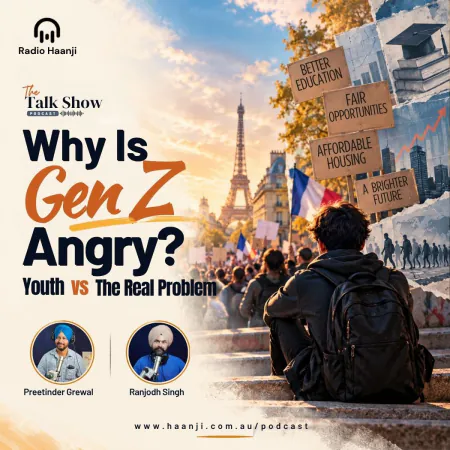






















































































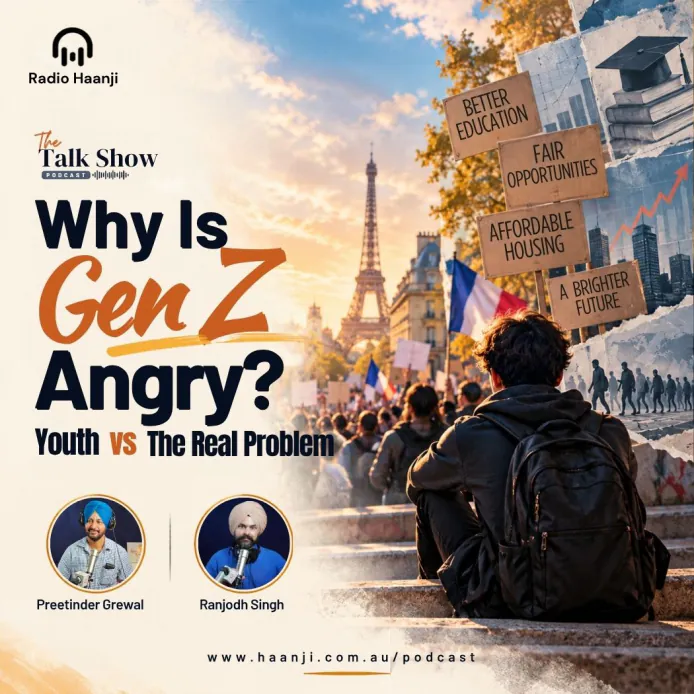
Why Is Gen Z Angry? The Real Truth Behind the France Riots - Preetinder Grewal & Ranjodh Singh
Host:-
 Preetinder Grewal
 Ranjodh Singh
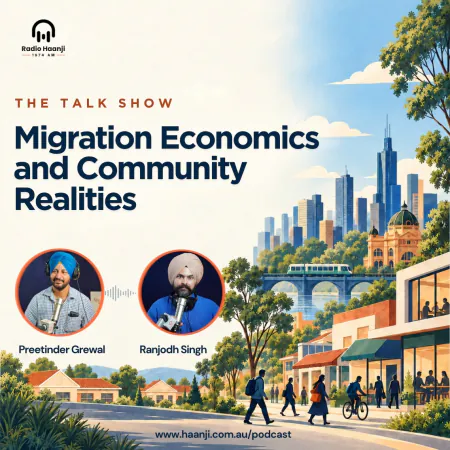
Radio Haanji's The Talk Show unpacks the France youth protests, school conditions, cost of living pressures, and migration debates with Preetinder and Ranjodh.
When big news breaks across the world, television screens fill up fast with images of burning cars, smashed shop windows, and police in riot gear. But behind the chaos, there is almost always a deeper, everyday problem that pushed ordinary people to the edge.
On a live broadcast of The Talk Show on Radio Haanji 1674 AM Melbourne, hosts Preetinder Grewal and Ranjodh Singh took a step back from the noise to explain what is happening on the streets of France, why young people are so frustrated, and why this story matters to working families everywhere.
How It Started: Broken Classrooms, Not Big Politics
The protests did not begin over grand political ideas. They started in ordinary local high schools with teenagers aged 16 to 18.
Students were walking into classrooms packed with 30 or more kids. During heatwaves where temperatures touched 40°C, there was no air conditioning or basic cooling. Even worse, schools faced severe staff shortages. As one student pointed out, the government somehow found the money to send four police officers to watch a single student on the street, but could not afford one teacher for a class of 35 children.
Frustrated by feeling ignored, students walked out. Within days, that small spark caught fire. The walkouts spread to anywhere between 110 and 150 cities across France, bringing an estimated 500,000 to 600,000 people onto the streets.
When Peaceful Marches Turn Destructive
Whenever half a million people take to the streets, things can get out of hand quickly. While most people marched peacefully for better schools and fairer treatment, opportunists and rioters slipped into the crowds.
High-end stores like Apple and Louis Vuitton were looted, cars were set on fire, and streets turned into battlegrounds.Over 2,400 people were arrested, and around 1,000 police officers were injured.
As the hosts pointed out, this destruction ended up hurting the students' cause. The moment luxury shops were trashed on camera, news channels and politicians stopped talking about underfunded schools. Instead, they focused entirely on crime and law enforcement, drowning out the real problems that started the march in the first place.
Why Gen Z Feels Trapped
Why are so many young people—often called "Gen Z"—so ready to protest?
For years, parents and teachers told them the same simple story: study hard, get a degree, and you will get a good job and build a comfortable life. Millions of young people did exactly that. But when they graduated, the jobs were not there, wages were flat, and the cost of rent and groceries had skyrocketed.
On top of that, birth rates have dropped in many wealthy countries. That means people aged 16 to 26 now make up only about 16% to 26% of the population. Because there are fewer young voters, politicians often ignore their needs and focus on policies that favor older, wealthier voters who own property. Feeling powerless at the ballot box, young people feel the only place left to make noise is out on the road.
With phones in their pockets, apps like TikTok and Instagram allow these teenagers to share footage and organize marches in a matter of minutes. It is the exact same frustration seen in places like Nepal, Sri Lanka, Kenya, Indonesia,and across India, where youth have protested over job shortages and paper leaks in exams like NEET.
Protest Is in France's DNA
To understand France, you have to look at its history. More than 200 years ago, during the French Revolution, the people rose up against absolute kings who lived in luxury while the poor starved. They tore down the Bastille prison and fought for the rights of everyday citizens. Standing up to the government is not new in France—it is part of their culture.
Yet, despite being one of the wealthiest countries on the planet, France has a massive wealth gap. Right outside glamorous cities like Paris are poor suburbs where 70% to 80% of families struggle with poverty, joblessness, and rundown neighborhoods. When life feels hopeless for long enough, it does not take much for anger to boil over.
The Blame Game: Is Immigration Really the Problem?
As soon as the riots made headlines, right-wing politicians in Europe and Australia (including figures like Pauline Hanson) jumped in front of cameras. Their message was simple: blame the immigrants.
Preetinder and Ranjodh broke down why that argument does not hold up:
-
The Numbers: While many immigrant families in France trace their heritage to North African countries like Algeria (~13%), Morocco (~12%), and Tunisia (~4.5%), just as many come from European neighbors like Portugal (~8.6%), Italy (~4%), and Spain (~3.5%).
-
The Real Cause: A carton of milk, a tank of fuel, and a month of rent cost too much for everyone, regardless of their skin color or religion.
-
The Political Trick: When governments fail to fix schools, hospitals, and housing, pointing a finger at immigrants is an easy way to dodge responsibility and divide working-class people.
A Squeeze Felt Across the Entire Globe
France is not alone. Around the world, everyday people are feeling the exact same pressure:
-
Italy & Belgium: Thousands have marched against budget cuts to schools and basic public services.
-
Portugal & Spain: Rent has jumped so high that ordinary workers are packing the streets of Lisbon and Madrid demanding rent caps.
-
South America: Massive crowds in Colombia and Argentina have protested against university budget cuts and labor laws.
At the same time, governments pour billions of public dollars into foreign wars, leaving ordinary taxpayers asking why there is always money for weapons, but never enough for local hospitals, housing, and schools.
The Takeaway for Families in Australia
For the Indian and Punjabi community listening across Melbourne and broader Australia, this discussion hits close to home. Families here are navigating their own worries—rising interest rates, expensive rent, visa changes for international students, and political finger-pointing that tries to blame newcomers for housing shortages.
As the hosts summed up, working-class people in Paris, Delhi, and Melbourne are all trying to solve the same basic puzzle: put food on the table, keep a roof over their heads, and build a decent future for their children. Falling for political blame games only distracts from the real issues. True community strength comes from staying informed,asking tough questions of leaders, and standing together.
Frequently Asked Questions
What initially caused the youth protests across France discussed on The Talk Show?
Why do young people feel disconnected from traditional politics today?
Is the civil unrest in France solely caused by immigration?
How can listeners in Melbourne and across Australia tune into The Talk Show?
What's Your Reaction?