

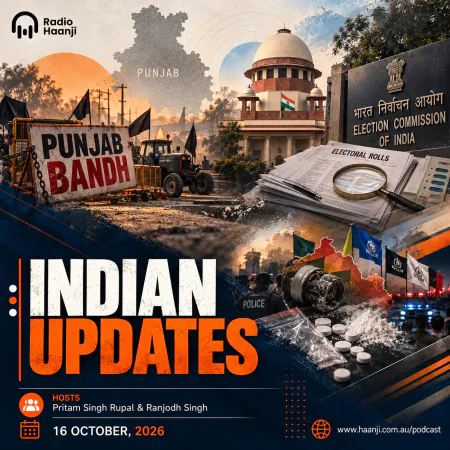








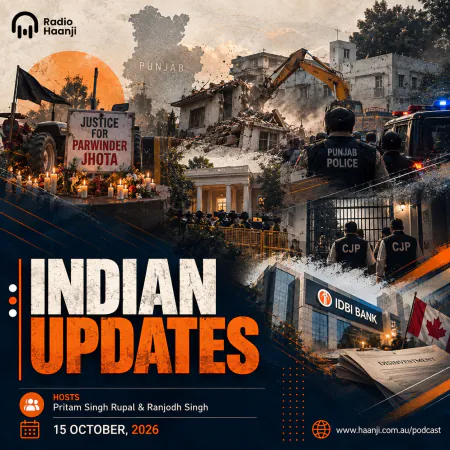



























































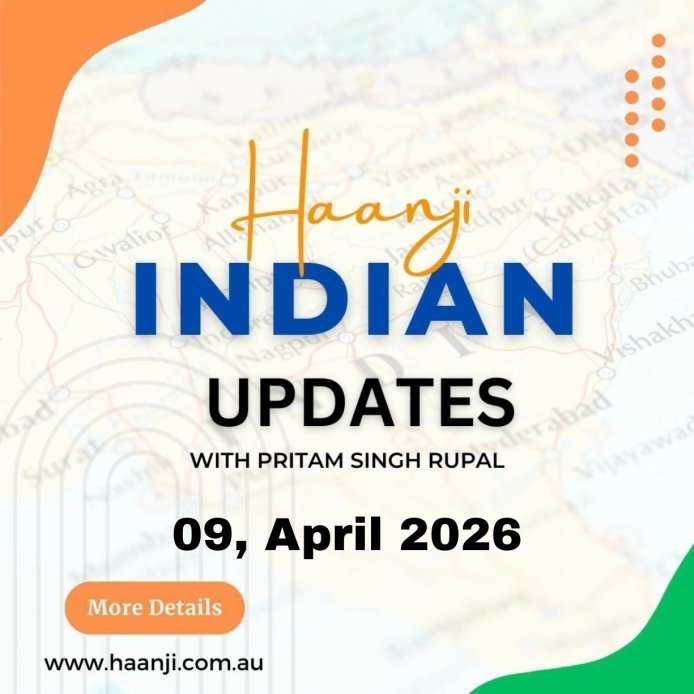


Pritam Singh Rupal analyzes the TMC-EC rift and Punjab's crop damage relief. Trusted analysis for the diaspora, free every weekday on Radio Haanji.
Indian Updates — 09 April 2026 | EC Controversy and Badal’s Institutional Challenge — Radio Haanji
The current political climate in India is moving at a pace that often leaves the headlines struggling to keep up with the deeper implications of today’s decisions. In this edition of Indian Updates on Radio Haanji 1674 AM, Ranjodh Singh is joined by Senior Journalist Pritam Singh Rupal. With his decades of experience at All India Radio and a career rooted in the nuances of Punjabi journalism, Rupal brings a rare level of clarity to stories that are frequently oversimplified by the 24-hour news cycle.
Today’s discussion moves from the volatile polling booths of West Bengal to the rain-lashed fields of Punjab, where the intersection of governance and nature is creating a new set of challenges for the state. We also look at the evolving legal and religious debates surrounding the Sabarimala temple and the internal friction within the Shiromani Akali Dal, providing the diaspora with a comprehensive view of the forces shaping their homeland.
The Escalating War Between TMC and the Election Commission
The friction between the Trinamool Congress and the Election Commission has reached a boiling point that threatens to overshadow the actual polling process in West Bengal. Recent reports of a heated exchange where TMC leaders allege the Chief Election Commissioner told them to "get out" are just the surface of a much deeper institutional rift. This conflict is not merely about a single meeting but represents a fundamental disagreement over the authority of the commission to transfer over 500 officials during an election cycle.
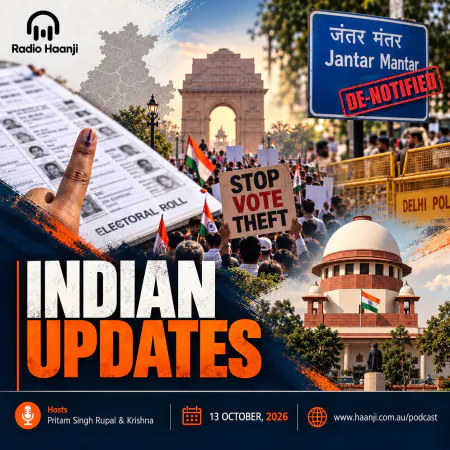
Mamata Banerjee’s party argues that these administrative shifts are unjustified and represent a bias that favors the central government. On the other side, the Election Commission maintains that these moves are necessary to ensure a fair environment, citing the need to insulate the election from local administrative influence. The massive deletion of names from voter rolls, particularly in districts where the TMC has historically been strong, has only added fuel to the fire, leading to a legal challenge in the Calcutta High Court.
Polling Dynamics in Kerala, Assam, and Puducherry
While West Bengal captures the most attention for its administrative drama, the democratic process is in full swing across Kerala, Assam, and Puducherry. In Kerala, the contest remains a traditional but intense battle between the Left Front and the United Democratic Front led by Congress. The stakes are high for both coalitions as they attempt to capture the narrative of social progress in a state known for its high political engagement.
In Assam, the battle lines are drawn between the BJP and the Congress party, with each side focusing on regional identity and developmental promises. Puducherry is also witnessing active polling, contributing to a complex national picture where local issues are driving voter turnout. These elections are more than just a tally of seats; they are a real-time test of how the electorate responds to the economic and social policies enacted over the last few years.
Punjab’s Agricultural Crisis: A Plea for Central Intervention
Punjab’s agriculture is currently facing a dual challenge from unpredictable weather and a slow-moving bureaucracy. Agriculture Minister Gurmeet Singh Khuddian recently confirmed that crops across more than 1.30 lakh acres have suffered significant damage due to unseasonal rain and hailstorms. For farmers who were just days away from harvesting a bumper wheat crop, the sight of flattened fields in districts like Fazilka, Muktsar, and Bathinda is nothing short of a catastrophe.
The state government has ordered a special assessment to evaluate these losses, but the scale of the damage requires federal assistance. Minister Khuddian has written to the Union Agriculture Minister, requesting an immediate dispatch of a high-level team to assess the situation and release a compensation package. This highlights the ongoing vulnerability of the agrarian economy and the need for a faster, more responsive system of disaster relief that doesn’t leave farmers waiting for months as their livelihoods sit in ruins.
Sukhbir Badal and the Challenge to Institutional Authority
The internal dynamics of the Shiromani Akali Dal took an unexpected turn this week as Sukhbir Singh Badal labeled the religious punishment imposed on him by the Akal Takht a "conspiracy." This stance is a significant departure from his initial acceptance of the decree, where he performed service at the Golden Temple as a mark of humility. The shift from a humble follower to a critic of the process suggests a growing friction between political survival and religious authority.
Critics argue that this challenge to the Jathedars of the Akal Takht follows a historical pattern where political interests are prioritized when the leadership faces a crisis. While Badal maintains that his religious misconduct was a matter of political decision-making rather than a betrayal of faith, the community is watching closely to see how this affects the credibility of both the leader and the institution. It is a moment that tests the traditional hierarchy of Sikh temporal and political power.
The Sabarimala Debate: Can Courts Define Superstition?
The Supreme Court is currently navigating one of the most sensitive areas of Indian law: the boundary between faith and judicial oversight. During recent hearings on the Sabarimala temple, the court asserted its jurisdiction to identify and strike down practices that it deems to be superstitious, especially if they violate public order or morality. This is a bold claim that has been met with resistance from the Centre’s legal representatives.
The Solicitor General argued that secular courts lack the scholarly competence to decide what constitutes a religious practice versus a mere superstition. He noted that what might be a deeply held belief in one state could be viewed as superstition in another, making any universal judicial standard problematic. The court’s position, however, is that it cannot be a silent spectator when practices infringe on constitutional rights. This debate is fundamental to how India defines its secularism and the extent to which the law can intervene in the "essential practices" of a religion.
Why Indian Updates on Radio Haanji Is Essential for the Indian Diaspora
For the Punjabi and Indian diaspora in Australia and Singapore, keeping up with these rapid developments is about more than just staying informed; it is about maintaining a connection to the social and political fabric of home. The nuance provided by Pritam Singh Rupal and Ranjodh Singh ensures that our listeners receive an analysis that goes beyond the noise of social media. We provide the context that helps you understand why a policy in Punjab or a court ruling in New Delhi matters to your family back home.
Our commitment is to deliver a balanced and deep-reaching perspective that respects the intelligence of our audience. Whether it is an update on agricultural relief or a breakdown of election controversies, Indian Updates is the bridge between the diaspora and the changing landscape of India.
Listen to Indian Updates — Free, Every Weekday
Don't miss the deep analysis and trusted insights from Ranjodh Singh and Pritam Singh Rupal. Stay ahead of the headlines with Radio Haanji.
Listen free:
Radio Haanji 1674 AM is Austalia's Punjabi community radio station.
Listen free at haanji.com.au | Spotify | Apple Podcasts | iOS App | Android App
Serving the Punjabi community in Australia, Canada, Singapore and world wide.
What's Your Reaction?







Related Posts