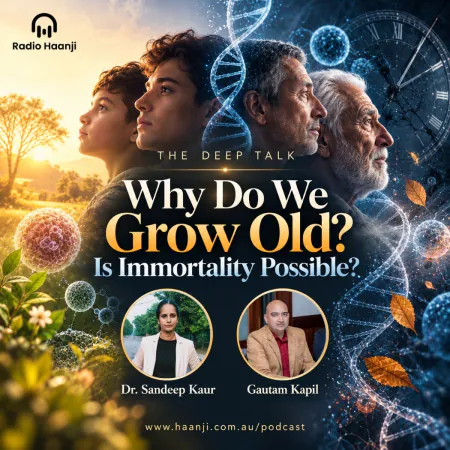






























































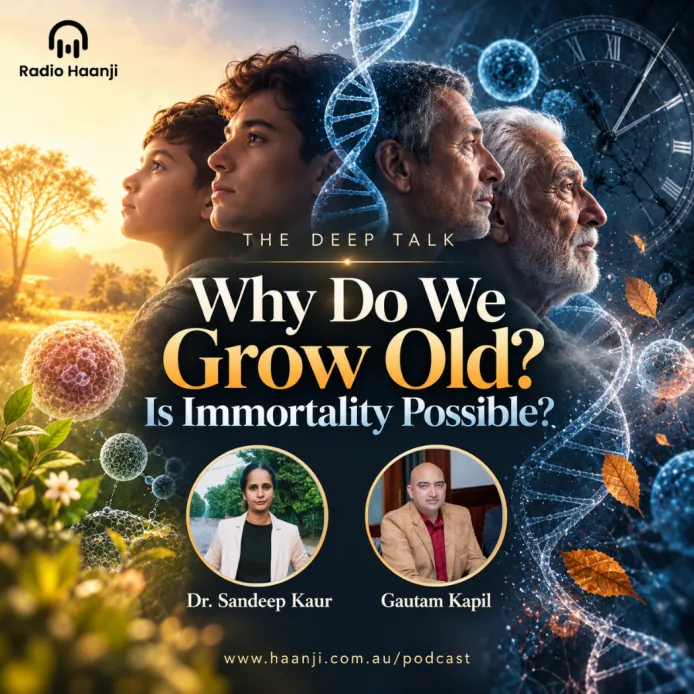
Why Do We Grow Old? Is Immortality Possible?- The Deep Talk - Dr. Sandeep Kaur - Gautam Kapil
Host:-
 Dr. Sandeep Kaur
 Gautam Kapil
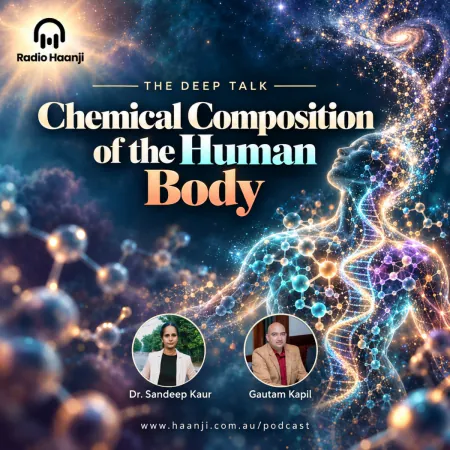
Join Gautam Kapil and expert guest Dr. Sandeep Kaur on Radio Haanji's The Deep Talk as they decode the fascinating science of human aging, examining cellular changes, DNA mechanics, and lifestyle impacts on longevity.
For centuries, humanity has chased the promise of eternal youth, from ancient folklore to modern shelves packed with cosmetic treatments promising to roll back the clock. Yet beneath the surface of skin creams and cultural fixations on looking youthful lies a far deeper reality dictated by human biology. Understanding the science of human agingrequires looking past external appearances and examining what is actively taking place inside our tissues and genetic code.
In an illuminating installment of the Deep Talk Show on Radio Haanji 1674 AM, host Gautam Kapil sat down with Dr.Sandeep Kaur to dissect the fundamental mechanics of why our bodies grow older. Rather than viewing aging simply as wrinkles or lost energy, the discussion unpacked the cellular wear, genetic limits, and evolutionary trade-offs that shape our lifespans.
Aging is not an abrupt switch that flips late in life; it is an ongoing biological reality that begins long before adulthood.As explored on Radio Haanji, the human body is an intricate network of trillions of cells constantly dividing, repairing,and responding to environmental pressures, with internal clocks and external stressors defining our health over time.
Where to Listen
Catch the full conversation with Gautam Kapil and Dr. Sandeep Kaur on the Deep Talk Show broadcast via Radio Haanji 1674 AM. Stream the full episode and follow the series across your preferred audio platforms:
Episode Highlights
-
The Reality of Aging: Moving past commercial beauty trends and cosmetic promises to examine what biological aging actually represents across cells and tissues.
-
Internal vs External Drivers: How genetics account for approximately 25% of the aging process, while lifestyle, pollution, and external environments dictate the rest.
-
Cellular Division and Telomeres: How chromosomes carry protective caps called telomeres that shorten with successive cell divisions, capping replication.
-
Mitochondrial Health and Inflammation: The critical role of cellular powerhouses and how lingering,damaged senescent cells spark damaging systemic inflammation.
-
Evolutionary Biology and Natural Selection: Why natural selection prioritizes reproductive success and species survival over prolonged individual lifespans.
-
Experimental Longevity Science: An objective look at ongoing scientific trials, including caloric restriction,cellular cleanup, and blood exchange studies.
-
Everyday Protective Habits: The practical role of balanced nutrition, daily physical movement, mental stimulation, and sun protection in safeguarding longevity.
The Two Driving Forces: Internal vs External Aging
The biological aging process is divided into two distinct but interconnected mechanisms: intrinsic (internal) aging and extrinsic (external) aging. Intrinsic aging is driven by the genetic blueprint inherited from our parents and ancestors.Interestingly, genetic programming accounts for only about 25% of how our bodies age over time.
The remaining 75% of cellular aging is driven by extrinsic factors. These encompass our everyday physical environments, lifestyle habits, ambient pollution, UV light exposure, systemic stress levels, and access to medical healthcare. Two individuals born with comparable genetics can age along completely different biological trajectories based on how their daily lives interact with these external variables.
Aging begins at the cellular level even before birth during embryonic tissue development. As cells replicate and divide to sculpt organs, fingers, and body systems, biological wear begins. What we eventually identify as aging in later decades is simply the cumulative result of these continuous internal processes running alongside external wear and tear.
Why Do Human Cells Age and Stop Dividing?
Human cells age because chromosomes lose protective DNA caps called telomeres with each division cycle. Over time, shortened telomeres prevent safe replication, cellular repair mechanisms lose efficiency, and accumulated mutations diminish the cell's ability to maintain normal function, causing progressive tissue decline.
Every cell in our body houses chromosomes containing our DNA. At the tips of these chromosomes sit specialized protective structures called telomeres, which function much like the plastic caps on the ends of shoelaces. Each time a cell divides to sustain life or repair damage, its telomeres shorten slightly.
Once telomeres reach a critically short threshold, the cell can no longer divide safely without risking severe genetic corruption. When replication ceases, natural repair becomes impaired. Unlike childhood and young adulthood—when cellular repair systems operate at peak capacity—older tissues struggle to replace lost or degraded cells at the same pace.
Compounding this loss is the gradual decline of mitochondria, the dedicated powerhouses inside our cells that produce energy. As mitochondrial integrity falters, available cellular energy drops, leaving tissues more vulnerable to genetic mutations, DNA strand damage, and environmental insults.
The Role of Chronic Inflammation and Senescent Cells
Chronic inflammation accelerates human aging when damaged or dead cells fail to clear from tissues properly. These lingering senescent cells secrete harmful biochemical signals that disrupt neighboring healthy cells, fueling low-grade systemic inflammation linked to heart disease, obesity, and accelerated physical degradation.
Under normal circumstances, the immune system detects dying or defective cells and systematically clears them away.However, as our bodies age, this clearance mechanism can lose precision. Cells that enter an irreversible state of division arrest—known as cellular senescence—often remain stuck within tissues instead of being eliminated.
These senescent cells do not remain neutral. They actively release inflammatory compounds into surrounding tissue,degrading adjacent healthy cells and stressing nearby blood vessels. While acute inflammation is a life-saving mechanism that heals cuts and fights off pathogens, chronic low-grade inflammation acts as a silent catalyst for progressive bodily wear.
This persistent inflammatory state contributes directly to systemic health challenges commonly seen in aging populations, including cardiovascular disease, metabolic disorders, and tissue frailty. Managing the burden of systemic inflammation represents one of the central frontiers in longevity research.
Why Has Evolution Not Eliminated Aging and Death?
Evolution has not eliminated aging because natural selection prioritizes reproductive survival and the continuation of the species rather than indefinite individual longevity. Genes that promote vigorous early-life development and reproduction are preserved, even if those same genetic pathways contribute to cellular breakdown and disease in later decades.
From an evolutionary biology perspective, nature does not optimize organisms for immortality. Evolutionary pressures favor traits that allow an individual to survive long enough to reproduce and pass their genetic information to the next generation. Once reproductive years pass, natural selection's influence on an organism's survival diminishes sharply.
Certain biological mechanisms that provide immense survival advantages during youth can lead to complications later in life. For instance, aggressive cellular proliferation supports rapid growth, wound healing, and reproductive vigor during our early decades. However, unrestrained cellular proliferation in older age can manifest as abnormal growths and tumors.
Different species showcase how natural selection tailors lifespan to ecological roles. Greenland sharks can endure for centuries in cold marine environments, and certain tortoises live for hundreds of years. Conversely, smaller creatures with high predation risks, such as mice or insects, prioritize rapid reproduction within a brief window. Nature ensures species continuity; it does not guarantee permanent individual survival.
Can Science Reverse the Human Aging Process?
Science cannot currently reverse human aging or grant biological immortality. While experimental models involving caloric management, senescent cell removal, and plasma transfers show promise in laboratory animals, translating these findings safely to humans requires extensive clinical verification to prevent severe risks like cancer and immune dysfunction.
Modern research into life extension has made notable strides in laboratory settings. Scientists continue to investigate methods for identifying and purging damaged senescent cells without triggering collateral tissue harm. Controlled caloric restriction and targeted nutritional balancing have also demonstrated measurable lifespan extensions across various animal models.
Other exploratory research, such as parabiosis trials connecting the circulatory systems of young and old mice, revealed physiological improvements in older animals. However, applying these interventions to humans introduces significant biological hurdles. What benefits an animal model can disrupt human biology, carrying serious risks of uncontrolled cellular growth or immune failure.
Beyond biological hurdles, extending lifespan raises complex ethical and social considerations. Regulatory bodies such as the Food and Drug Administration (FDA) maintain strict trial standards because experimental interventions must prove safety before human implementation. The scientific consensus remains clear: slowing down functional decline is achievable, but true biological reversal remains unproven.
Healthspan vs Lifespan: The Priority of Modern Research
In contemporary longevity discussions, researchers increasingly distinguish between lifespan—the total number of years an individual lives—and healthspan, which represents the period of life spent in vibrant, disease-free health. The primary objective of medical science is not merely tacking years onto the end of life, but ensuring that those years remain active and functionally sound.
While cutting-edge pharmaceutical therapies remain in development, proven daily choices directly influence healthspan:
-
Balanced, Proportionate Nutrition: Maintaining a diet rich in vegetables, fruits, and adequate protein while moderating heavy carbohydrate overconsumption supports steady cellular metabolism.
-
Consistent Physical Activity: Engaging in roughly 30 minutes of moderate exercise five days a week helps sustain mitochondrial function, muscle tone, and heart health.
-
Sun Protection: Applying sunscreen consistently shields the skin from ultraviolet radiation that damages cellular DNA, degrades elasticity, and elevates skin cancer risk.
-
Avoiding Toxic Exposures: Steering clear of tobacco products and moderating alcohol intake reduces unnecessary chemical stress on the liver and vascular system.
-
Cognitive and Social Vitality: Keeping the brain actively stimulated through learning, hobbies, and emotional connection helps mitigate stress-induced physical wear.
Key Takeaways
-
Aging is a continuous biological process influenced by cellular division limits, genetic caps, and environmental wear.
-
Genetics account for approximately 25% of human aging variation, with lifestyle, environment, and healthcare access determining the remaining 75%.
-
Telomeres sit at the ends of chromosomes and shorten with each cycle of cellular division, eventually halting healthy tissue replication.
-
Lingering senescent cells release damaging inflammatory signals that accelerate tissue aging and elevate disease vulnerability.
-
Natural selection preserves traits essential for early growth and reproduction, offering no evolutionary incentive for individual immortality.
-
Longevity science concentrates on extending healthspan—the duration of active, healthy living—rather than chasing unverified immortality therapies.
References and Further Reading
-
Radio Haanji 1674 AM — Episode on human aging and longevity science featuring host Gautam Kapil and Dr.Sandeep Kaur.
-
U.S. Food and Drug Administration (FDA) — Standards on clinical trials and experimental therapy regulations.
Aging is an inevitable chapter of human biology, but understanding how our cells function empowers us to make mindful choices for long-term vitality. To hear the full conversation exploring cellular mechanics, evolutionary theory, and longevity science, listen to the complete episode of the Deep Talk Show on Radio Haanji's Spotify, Apple Podcasts, or by downloading the official Radio Haanji App.
Frequently Asked Questions
What is The Deep Talk on Radio Haanji?
How does cellular aging occur according to Dr. Sandeep Kaur?
Can lifestyle choices affect how fast we age at a cellular level?
Where can I listen to past episodes of The Deep Talk?
Why do some people appear to age faster than others?
What is the primary difference between lifespan and healthspan?
Can applying sunscreen every day genuinely slow down aging?
Are senescent cells entirely bad for the human body?
Is biological immortality found anywhere in nature?
How does daily physical exercise slow down cellular aging?
What's Your Reaction?







Related Posts