























































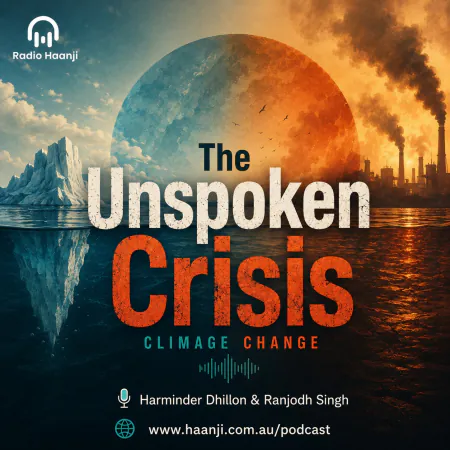





























The Unspoken Crisis: Global Warming, Ocean Heating, and Environmental Disruption - Harminder Dhillon - Ranjodh Singh
Host:-
 Harminder Dhillon
 Ranjodh Singh
Listen to Harminder Dhillon and Ranjodh Singh on Radio Haanji as they break down global warming drivers, ocean heating impacts, media silence, and actionable environmental awareness.
Environmental shifts across the globe are no longer distant warnings for future generations; they are unfolding rapidly in our daily lives. From unpredictable weather events disruptively delaying farming cycles to unprecedented atmospheric heatwaves, the planet is signaling a clear loss of ecological equilibrium. On a recent episode of the Climate Change Special broadcast on Radio Haanji, host Ranjodh Singh engaged in a thought-provoking conversation with Canada-based environmental strategist Harminder Dhillon to deconstruct the drivers behind global warming and analyze why mainstream narratives often miss the true scale of the crisis.
Understanding the Acceleration of Global Warming
A common question raised by listeners is why the term climate change seems to have dominated headlines only over the last decade or two. The scientific data offers a direct explanation: atmospheric carbon emissions have spiked exponentially in recent decades.
Humanity began industrializing at scale around 1850. However, over 50% of the total carbon dioxide emitted since 1850 has been released into the atmosphere after 1980. This dramatic acceleration coincides with the rapid industrial expansion of major developing economies alongside established Western industrial powers.
| Historical Era | Primary Emission Drivers | Impact on Atmospheric Balance |
|---|---|---|
| 1850 – 1980 | Early Industrial Revolution, Western Expansion, Coal & Early Oil Use | Gradual increase in atmospheric carbon levels; manageable baseline. |
| 1980 – Present | Globalized Industry, Massive Fossil Fuel Consumption, Freight Growth | Over 50% of cumulative CO2 emitted; sharp rise in global temperatures. |
Between 2015 and 2025 alone, roughly 90% of the global net growth in new carbon emissions originated from emerging industrial hubs, primarily China and India, where manufacturing and power generation demand remain extremely high.
Corporate Silence, Propaganda, and Media Resistance
If atmospheric heat accumulation has reached critical levels, why has public awareness lagged so far behind? The discussion highlighted two primary structural reasons:
- Concentrated Fossil Fuel Ownership: Roughly 80 major fossil fuel corporations worldwide account for nearly 90% of global industrial carbon emissions.
- Systematic Disinformation Campaigns: Historical internal documents reveal that major petroleum companies had accurate scientific climate predictions in the mid-20th century. Instead of acting, billions were invested into funding counter-narratives to sow doubt regarding global warming facts.
Furthermore, because modern media outlets depend heavily on corporate advertising, environmental reporting has frequently been minimized or side-lined in favor of short-term headlines, leaving communities underinformed about long-term ecological risks.
The Critical Role of Ocean Heating and AMOC Currents
While surface temperature spikes draw immediate attention, ocean warming presents a far more dangerous threat to global stability. Oceans naturally absorb approximately 90% of the solar heat trapped by greenhouse gas emissions. However, marine thermal capacity is reaching a critical point.
A major area of concern is the Atlantic Meridional Overturning Circulation (AMOC)—the massive ocean current system that redistributes heat from the equator toward the northern hemisphere.
The movement of deep ocean currents regulates world climate. As arctic waters warm and glacial runoff dilutes ocean salinity, key marine currents are slowing down. Scientists estimate a potential 15% reduction in AMOC speed by the end of this century, which would fundamentally disrupt global rainfall patterns and intensify seasonal weather extremes.
These oceanic disruptions directly affect localized weather systems. In North America, drier conditions and warmer temperatures have led to persistent forest fire seasons, spreading smoke clouds thousands of kilometers across major metropolitan regions.
Local Awareness and Grassroots Leadership
Addressing the climate crisis requires bridging the gap between broad scientific terminology and ground-level reality. Agricultural communities, for example, experience global warming directly through shifting rain patterns, damaged crops, and failing groundwater tables, even if they do not regularly use technical jargon.
While massive policy commitments—such as industrial green infrastructure and electric transit investments—are essential in high-emitting nations, local leadership remains equally vital. Every community member can act as an advocate by sharing clear, factual environmental insights within their local networks to foster genuine awareness.
Explore more engaging shows and community discussions on Radio Haanji:
- Bring joy to your daily routine with our Laughter Therapy Episodes.
- Listen to captivating narratives on Kitaab Kahani Audio Stories.
- Expand your understanding of science, nature, and space on The Deep Talk Show.
- Stay updated with local and international news on Today Updates and Indian Updates.
- Tune into casual discussions and youth perspectives on Boys Meetup or dive into thoughtful journal entries on Notebook.
Frequently Asked Questions
Who is the host of the Climate Change Special on Radio Haanji 1674 AM?
Who is Harminder Dhillon, and what is his role on the show?
Where can I listen to the Radio Haanji Climate Control podcast?
Why does Radio Haanji broadcast climate change programs in Punjabi?
What topics are discussed in Ranjodh Singh's climate change shows?
What's Your Reaction?