








































































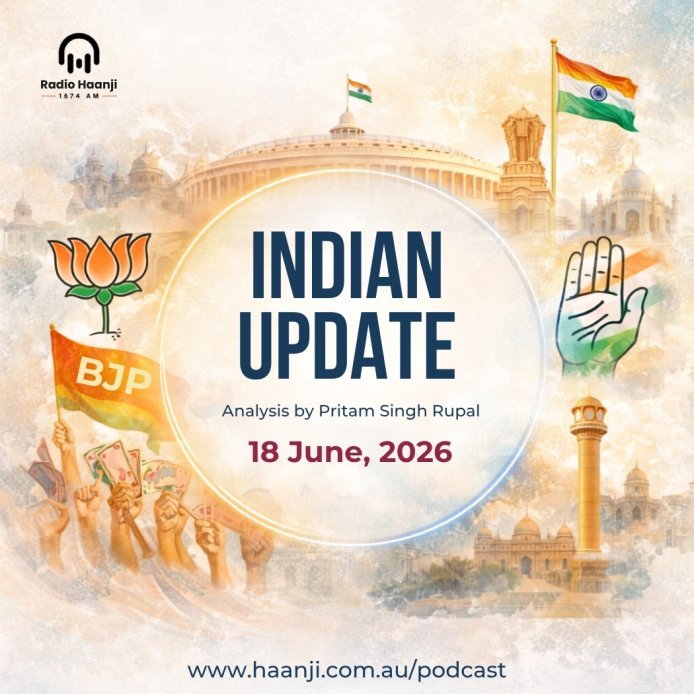
18 June - Indian Updates - Shiv Sena UBT Crisis & BJP Punjab Strategy
Host:-
 Pritam Singh Rupal
 Ranjodh Singh
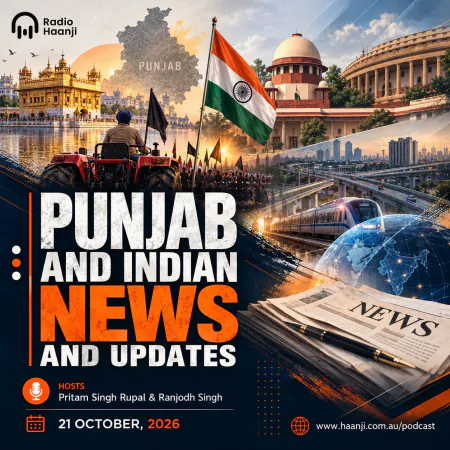
Catch the latest Indian Updates on Radio Haanji with Pritam Singh Rupal & Ranjodh Singh. Analysis of the Shiv Sena UBT rebellion, BJP's strategy in Punjab, and local body polls.
The Indian political landscape is witnessing rapid developments that challenge established alliances and alter parliamentary strategies. In today’s episode of Indian Updates on Radio Haanji 1674 AM, hosts Pritam Singh Rupal and Ranjodh Singh break down the high-stakes developments reshaping national and regional power dynamics. From the escalating crisis within the Shiv Sena (Uddhav Balasaheb Thackeray faction) to the strategic calculations of the Bharatiya Janata Party (BJP) in Punjab, the political playground is highly active.
This deep dive covers parliamentary numbers game, shifting regional dynamics, local governance updates in Punjab, and critical administrative directives impacting water resource management.
The Shiv Sena (UBT) Crisis: Defection Rumors and Parliamentary Math
The Uddhav Thackeray faction of the Shiv Sena is facing severe internal friction following reports that six of its nine Lok Sabha Members of Parliament (MPs) are planning a political shift. This group of lawmakers has shown a growing intent to align with the BJP-led coalition, indicating a major shift in Maharashtra's parliamentary representation.
Allegations of Bribery and Public Mandate Critiques
The reports have triggered intense reactions from the opposition alliance. Senior Shiv Sena (UBT) leader Sanjay Raut openly criticized the rebel MPs, alleging that substantial financial inducements—ranging between 15 crore to 50 crore INR—were involved in securing these defections. Concurrently, the Congress party has condemned the anticipated moves, characterizing the actions as a direct insult to the public mandate delivered by voters in the 2024 general elections.
The Strategic Two-Thirds Majority Strategy
From a national perspective, political analysts view these developments through the lens of long-term parliamentary strategy. Having fallen short of a single-party majority in 2024, the BJP is actively working to consolidate its numbers in the Lower House. Securing a steady stream of incoming lawmakers helps the ruling coalition build toward a two-thirds majority in Parliament over the next three years. Attaining this legislative threshold is essential for passing major constitutional amendments and key structural legislations smoothly without procedural delays.
The BJP's Solo Trajectory and Pressure Tactics in Punjab
In northern India, the BJP is systematically altering its approach toward regional politics, particularly within Punjab. National spokesperson Sambit Patra recently reinforced the party's decision to contest all 117 assembly seats in the state independently.
Public Outreach and Structural Focus
During high-level party organizational meetings held in Anandpur Sahib and Chandigarh, the leadership focused extensively on highlighting the socio-economic achievements and infrastructure developments under the central government. By projecting an independent governance roadmap, the party aims to establish a stronger, direct footprint among the electorate.
Pressure Dynamics on the Shiromani Akali Dal (SAD)
Despite the public commitment to go solo, political analysts suggest that this strategy serves a dual purpose as a calculated pressure tactic. By aggressively demonstrating its organizational independence and welcoming political defectors, the BJP is positioning itself for leverage against its former long-term ally, the Shiromani Akali Dal (SAD). Should talks of a future coalition emerge, this independent posture ensures the BJP can negotiate from a position of strength, aiming for an equal 50-50 seat-sharing split rather than accepting a junior partner status.
State and Regional News: Local Governance and Administrative Directives
Beyond core party politics, significant administrative and legal updates have emerged from Punjab and neighboring Himachal Pradesh.
Clearance for Punjab Local Body Elections
The Punjab Government has officially cleared the administrative path for holding long-delayed elections across various local government bodies and municipal corporations. This move is set to restore local leadership across municipal councils and nagar panchayats. To ensure balanced representation, the state administration has implemented specific structural seat reservations, setting aside 11 presidential posts across 102 local bodies for designated categories.
The BBMB Gobind Sagar Lake Silt Extraction Directive
A significant regulatory dispute has developed regarding water resources and environmental management. The Bhakra Beas Management Board (BBMB) has been restricted from extracting silt from the Gobind Sagar Lake.
The Himachal Pradesh state government has stated that the BBMB cannot proceed with or interfere in these operations without obtaining a formal No Objection Certificate (NOC). This directive underscores the ongoing friction regarding resource management and state jurisdictions.
Federalism Under Strain: The Rise of Centralized Frameworks
The developments discussed by the hosts point to a broader concern regarding India's constitutional setup: the gradual transition toward highly centralized frameworks.
The implementation of nationwide policies—such as the Goods and Services Tax (GST) structural model and highly centralized education guidelines—increasingly impacts the traditional federal structure of the country. As central bodies exercise greater regulatory oversight, regional administrations often find their financial and administrative autonomy constrained, reshaping the balance of power between the Union and the States.
Frequently Asked Questions (FAQs)
What is the anti-defection law implication for the Shiv Sena (UBT) MPs?
Under the Tenth Schedule of the Indian Constitution, elected lawmakers can face disqualification if they voluntarily give up party membership or vote against party whips. However, a split escapes disqualification if at least two-thirds of the legislative party members agree to merge with or form another faction. With the Uddhav Thackeray faction holding nine seats in the Lok Sabha, a group of six MPs satisfies the two-thirds threshold required to avoid disqualification.
Why is the BJP focusing on a two-thirds majority in Parliament?
A two-thirds majority is legally necessary to pass constitutional amendment bills under Article 368. Lacking a simple single-party majority, the ruling coalition relies on legislative integration to pass major, transformative structural reforms and long-term policies smoothly over the coming years.
What are the seat reservation metrics for Punjab's upcoming local elections?
The Punjab government has reserved 11 presidential positions across 102 municipal councils and nagar panchayats to ensure fair demographic and gender representation in local self-governance.
Why did Himachal Pradesh stop the BBMB from removing silt?
The Himachal Pradesh government intervened to protect regional environmental interests and enforce state regulatory authority. It ruled that no silt extraction operations can occur within Gobind Sagar Lake without a verified No Objection Certificate (NOC) evaluating ecological impacts.
Explore More From Radio Haanji
Stay updated with Indian affairs, community insights, and cultural programming by checking out our other specialized audio segments:
-
Dive into lighthearted banter and community humor with our Laughter Therapy Episodes.
-
Experience traditional storytelling and deep prose via our Kitaab Kahani Audio Stories.
-
Expand your knowledge on science, space, and exploration with The Deep Talk Show.
-
Get your quick fix of global and regional current events via Today Updates and the dedicated Indian Updates Archive.
-
Catch up on lifestyle discussions and social commentaries on Boys Meetup and Notebook.
What's Your Reaction?