
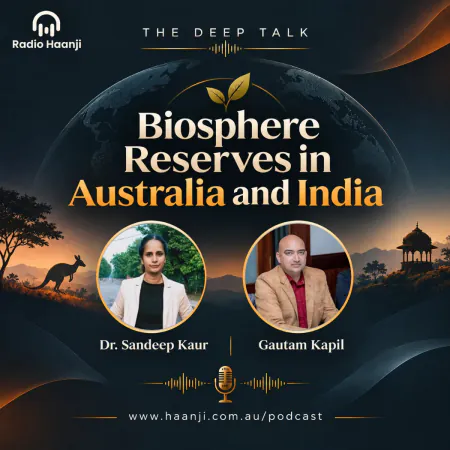




















































































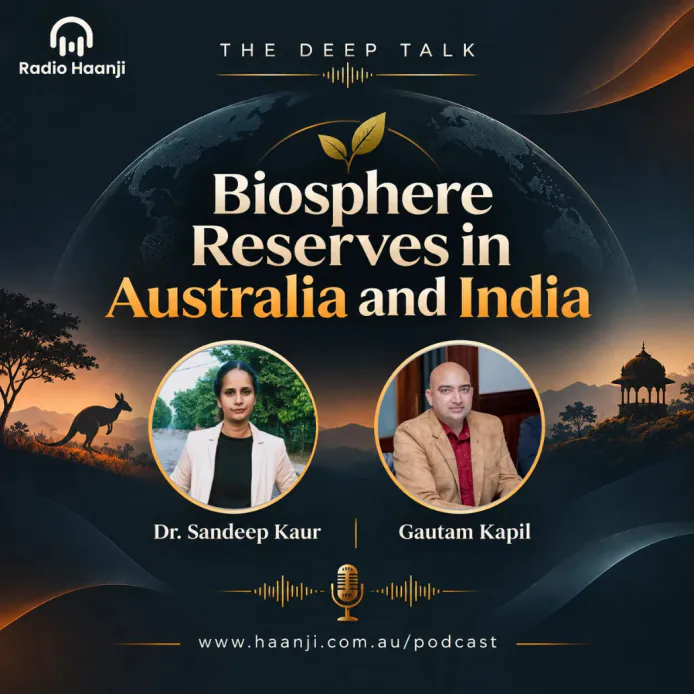
Biosphere Reserves in Australia and India - The Deep Talk - Dr. Sandeep Kaur - Gautam Kapil
Host:-
 Dr. Sandeep Kaur
 Gautam Kapil
Explore how UNESCO biosphere reserves balance nature conservation with human livelihoods across Australia and India, featuring insights from The Deep Talk.
When floods sweep through mountain regions or heatwaves strain local water supplies, the link between rapid urban development and environmental damage becomes hard to ignore. Yet telling communities to stop building, farming, or fishing to save the planet raises an immediate practical dilemma: where do people live, and how do they earn a living?
On The Deep Talk on Radio Haanji 1674AM, hosts Dr. Sandeep Kaur and Gautam Kapil examine how biosphere reserves in Australia and India offer a realistic middle ground. Marking the International Day for Biosphere Reserves, observed annually on 3 November, the discussion moves past abstract climate slogans to look at how conservation works on the ground.
How Biosphere Reserves Differ from National Parks
Most people are familiar with national parks and wildlife sanctuaries, where human activity is heavily restricted to keep native habitats intact. Biosphere reserves take a broader approach.
Launched under UNESCO's Man and the Biosphere (MAB) Programme in 1971, biosphere reserves are designed to reconcile biodiversity conservation with sustainable economic use. Rather than treating humans as outsiders, the framework recognises that local and Indigenous communities hold deep traditional knowledge—from medicinal plants to seasonal land management—that strengthens conservation.
As Dr. Sandeep Kaur explains on the program, UNESCO will not recognise a site as a biosphere reserve unless local communities are actively involved in its planning and stewardship.
The Three Zones of Conservation
To balance strict protection with everyday life, every UNESCO biosphere reserve is organised into three interconnected zones:
-
Core zone: The strictly protected heart of the reserve, where human interference is prohibited so native flora,fauna, and ecosystems can evolve naturally.
-
Buffer zone: The area surrounding the core, which functions as a living laboratory for scientific research, student education, and low-impact eco-tourism.
-
Transition zone: The outermost ring where communities live, farm, and run sustainable businesses.
This tiered layout allows a coastal wetland, forest, or mountain desert to remain ecologically healthy while still supporting the families who call the region home.
Biosphere Reserves in Australia and India
Both Australia and India host diverse ecosystems within UNESCO's World Network of Biosphere Reserves, offering clear examples of how the three-zone model operates in practice.
Australia has five UNESCO-designated biosphere reserves:
-
Sunshine Coast Biosphere Reserve (Queensland): Blends coastal ecosystems, Ramsar-listed wetlands, and mountains with active human communities.
-
Noosa Biosphere Reserve (Queensland): Protects coastal and hinterland ecosystems alongside sustainable tourism and local living.
-
Great Sandy Biosphere Reserve (Queensland): Encompasses diverse marine, sand island, and forest habitats.
-
Mornington Peninsula and Western Port Biosphere Reserve (Victoria): Combines marine parks, agricultural land, and urban growth areas.
-
Fitzgerald Biosphere Reserve (Western Australia): Recognised for its rich native flora and coastal biodiversity.
India maintains 18 nationally designated biosphere reserves, 13 of which are part of UNESCO's international network.India's first UNESCO site was the Nilgiri Biosphere Reserve, established in 1986 across Tamil Nadu, Kerala, and Karnataka, while the Gulf of Mannar in Tamil Nadu is the largest. In September 2025, UNESCO officially added India's Cold Desert Biosphere Reserve in Himachal Pradesh's Lahaul-Spiti region to the global network. Other prominent Indian reserves include the Sundarbans in West Bengal, Nanda Devi in Uttarakhand, Great Nicobar, and the Rann of Kutch in Gujarat. While Punjab has important wildlife sanctuaries such as Harike, it does not currently have a biosphere reserve.
Why Healthy Ecosystems Are an Economic Issue
Conservation is often dismissed as a luxury when governments and businesses focus on short-term economic growth.Dr. Sandeep Kaur challenges that view by pointing to the free services healthy ecosystems provide every day.
Wetlands absorb floodwaters, tree roots anchor soil against erosion, insects pollinate agricultural crops, and forests filter air and supply medicinal plants. When rivers are polluted by industrial waste or natural buffers are cleared,societies end up paying steep financial and health costs to replace what nature once supplied for free.
As the hosts note, nature itself does not need humans to survive—Earth continued evolving long after the dinosaurs disappeared. Protecting biodiversity is ultimately about safeguarding human survival and quality of life.
Measuring Success and Avoiding Greenwashing
Declaring an area a biosphere reserve is only the first step. UNESCO reviews designated reserves every 10 years to verify that they still meet conservation and community standards. Sites that fail to maintain these criteria can be removed from the network.
To track whether protection is working, researchers conduct periodic field surveys using camera traps, acoustic recorders, and AI software to monitor species numbers. The hosts point to India's Project Tiger, which helped rebuild Bengal tiger populations, and a heavily degraded beach in Thailand that restored its coral life after authorities closed it to tourists for four years and later capped daily visitor numbers.
At the same time, Dr. Sandeep Kaur warns against greenwashing, where organisations announce conservation policies on paper without genuine enforcement. Real-world conservation also requires fair economic transitions: if a protected zone limits traditional fishing or farming, local residents should be prioritised for new roles such as park rangers,guides, or conservation monitors.
Listen to the Full Episode
Understanding how biosphere reserves work changes the way we look at the parks, rivers, and coastlines in our own neighbourhoods. For the full conversation with Dr. Sandeep Kaur and Gautam Kapil, listen to The Deep Talk on Radio Haanji 1674AM via Spotify, Apple Podcasts, or the Radio Haanji App. You can also explore more episodes on the Radio Haanji Deep Talk podcast page.
Frequently Asked Questions
Why is International Day for Biosphere Reserves celebrated on 3 November?
Can tourists visit a biosphere reserve?
How does a site become a UNESCO biosphere reserve?
How does UNESCO ensure biosphere reserves remain protected?
What's Your Reaction?







Related Posts