

















































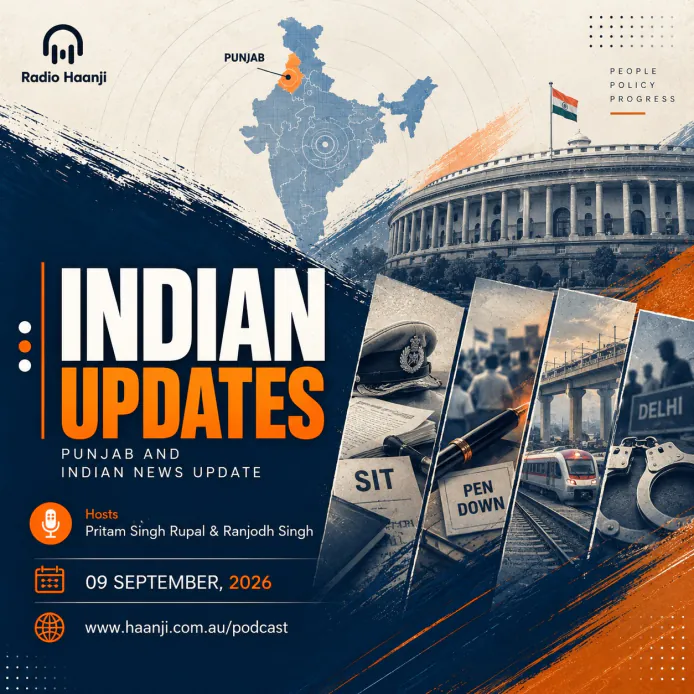
09 Sept - Punjab Drug Crisis & Political Shifts - Pritam Singh Rupal
Host:-
 Pritam Singh Rupal
 Ranjodh Singh
Explore Punjab political developments and drug crisis insights from Radio Haanji's Indian Updates with Ranjodh Singh and Pritam Singh Rupal. Listen now.
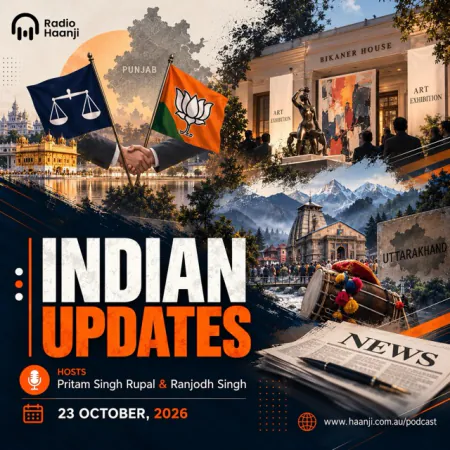
Punjab stands at a critical juncture where internal party friction, administrative standoffs, and deep-seated socio-economic challenges intersect. Understanding these shifting dynamics requires a clear look at both high-level governance and the realities facing families on the ground. On the Indian Updates broadcast by Radio Haanji 1674 AM, host Ranjodh Singh and senior reporter Pritam Singh Rupal examined the state's most pressing current affairs. Their analysis tied together leadership struggles within major political parties and the persistent challenges confronting Punjab's communities.
The discussion highlighted major developments shaping the state's civic dialogue, notably the ongoing Punjab political developments and drug crisis that dominate both public sentiment and party agendas. From high-level party summits in New Delhi to localized unrest in Sangrur and coordinated employee walkouts across administrative departments, the broadcast provided a grounded perspective on issues often reduced to partisan talking points.
By focusing on institutional accountability rather than political rhetoric, the broadcast unpacked the structural failures that allow illicit networks to flourish while communities struggle with loss. The following sections break down the core reporting, providing full context on party friction, law enforcement actions, civil service disruptions, and public health dilemmas.
Where to Listen
You can hear the full broadcast of Indian Updates hosted by Ranjodh Singh with reporting from Pritam Singh Rupal on Radio Haanji 1674 AM. The program delivers daily journalistic commentary and on-the-ground reporting across regional, national, and diaspora issues.
-
Listen on Spotify
-
Listen on Apple Podcasts
-
Stream directly on the Radio Haanji App
Episode Highlights
The broadcast covered multiple critical stories spanning state-level politics, civil administration, law enforcement, and national news. Each topic reflects broader shifts across governance and public accountability.
-
Punjab Congress Realignment: Internal friction surfaced following Sachin Pilot's meetings with Rahul Gandhi and Priyanka Gandhi. The Channi faction's absence from a Chandigarh party demonstration raised questions about internal unity, state leadership tenure, and potential structural adjustments ahead of the 2027 assembly elections.
-
Sangrur Gulzar Singh Investigation: Punjab Police established a Special Investigation Team headed by an Additional Director General of Police to examine the suicide of Gulzar Singh. The cremation took place only after local authorities offered family assurances, highlighting heightened tensions around public confrontations.
-
Civil Service Pen-Down Action: Administrative operations across Punjab faced delays as ministerial and clerical staff extended their statewide "Kalam Chhod" strike through September 11, pressing demands for service conditions and administrative resolutions.
-
Infrastructure and National News: Prime Minister Narendra Modi inaugurated major development projects totaling 35,000 crore rupees in Gujarat, including a dedicated rail corridor. In national crime developments, Delhi Police arrested seven individuals tied to the mob-led killing of a Manipuri musician.
-
The Anatomy of the Illicit Trade: A comprehensive evaluation of the state's drug trade pinpointed systemic coordination between political figures, law enforcement personnel, and bureaucratic gatekeepers, alongside a precipitous drop in youth athletic and cultural institutions.
Why Is Congress Considering a Leadership Change in Punjab?
The Punjab Congress leadership change is under review due to persistent factional divisions, structural friction with current state chief Amarinder Singh Raja Warring, and demands from senior leaders to recalibrate command structures before the 2027 assembly elections, prompting high command consultations with party in-charge Sachin Pilot in New Delhi.
Recent meetings between party in-charge Sachin Pilot, Rahul Gandhi, and Priyanka Gandhi indicate that national organizers are closely reviewing regional operations. A primary factor is the vocal discontent expressed by the camp aligned with former Chief Minister Charanjit Singh Channi. Tensions grew apparent when the Channi faction stayed away from a coordinated protest organized by the state leadership in Chandigarh, illustrating internal rifts rather than a united front.
The internal opposition has consistently voiced objections to current party president Amarinder Singh Raja Warring. Senior leaders from the Majha region, including Sukhjinder Singh Randhawa and Tript Rajinder Singh Bajwa, have called for leadership evaluations to unify disparate groups. Party figures have questioned whether the high command will replace the state president entirely, install Channi at the helm, or bring in a compromise candidate to manage competing factions.
Complicating matters further are recurring rumors regarding veteran figures, including unverified speculation about former Chief Minister Captain Amarinder Singh re-entering party discussions. While his daughter, an active political figure, firmly denied any departure from the Bharatiya Janata Party, regional observers note that pre-election alignments often fuel intense jockeying. With Punjab's elections expected around February 2027 following the completion of national census procedures, stabilizing party leadership remains an urgent priority for party headquarters.
What Led to the SIT Formation in the Sangrur Gulzar Singh Case?
The Gulzar Singh Sangrur case SIT was established following widespread public anger over a local man who ingested poison after being publicly rebuked by villagers for confronting the state finance minister about the pervasive narcotics trade during a local public appearance, culminating in formal government assurances to his grieving family.
The tragic incident occurred in Sangrur district after Gulzar Singh attended a public event featuring the Punjab Finance Minister. During the gathering, Singh raised direct, pointed questions regarding the unchecked availability of narcotics in the area. Following his intervention, village elders and local figures allegedly accused him of causing public embarrassment and showing disrespect, leading to intense social pressure that prompted him to ingest aluminum phosphide (sulfas).
The tragedy sparked immediate public outrage, drawing criticism from opposition parties and local civic groups toward the ruling administration's handling of public grievances. The victim's family initially withheld consent for his cremation, demanding formal accountability and institutional support. The administration resolved the standoff by providing assurances of employment for a family member, after which the final rites were performed.
To investigate the circumstances that led to Singh's death, Punjab Police formed a high-level Special Investigation Team led by Additional Director General of Police (ADGP) Naunihal Singh. The case underscores the personal dangers ordinary citizens face when speaking out on sensitive issues, while highlighting how quickly local confrontations can evolve into statewide political flashpoints.
What Is Driving the Ongoing Drug Crisis in Punjab?
The persistence of the Punjab youth drug nexus stems from an entrenched collusive network uniting illicit suppliers, compromised police elements, and political patrons, compounded by the decay of village sports infrastructure, rural youth clubs, and constructive social engagement programs that historically channeled community energies into healthy pursuits.
For successive electoral cycles, rival political parties have traded accusations over the narcotics trade, promising rapid eradication within days or weeks of taking office. Yet ground-level observations reveal that supply networks remain durable across rural and urban centers. The illicit trade generates massive untaxed revenue, fostering an entrenched nexus where corrupt officials and street-level distribution networks operate with minimal operational disruption regardless of which party is in power.
The social fallout falls disproportionately on lower-middle-class and economically vulnerable families. Rather than establishing comprehensive rehabilitation centers and durable economic pathways, the institutional response has tilted toward sporadic public posturing and reactionary arrests. Opposition groups often highlight individual tragedies to attack incumbents, yet rarely build consensus around structural enforcement or public health interventions.
Beyond law enforcement failures, the decline of community institutions has worsened the crisis. Decades ago, even through turbulent political periods, rural sports leagues, village welfare committees, and active youth clubs offered structured alternatives for young people. Over the past few decades, state funding for youth welfare departments declined, leaving local facilities dormant and young people increasingly vulnerable to addiction and despair.
Statewide Governance: Strikes, Protests, and National Projects
Administrative friction extended into the civil service as clerical and departmental employees expanded their Punjab employee pen-down strike across district offices. Running through September 11, the "Kalam Chhod" strike brought administrative work to a standstill, delaying public documentation, licensing, and local departmental approvals. The strike highlights a persistent communications gap between state authorities and public sector employee unions seeking long-delayed service adjustments.
Simultaneously, political friction across the state has intensified ahead of the upcoming electoral cycle. Black flag demonstrations targeting government events—such as protests at Sherpur and disruptions during ministerial tours—have become standard tools of public and opposition dissent. However, observers warn that using street-level confrontations without addressing systemic challenges leaves root issues unresolved, from farm debt to narcotics distribution.
On the national front, Prime Minister Narendra Modi's trip to Gujarat saw the rollout of major infrastructure developments valued at 35,000 crore rupees, featuring modern rail corridors designed to expand regional freight capacity. In Delhi, law enforcement made critical arrests following the mob-driven murder of a Manipuri musician. Seven suspects were detained in an investigation that has renewed national conversations regarding public safety and community relations in the capital.
Key Takeaways
-
Punjab Congress leadership stability remains uncertain as Sachin Pilot consults with the central high command following the Channi faction's boycott of state party events in Chandigarh.
-
A Special Investigation Team under ADGP Naunihal Singh is investigating the suicide of Gulzar Singh following a public confrontation regarding the local narcotics trade in Sangrur.
-
Punjab ministerial staff extended their "Kalam Chhod" administrative strike through September 11, leaving routine public services and clerical work suspended across the state.
-
The durable narcotics distribution network in Punjab relies on an entrenched nexus between political networks, corrupt local police personnel, and illicit distributors.
-
Community sports organizations, rural youth clubs, and state-backed cultural programs have largely declined, depriving youth of constructive community infrastructure.
-
On the national stage, Prime Minister Narendra Modi inaugurated 35,000 crore rupees worth of infrastructure in Gujarat, while Delhi authorities detained seven suspects in the death of a Manipuri artist.
References and Further Reading
-
Punjab Police Departmental Probe: Official constitution of the Special Investigation Team led by Additional Director General of Police (ADGP) Naunihal Singh in the Sangrur district suicide case.
-
Punjab State Ministerial Staff Union: Documentation and public declarations regarding the statewide "Kalam Chhod" administrative strike observed through September 11.
-
Radio Haanji 1674 AM Broadcast Archive: Full audio recording and journalistic analysis of Indian Updates with hosts Ranjodh Singh and Pritam Singh Rupal.
The ongoing developments across Punjab demonstrate that political realignments and administrative friction are closely tied to the well-being of everyday citizens. Addressing the narcotics trade, stabilizing public administration, and rebuilding civic trust require systemic transparency rather than short-term political posturing. To follow comprehensive reporting and commentary on these stories, listen to the complete broadcast of Indian Updates on Spotify, stream through Apple Podcasts, or download the Radio Haanji App to keep up with daily regional analyses.
Frequently Asked Questions
What triggered the Punjab administrative pen-down strike?
Who is leading the Special Investigation Team in the Sangrur case?
Why are youth clubs considered vital to combating substance abuse in Punjab?
What are the main demands surrounding the Punjab Congress presidency?
Did Captain Amarinder Singh confirm a return to the Punjab Congress?
What major infrastructure projects were launched in Gujarat?
What's Your Reaction?