





































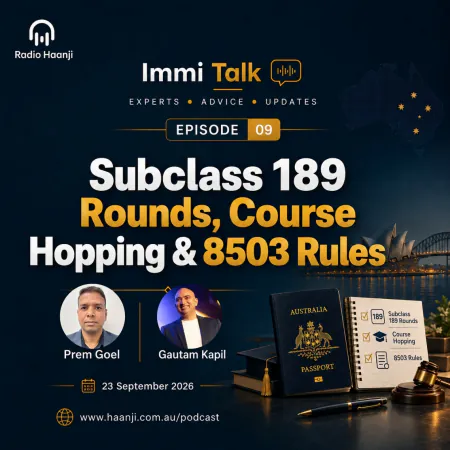










































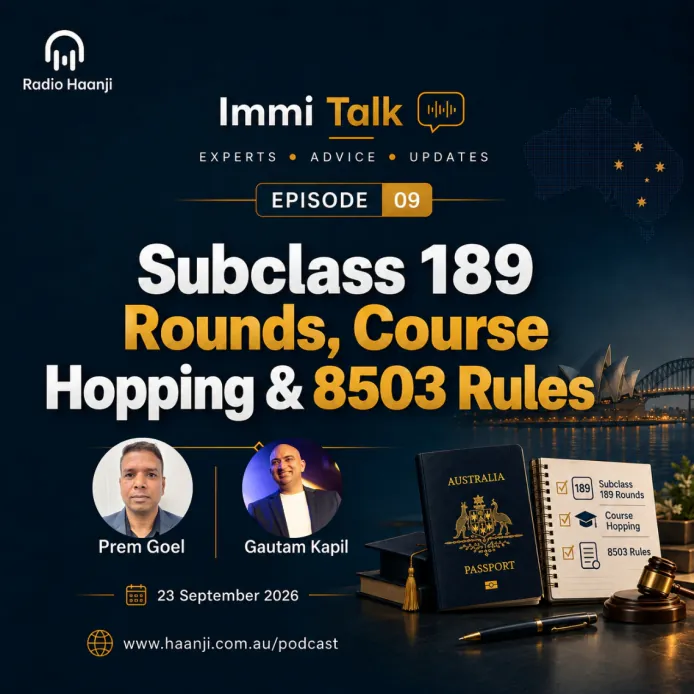

Analysis of subclass 189 rounds, course hopping rules, and condition 8503 with Prem Goel from IME Advisor (MARN: 2418571) on Radio Haanji's Immi Talk. Listen to the full episode.
Navigating skilled migration pathways and temporary visa compliance requires a clear understanding of departmental policy enforcement and invitation benchmarks. On the Immi Talk program broadcast across Australia on Radio Haanji 1674 AM, host Gautam sat down with registered migration expert Prem Goel from IME Advisor (MARN: 2418571) to examine subclass 189 rounds course hopping and 8503 rules shaping skilled migration, onshore student arrangements, and family stays.
As procedural adjustments move from administrative guidance into operational case processing, applicants face tightening restrictions across temporary entry permits alongside targeted openings in priority industries. Evaluating these mechanisms helps prospective candidates avoid severe compliance pitfalls while aligning their Expression of Interest strategies with current invitation rounds.
Where to Listen
Immi Talk is hosted by Gautam with featured guest Prem Goel from I M E Advisor, broadcasting across Australia on Radio Haanji 1674 AM.
Episode Highlights
The discussion focused on actionable migration rules and immediate departmental trends:
-
Visitor Visa Processing: Departmental application of mandatory condition 8503 "No Further Stay" restrictions and the resulting impact on onshore Aged Parent Visa transitions.
-
Student Integrity Reforms: Heightened scrutiny on student dependent applications and prohibitions against downgrading qualification levels.
-
Concurrent Study Pathways: Permissible study arrangements enabling university students to pursue vocational trade certificates concurrently without violating primary visa obligations.
-
Teaching Accreditations in NSW: State registration protocols through the NSW Education Standards Authority (NESA), English test exemption thresholds, and subsequent AITSL skills assessments.
-
Subclass 189 Invitation Analysis: Invitation allocations and sector disparity across healthcare, construction trades,and teaching versus saturated fields like information technology.
-
Expression of Interest Integrity: The technical mechanics of SkillSelect Date of Effect (DoE) and the risks of unattended automated points accruals.
Can Visitor Visa Holders Still Apply for Aged Parent Visas Onshore?
Visitor visa holders arriving with a mandatory "No Further Stay" condition cannot lodge an onshore Aged Parent Visa application unless they successfully obtain an official waiver. This operational enforcement largely curtails onshore aged parent transitions for passport holders from non-exempt regions such as the Indian subcontinent.
Since mid-year enforcement adjustments, visitor visas granted to incoming travellers frequently carry the condition 8503 "No Further Stay" restriction. Historically, eligible parents aged 67 and older could enter on a long-stay visitor visa and subsequently submit an Aged Parent Visa application while remaining in Australia on a bridging visa.
Under current conditions, this conversion pathway is virtually closed for eligible families unless substantial and unpredicted changes in circumstances warrant an exemption. While passport holders eligible for an Electronic Travel Authority (ETA)—such as citizens from select European countries, the United States, and Canada—frequently bypass this restriction, applicants from the Indian subcontinent must navigate standard visitor streams where the condition is consistently applied.
How Do New Rules Impact Australian Student Visa Course Changes?
International students cannot downgrade their Australian Qualifications Framework (AQF) study levels, meaning moving down from a Bachelor's or Master's program into diploma or certificate packages is prohibited. Attempting to drop study levels can prompt visa cancellations, whereas moving horizontally or upgrading remains fully compliant.
Departmental measures prevent course hopping, specifically instances where students secure university visas and subsequently transfer down into low-cost vocational diplomas. While students are free to change institutions within their current qualification tier or progress upward into postgraduate coursework, lowering the credential tier invalidates the integrity grounds on which the initial visa was issued. Student dependent visas are also encountering rigorous scrutiny and elevated refusal rates where genuine temporary entrant requirements fail to satisfy case officers.
For individuals who want to develop trade capabilities without compromising their higher education status, concurrent study provides an alternative. Australian regulations permit students to remain enrolled in their primary higher education qualification while simultaneously undertaking a relevant trade certificate or vocational qualification. This approach maintains complete compliance with initial visa grant conditions while enabling candidates to build eligibility for technical assessments.
What Are the Teacher Registration and Skills Assessment Pathways in NSW?
In New South Wales, educators obtain state teaching registration through NESA before undertaking a formal migration skills assessment with AITSL. Applicants who have completed four years of Australian higher education study can secure an exemption from specialized academic English language examination scores.
Securing a permanent skilled pathway in teaching requires distinguishing between professional state licensing and skilled migration assessments. In New South Wales, candidates must register with the NSW Education Standards Authority (NESA) to teach in mainstream educational institutions. Registration requirements demand either an Academic IELTS score of 7.0 in reading and writing alongside 8.0 in speaking and listening, or qualifying under explicit Australian study exemption clauses.
Applicants qualify for an English language testing exemption if they have completed four years of tertiary study at a Bachelor's level or higher within an Australian institution, regardless of whether all four years were dedicated exclusively to education degrees. Alternatively, candidates presenting two years of Australian higher education combined with three continuous years of teaching experience conducted entirely in English can petition for an exemption. Once official state registration is granted, educators can approach the Australian Institute for Teaching and School Leadership (AITSL) for migration skills clearance without facing additional English testing hurdles.
Which Occupations Lead the Skilled Independent Subclass 189 Rounds?
Priority sectors including healthcare, secondary school education, and licensed construction trades dominate Skilled Independent Subclass 189 invitations at baseline scores, whereas general IT fields face high saturation and elevated cut-offs.
Skilled Independent Subclass 189 invitations prioritize federal shortage lists. Demand remains steady across specialized fields:
-
Healthcare & Allied Health: Registered nurses, general practitioners, physiotherapists, occupational therapists,chiropractors, and speech pathologists secure invitations at accessible cut-off ranges between 70 and 80 points.
-
School Education: Secondary school teachers often secure invites at 75 points, while early childhood educators require higher point tallies (85 to 90 points) due to elevated application volumes.
-
Construction & Trades: Substantial market shortages yield invitations at baseline qualifying thresholds of 65 points for carpenters, bricklayers, wall and floor tilers, cabinet makers, and roof plumbers.
-
Saturated Sectors: Over-subscribed disciplines like software engineering, business analysis, and general system administration feature hundreds of registered EOIs sitting at 100 points or more, leaving minimal invitation room during general allocation cycles. Commercial cookery also faces heavy application volumes compared to structural construction roles.
Why Is the SkillSelect Expression of Interest Date of Effect Critical?
When two or more candidates present identical overall point scores within the same occupational code, the SkillSelect database prioritizes invitations according to the Date of Effect (DoE). The applicant whose profile reached that point score first receives precedence.
Managing an Expression of Interest (EOI) requires proactive maintenance to prevent visa processing complications. If an applicant updates language scores, completes partner assessments, or gains point-yielding credentials, the system automatically logs a new Date of Effect. Modifying non-point fields, such as updating personal contact details, retains the original timestamp intact.
An automated increase in work experience points can create risks if left unchecked. When an applicant leaves an employment position without marking the role as concluded in the portal, SkillSelect continues to tally active months automatically. If an invitation is issued on points the applicant cannot substantiate with verified documentation and pay records, immigration case officers will refuse the ensuing visa application.
Key Takeaways
-
Mandatory condition 8503 "No Further Stay" restrictions applied to visitor visas largely halt onshore transitions to Aged Parent Visas for applicants requiring standard visitor streams.
-
International students are restricted from downgrading their study level from university degrees into vocational certificates, though concurrent study options remain viable.
-
Teacher registration through NESA permits an exemption from academic English testing if the candidate has completed four years of higher education in Australia.
-
Healthcare specialists, secondary teachers, and construction tradespersons continue to receive Subclass 189 invitations at accessible point ranges, including the baseline 65 points for select trades.
-
IT categories remain heavily saturated, with high applicant volumes concentrated at 100 points or above.
-
The SkillSelect Date of Effect decides ties between identical point scores, making meticulous profile maintenance necessary to avoid lodging unsubstantiated claims.
References and Further Reading
-
I M E Advisor — Migration consultancy providing regulatory commentary, visa assistance, and skilled assessment processing.
-
NSW Education Standards Authority (NESA) — The regulatory body governing teacher accreditation and institutional registration criteria in New South Wales.
-
Australian Institute for Teaching and School Leadership (AITSL) — National assessing authority managing skilled migration assessments for school teachers.
Staying informed on shifting visa rules requires evaluating official policy announcements against practical case handling. To hear the complete breakdown of invitation rounds, professional registration processes, and case management guidance, listen to the full episode of Immi Talk with host Gautam and migration expert Prem Goel on Spotify, Apple Podcasts, or the Radio Haanji App.
Frequently Asked Questions
Can visitor visa holders request a waiver for condition 8503?
What happens if an international student downgrades their study level?
How can university students legally acquire a trade qualification?
Do all Australian states follow the same teacher registration standards?
Can an applicant hold multiple active Expressions of Interest simultaneously?
What occurs if an EOI contains unverified points when an invitation arrives?
What's Your Reaction?







Related Posts