







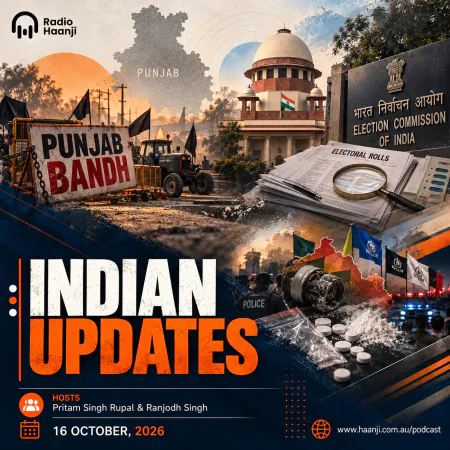






















































Indian Updates - 06 March 2026 - Punjab Budget and India Diplomacy on Radio Haanji
Host:-
 Pritam Singh Rupal
 Ranjodh Singh
Preetam Singh Rupal analyses Punjab's budget session, India's Iran diplomacy and Modi's Finland meeting on Indian Updates, Radio Haanji 1674 AM. Listen free.
Indian Updates - 06 March 2026 - Punjab Budget Session, India's Diplomacy and Political Shifts - Analysis on Radio Haanji
Friday's edition of Indian Updates on Radio Haanji 1674 AM brings together some of the most consequential stories shaping India's political and diplomatic landscape this week. Respected India-based journalist Preetam Singh Rupal takes the lens beyond the headlines today, unpacking what the opening of Punjab's budget session means for governance, why India's response to the death of an Iranian leader carries quiet but significant diplomatic weight, and what a series of political developments — from Bihar to the halls of the Rajya Sabha — tell us about the state of Indian democracy right now.
Punjab's Budget Session Opens — What the Next Ten Days Will Reveal About AAP's Governance
The Punjab Vidhan Sabha budget session commences today and runs through to 16 March, and for those watching Punjabi politics closely, this is one of the most revealing stretches of the legislative calendar. A budget session is where rhetoric meets reality. Whatever promises have been made from the podium, the floor of the assembly in the days ahead will expose how the Aam Aadmi Party government is actually choosing to allocate resources, prioritise welfare and respond to the state's persistent fiscal challenges.
Punjab enters this session carrying a complex economic burden. The state's finances have been under sustained pressure, and the budget presented over the coming days will be scrutinised by opposition parties, economists and the public for how seriously the government is addressing long-standing issues — agricultural debt, unemployment among youth and the infrastructure demands of a rapidly urbanising state.
The Congress party has already signalled its intent to raise the issue of law and order during the session, indicating that the opposition sees this as a key vulnerability for the ruling government. Crime, drug-related offences and policing effectiveness have been recurring flashpoints in Punjab's political discourse, and Congress's decision to make this a formal point of engagement during the session suggests they believe the public mood is receptive to scrutiny on this front.
For the Punjabi diaspora in Australia, this budget session is more than a domestic political event. It is a window into the health of the state that most of them or their families call home. How Punjab's government manages its finances directly affects schools, hospitals, roads and the everyday quality of life for millions — and for NRIs who send remittances, invest in property or plan eventual returns, the direction of policy matters deeply.
India's Quiet Acknowledgement of an Iranian Leader's Passing — Diplomacy Spoken in Gestures
India's decision to extend condolences following the death of an Iranian leader is a moment that rewards careful reading. On the surface, it is a standard diplomatic courtesy. At a deeper level, it reflects the extraordinary balancing act that defines India's foreign policy posture in the current global environment.
With the United States and Israel conducting active military operations against Iran, and with the conflict now entering its seventh day, any statement or gesture from India carries heightened significance. India has historically maintained warm and pragmatic ties with Iran — rooted in energy partnerships, connectivity projects like the Chabahar port, and shared regional interests — while simultaneously managing its growing strategic relationship with the United States and its strong economic ties with Israel.
The decision to acknowledge the passing of an Iranian official, even in a period of open conflict, is consistent with India's long-held principle of strategic autonomy. It signals to Tehran that New Delhi does not consider the current military confrontation a reason to rupture bilateral goodwill, while stopping well short of any statement that could be construed as a criticism of Washington or Tel Aviv.
For the Indian community in Australia — a community deeply embedded in a country that is itself a close US ally — this kind of nuanced Indian diplomacy is worth understanding. India's refusal to be pulled into binary alignments on global conflicts is both a strength and a source of occasional international friction. Prime Minister Modi's meeting with the Finnish President this week further underscores India's active diplomatic calendar, as it continues to strengthen ties with European nations navigating their own complex relationship with geopolitical uncertainty.
Modi and Finland — The Quiet Architecture of India's European Engagement
Prime Minister Modi's engagement with the President of Finland this week may not dominate the headlines the way the Middle East crisis does, but it belongs to a broader pattern of deliberate and significant diplomatic outreach. Finland, now a NATO member following Russia's invasion of Ukraine, represents a new kind of strategic partner for India — a technologically advanced Nordic nation with deep expertise in areas including clean energy, education and digital governance.
India's relationship with Europe has been evolving meaningfully over the past several years. As European nations have grown more cautious about Chinese economic influence and more anxious about Russian aggression, India has emerged as an increasingly attractive partner — a large, democratic, fast-growing economy with a stated commitment to multipolarity. Modi's engagements with European leaders consistently reinforce this positioning.
For NRIs watching from Australia, this European pivot in Indian diplomacy carries practical relevance. It reflects an India that is actively shaping its place in a changing world order — not merely reacting to it. The more embedded India becomes in European diplomatic and economic networks, the more options open up for trade, technology transfer and the kind of bilateral agreements that ultimately affect Indian citizens and the diaspora alike.
Nitish Kumar and the Rajya Sabha — A Political Move That Speaks Volumes
The question of Nitish Kumar's Rajya Sabha membership is the kind of story that appears procedural on the surface but carries real political meaning underneath. Nitish Kumar's political career has been defined by his extraordinary ability to navigate, switch and survive across India's fractious coalition landscape. His presence in or relationship with the upper house of parliament is never simply an administrative matter — it is a reflection of where he stands within the National Democratic Alliance and what his political future may hold.
Bihar remains one of India's most electorally significant states, and Nitish Kumar remains its most dominant political figure. Any development regarding his parliamentary positioning invites analysis of his relationship with the BJP, his own party's fortunes and the longer-term question of succession and stability in Bihar's governance.
For Indian community members in Australia with roots in Bihar or in the Hindi-speaking belt more broadly, political developments in this region resonate strongly. Bihar is a major source of India's domestic migration, and the policy environment there — shaped significantly by its chief minister — affects the lives of tens of millions of people.
Why Indian Updates on Radio Haanji Is Essential Listening for the Indian Diaspora
For Indians living in Australia, staying meaningfully connected to the political and diplomatic shifts happening back home requires more than scanning headlines. It requires the kind of expert context that transforms a news item into genuine understanding. Indian Updates on Radio Haanji 1674 AM delivers exactly that — every weekday morning, through the voice of a respected journalist who brings depth, experience and analytical rigour to each story.
This is not a news bulletin designed to inform you of events. It is a journalism podcast that helps you understand why those events matter — to India, to the diaspora and to the world. As one of the most substantive Indian current affairs podcasts available to the Indian community in Australia, the show fills a gap that few other platforms even attempt to address.
Whether you are a first-generation migrant keeping a close eye on Punjab's governance, a business professional tracking India's diplomatic relationships, or simply someone who cares deeply about what is happening in the country they grew up in, Indian Updates gives you the analysis to stay genuinely informed. In a media environment full of noise, this is one of the best India analysis podcasts available to NRIs — free, accessible and consistently credible.
Listen to Indian Updates - Free, Every Weekday on Radio Haanji
Indian Updates is free to access every weekday through multiple platforms. You can listen in whichever way suits your routine best.
Listen on Spotify — Follow the show on Spotify and receive new episodes directly in your feed.
Listen on Apple Podcasts — Subscribe on Apple Podcasts for seamless listening on any Apple device.
Download the iOS app — Stream Radio Haanji live and explore the full episode archive on your iPhone or iPad.
Download the Android app — Android users can access every episode of Indian Updates through the Radio Haanji app, available free on Google Play.
Join Preetam Singh Rupal again on Monday for the next edition of Indian Updates, where the analysis continues and the stories that matter to every Indian abroad are given the depth and attention they deserve — only on Radio Haanji 1674 AM.
Radio Haanji 1674 AM | Punjabi Podcast | Broadcasting from Melbourne, Australia
Listen free at haanji.com.au | Available on Spotify & Apple Podcasts
Serving the Punjabi community across Melbourne · Sydney · Brisbane · Australia · Worldwide
What's Your Reaction?







Related Posts