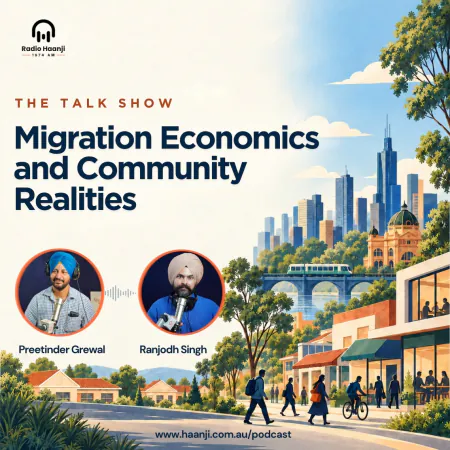



























































































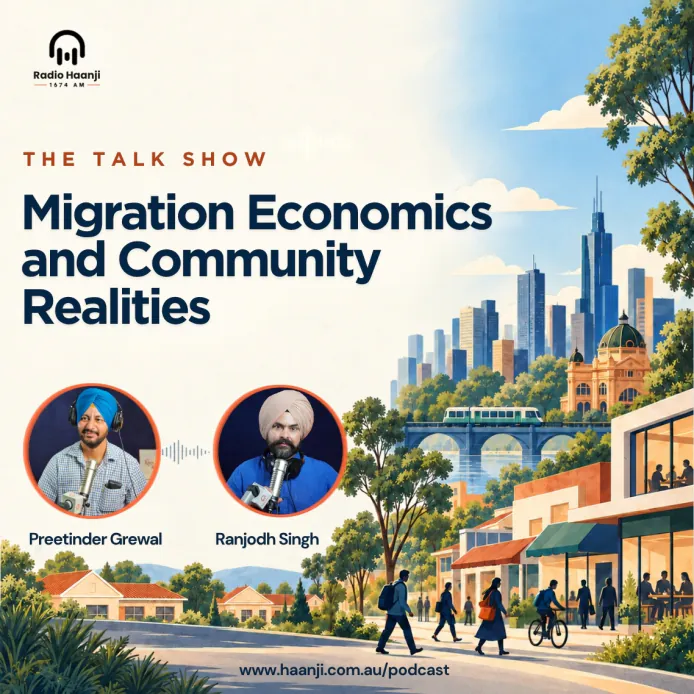
Migration Economics and Community Realities - The Talk Show - Preetinder Grewal & Ranjodh Singh
Host:-
 Preetinder Grewal
 Ranjodh Singh
Join Preetinder Grewal and Ranjodh Singh on The Talk Show as they examine migration economics, workforce contributions, and social challenges. Listen free now.
When political campaigns point fingers at newcomers for housing shortages and infrastructure strains, what is the actual economic reality on the ground? On this episode of The Talk Show, anchor Preetinder Grewal and co-host Ranjodh Singh cut through the political rhetoric to examine the indispensable role migrants play in Australia's workforce. Broadcasting on Radio Haanji, the hosts break down official Australian Bureau of Statistics figures, listen to candid caller perspectives from retail, education, and transport, and address critical social dilemmas touching families both in Australia and Punjab.
Where to Listen
Catch the full audio broadcast and join the conversation across our official platforms:
- Listen free at: haanji.com.au
- Official Radio Haanji App: Available on iOS & Android (Download App)
- Spotify: Radio Haanji on Spotify
- Apple Podcasts: Radio Haanji on Apple Podcasts
The Economic Truth Behind Australian Migration
Political parties frequently scapegoat migrants to win votes during election cycles, blaming them for broader economic pressures. However, Preetinder Grewal and Ranjodh Singh pointed out that such rhetoric ignores the foundational contribution of migrant workers across critical Australian industries. According to ABS data cited during the discussion, out of roughly 24 million total jobs in Australia, around 7 million are held by migrants who arrived after January 2000. Over 58 percent hold permanent residency or citizenship, while the remainder support vital sectors like healthcare, aged care, hospitality, and construction that would otherwise face severe labor shortages.
How is Australia's economy impacted without migration?
Australia's core industries rely heavily on migrant labor to sustain daily operations and economic output. If migration were abruptly halted, critical sectors such as healthcare, transport, and retail would face immediate collapse, as local workforce numbers alone cannot meet current consumer and infrastructure demands.
Callers like Richard and Rubi shared real-world observations from corporate retail and early childhood education, noting how workforce demographics have evolved and how businesses navigate labor supply. The dialogue highlighted the need for balanced management rather than extreme slogans that fail to offer practical economic solutions.
Community Voices and Workplace Realities
The conversation opened the phone lines to listeners who shared authentic experiences from their daily work lives across Australia. Richard offered a corporate and retail perspective, explaining how businesses utilize qualified migrant labor while stressing the need for fair wage management. Rubi, speaking from her experience in early childhood education and the public sector, highlighted how workforce demographics in community services have shifted significantly over the past decade, creating flexible pathways for families balancing livelihoods and childcare.
What Are the Real Workplace Challenges Faced by Diaspora Workers?
Diaspora workers and small business owners often encounter operational hurdles ranging from abrupt staff departures to contract disputes, highlighting the necessity of formal employment agreements and clear notice periods.
Another caller operating a local trucking business described the operational stress caused when an employee left without notice. Preetinder Grewal and Ranjodh Singh advised listeners to implement clear, formal employment contracts and transparent notice periods to protect both employers and workers from sudden disruptions.
Community Takeaways
- Migrants hold approximately 7 million jobs in Australia, serving as an essential pillar for healthcare, administration, hospitality, and transport.
- Political debates often rely on selective statistics rather than offering practical economic solutions to housing and infrastructure pressures.
- Workplace transparency, formal employment contracts, and clear notice periods are vital for protecting both small business owners and employees.
- Parental involvement, open communication, and active guidance remain crucial for protecting youth from substance abuse and reckless behavior.
- Radio Haanji continues to provide an open, fearless platform for the Punjabi diaspora to discuss complex social and economic realities.
The conversation also touched on the tragic loss of anti-drug activist Parvinder Singh Jhota in Mansa, prompting a sober reminder about the devastating impact of synthetic drugs and the urgent need for parental guidance and community vigilance. Join us next time on Radio Haanji as we continue to bring you honest discussions that matter. Share your thoughts, tune in live, and stay connected through the official Radio Haanji mobile app.
Frequently Asked Questions
How many jobs in Australia are held by recent migrants according to ABS data?
Which Australian industries rely most heavily on migrant workers?
What employment advice did the hosts give regarding small business operations?
How can listeners tune in to The Talk Show on Radio Haanji?
What's Your Reaction?







Related Posts