











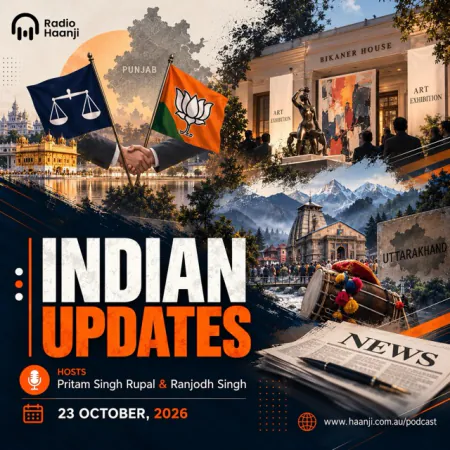































































Pritam Singh Rupal breaks down the AAP Rajya Sabha defections and Punjab's new political shifts. Trusted analysis for the diaspora, free on Radio Haanji.
Indian Updates — 27 April 2026 | AAP Rajya Sabha Crisis and Punjab's Political Shift — Radio Haanji
The political landscape in Punjab has shifted overnight following a seismic rift within the Aam Aadmi Party. As the dust settles on a massive defection at the federal level, the state is grappling with the implications for the upcoming 2027 assembly elections. In today’s edition of Indian Updates on Radio Haanji 1674 AM, Ranjodh Singh is joined by Senior Journalist Pritam Singh Rupal. His decades at All India Radio and deep roots in Punjabi journalism bring rare clarity to stories that often demand more than just a headline.
We are witnessing a moment where ideology seems to be taking a backseat to strategic survival. The mass exit of Rajya Sabha members from AAP to the BJP is not merely a change of flags. It is a fundamental challenge to the mandate given by the people of Punjab. This analysis explores why these leaders are making the move now and what it means for the common voter who believed in a different kind of politics.
The Rajya Sabha Implosion and the Washing Machine Narrative
The defection of seven out of ten AAP Rajya Sabha members marks one of the most significant political realignments in recent memory. While the party has filed petitions for their dismissal, the numbers tell a story of a deeper internal decay. Only Balbir Singh Seechewal remains from the original Punjab group, standing as a lone figure of loyalty amidst a wave of departures. This mass exit includes prominent faces like Raghav Chadha and Ashok Mittal, suggesting that the internal bonds of the party were far more fragile than they appeared.
The discussion often turns toward the popular washing machine narrative in Indian politics. Leaders facing scrutiny from central agencies like the ED or the Income Tax department frequently find a safe haven within the BJP. The case of Ashok Mittal is particularly telling, as his move followed significant raids on his properties. It raises a difficult question for the diaspora: is this a genuine political merger or a tactical retreat to silence investigations? When investigative pressure leads to political conversion, the integrity of the democratic process is inevitably called into question.
Ideology Versus Parachute Appointments
A recurring theme in our analysis today is the failure of parachute leadership. Pritam Singh Rupal notes that AAP’s central leadership in Delhi may have made a strategic error by appointing members based on wealth or proximity to the high command rather than grassroots connections. Many of these Rajya Sabha members lacked deep ideological roots in Punjab’s soil. Without that bond, they were susceptible to outside pressure or the lure of better prospects elsewhere.
This lack of ideological glue has left the party vulnerable at a critical time. For a party that rose to power on the promise of honest, grassroots-driven politics, seeing its top representatives defect to a traditional rival is a bitter pill for supporters. It suggests that the party’s vetting process focused on optics and funding rather than long-term commitment to the cause. This disconnect is now being exploited as the BJP seeks to weaken its competition before the next major electoral battle.
West Bengal’s Final Push and the North Indian Heatwave
While Punjab is preoccupied with defections, West Bengal is reaching the peak of a high-stakes assembly election. The final phase of voting is marked by intense clashes and a flurry of accusations between the TMC and the BJP. Campaigning has officially concluded, leaving the voters to decide the fate of a state that remains a critical battleground for national power. The energy on the ground is palpable, even as temperatures soar across the country.
In North India, the political heat is being matched by a literal surge in mercury. Bathinda has recorded a high of 44°C, making it the hottest spot in Punjab this season. This extreme weather is more than a discomfort; it is a direct threat to the agricultural heartland. As the region swelters, the conversation about infrastructure and climate resilience becomes as urgent as the political news. The ability of the state to manage both its political stability and its environmental challenges will define the coming months.
New Aspirations and the CM Bid of Amritpal Singh
The shift in Punjab's internal dynamics is also visible in the rising activities of the Waris Punjab De faction. The declaration by Amritpal Singh’s father, naming him a potential Chief Ministerial candidate for 2027, has sent ripples through the traditional political circles. Combined with reports of Simranjit Singh Mann’s group moving toward a closer alliance with the Punarsarjeet Akali Dal, we are seeing the emergence of a new Panthic front.
These movements suggest that the traditional political binary in Punjab is being challenged. As the Shiromani Akali Dal (Badal) navigates a difficult path between its religious agenda and its relationship with the BJP, these newer factions are filling the vacuum. They appeal to a specific sentiment that feels neglected by the mainstream. Whether these alliances can translate into a cohesive electoral force remains to be seen, but they are certainly redefining the stakes for 2027.
Why Indian Updates on Radio Haanji Is Essential for the Indian Diaspora
For the Punjabi diaspora in Australia and Singapore, keeping a pulse on these developments is about more than just staying informed. It is about understanding the future of a homeland that remains central to their identity. The deep analysis provided by voices like Pritam Singh Rupal offers a level of context that social media snippets simply cannot match. It provides the nuance required to navigate the complex web of Indian and Punjab politics.
Understanding these shifts helps the community make sense of how their families back home are affected by policy changes and political instability. Radio Haanji serves as a bridge, ensuring that the distance doesn't lead to a disconnect from the ground realities of Punjab. By focusing on why these events happen, rather than just what happened, we empower our listeners to engage with their heritage in a more meaningful and informed way.
Listen to Indian Updates — Free, Every Weekday
The political landscape of India and Punjab is changing every day, and we are here to help you make sense of it. Join us for daily episodes where we dive deep into the news that matters most to our community. You can catch every update on your favorite platform.
Listen free:
What's Your Reaction?