




























































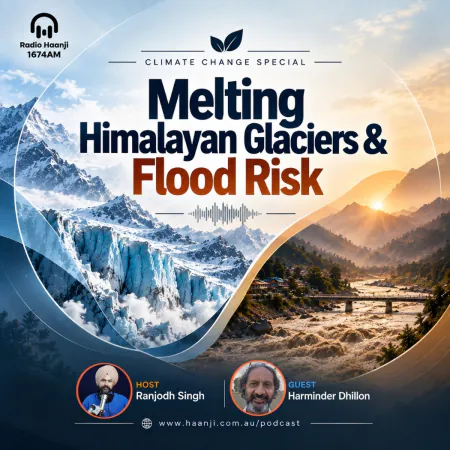





























Melting Himalayan Glaciers & Flood Risk - Climate Change Special - Harminder Dhillon
Host:-
 Harminder Dhillon
 Ranjodh Singh
Explore how melting Himalayan glaciers threaten Northern India with flash floods and learn how community solar can help. Listen to Radio Haanji 1674 AM now.
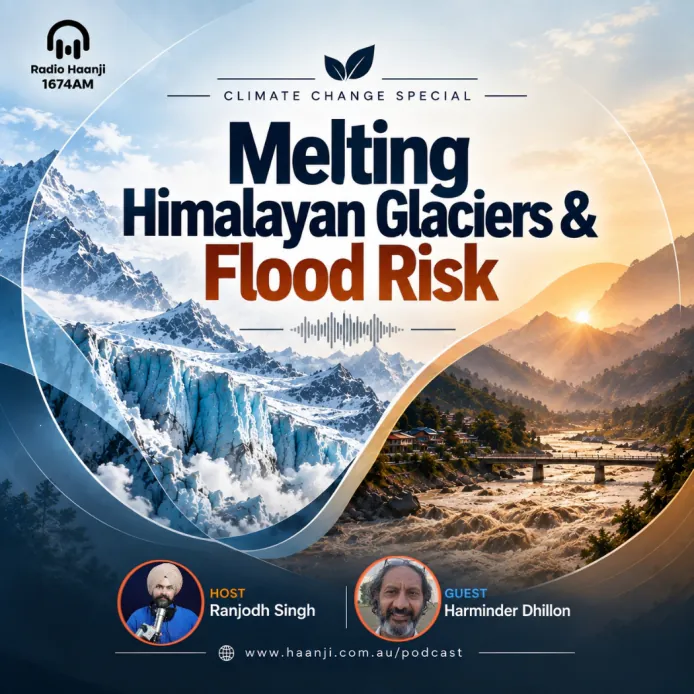
Unpredictable environmental shifts are transforming downstream river valleys across Northern India into high-risk disaster zones. On a special broadcast of Radio Haanji 1674 AM, host Ranjodh Singh joined environmental commentator Harminder Dhillon to dissect the alarming realities behind the melting Himalayan glaciers flood risk. Rather than abstract, distant projections, the discussion emphasized how rapid glacial retreat directly threatens daily life, water systems, and infrastructure across Punjab and surrounding states.
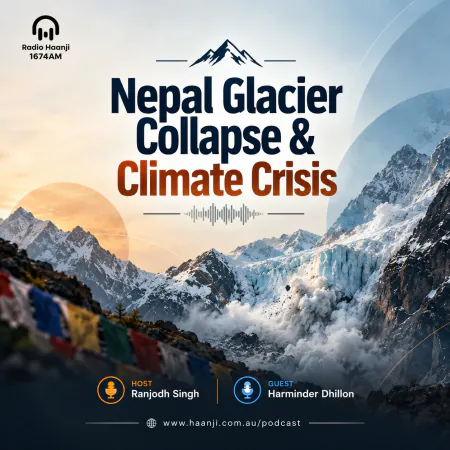
Recent disasters, such as the catastrophic glacial events in Nepal, prove that modern climate-induced catastrophes do not always arrive with the warning signs of traditional storms. Clear skies can turn into devastating torrents within seconds when high-altitude ice structures collapse. As Dhillon highlighted during the session, the Himalayan peaks serve as the direct headwaters for Northern India’s primary river systems, making upstream changes an urgent safety priority for downstream populations.
Addressing these regional threats requires understanding the dual pressures acting on the glaciers: global atmospheric warming and localized particulate pollution. Combating these dangers demands a shift away from coal-heavy power production toward decentralized community action, starting with clean energy installations on public, domestic, and religious buildings across the region.
Where to Listen
Tune in to the Climate Change Special on Radio Haanji 1674 AM featuring host Ranjodh Singh and commentator Harminder Dhillon.
-
Listen on Spotify
-
Listen on Apple Podcasts
-
Stream directly via the Radio Haanji App
Episode Highlights
The discussion between Ranjodh Singh and Harminder Dhillon explored critical environmental themes shaping Northern India's climate vulnerability.
Glacier Melting and Flood Risks in Northern India Sudden disasters in high-altitude zones present unprecedented challenges because they occur without the warning signals common to routine weather disturbances. The headwaters of major rivers—including the Sutlej, fed by roughly 2,100 glaciers, and the Beas, fed by around 470 glaciers—are destabilizing. Glacial retreat has spurred the creation of unstable meltwater reservoirs such as Himsoo Lake, which threatens sudden, massive breaches. Furthermore, regional emissions from industry and vehicles travel north, depositing dark soot that lowers ice reflectivity and accelerates melt rates.
UN Climate Goals and Global Emissions International benchmarks established under the Paris Agreement are under severe pressure. With average global temperatures already hovering roughly 1.3°C above pre-industrial levels, the target ceiling of 1.5°C is rapidly moving out of reach. Global emissions have added more than 400 gigatonnes of carbon dioxide since the agreement was drafted, driven significantly by rapid industrialization in emerging markets alongside slower-than-targeted reductions across Western economies.
Community Solutions and Individual Action Local power production remains deeply tied to fossil fuels, with coal generating 70 to 75 percent of regional electricity. This reliance accounts for half of an average resident's carbon footprint in North India. Transitioning to rooftop solar systems across residences, small businesses, and prominent community gathering places like Gurdwaras, Mandirs, and Masjids offers an immediate path to reduce regional coal consumption.
Why Are Himalayan Glaciers Melting at an Accelerated Rate?
Himalayan glaciers are melting rapidly due to rising atmospheric temperatures combined with heavy deposits of industrial black carbon and vehicle soot. This dark particulate matter coats pristine ice, drastically reducing its solar reflectivity, trapping thermal heat, and effectively doubling the rate at which high-altitude glaciers retreat.
The geographical geography of Northern India channels wind currents northward from industrial and agricultural belts directly toward the Himalayan mountain ranges. Emissions generated by factories, traffic, and thermal generation plants across Punjab, Haryana, and neighboring areas are lifted by these air patterns and settle directly onto high-altitude snowfields. Decades ago, these snowfields shone white; today, they are increasingly blanketed by a dark film of soot.
Dark surfaces absorb solar radiation rather than reflecting it back into the atmosphere. This localized heat retention accelerates thermal melt, causing glaciers to diminish far faster than atmospheric warming alone would dictate. Clear evidence of this dynamic appeared during the COVID-19 lockdowns: as transportation and industrial activity ceased, the reduction in airborne soot slowed glacial melting rates by roughly 40 percent.
What Happens if Glacial Lakes Like Himsoo Lake Breach?
If a glacial lake like Himsoo Lake breaches its natural barriers, it can trigger a sudden glacial lake outburst flood, discharging up to 1.4 million liters of water per second. This massive surge flows directly into the Beas river system, creating catastrophic downstream flooding across Punjab.
Glacial retreat does not merely cause ice to vanish; it leaves behind massive volumes of trapped meltwater bounded only by loose rocks, moraines, and residual ice dams. These natural dams are inherently fragile and vulnerable to seismic activity, internal hydrostatic pressure, or rockfalls. Himsoo Lake, formed by glacial runoff within the Beas river basin, represents an immediate hazard of this type.
A structural failure at Himsoo Lake would unleash an immense volume of water down steep river valleys without warning. Because the Beas River cuts directly through major agricultural, urban, and rural corridors in Punjab, a breach would submerge communities, destroy agricultural land, and overload regional drainage systems within hours.
How Does Regional Energy Use Accelerate Glacial Melting?
Regional energy production relies heavily on thermal power plants burning vast quantities of fossil fuels, with coal generating 70 to 75 percent of electricity in Northern India. The resulting airborne emissions and black carbon drift northward into the mountains, accelerating ice melt and worsening downstream flood risks.
Electricity generation accounts for approximately 50 percent of an individual's carbon footprint across North India. To sustain current baseline power demands, Punjab alone consumes between 20 and 30 trainloads of coal every day. This continual combustion produces both vast volumes of carbon dioxide and continuous plumes of fine fly ash and soot.
These plumes travel across regional borders, settling upon the glaciers that feed the Sutlej, Ravi, and Beas rivers. The energy choices made by urban and rural consumers in the plains are therefore directly linked to the physical stability of the glaciers above them.
Global Climate Targets: The Slipping 1.5°C Threshold
The international framework established under the Paris Agreement aimed to prevent catastrophic environmental damage by holding the rise in global temperatures below 1.5°C above pre-industrial levels. However, observational reports indicate that global warming has already reached approximately 1.3°C, leaving an extremely narrow margin before irreversible tipping points are crossed.
Since the signing of the Paris Agreement, human activities have added over 400 gigatonnes of carbon dioxide into the global atmosphere. Between 2015 and 2025, approximately 90 percent of the net increase in global carbon emissions originated from rapidly industrializing regions, including India and China. Concurrently, emissions reductions achieved across the United States and Europe proceeded at a slower pace than international benchmarks required.
This widening emissions gap increases the frequency and severity of non-linear environmental disasters. In mountainous zones, fractional temperature increases translate into disproportionate ice volume losses, destabilizing headwaters and increasing downstream hazards for millions of residents.
Community-Led Solar Solutions for North India
Mitigating the downstream flood risks associated with glacial retreat requires practical steps to eliminate fossil-fuel dependence at the municipal and household level. Because three-quarters of regional power is generated from coal, decentralized renewable energy offers the fastest path to reducing ambient emissions.
Rooftop solar panel installations provide an immediate alternative for homeowners and commercial operations. Generating electricity on-site from sunlight directly reduces the demand placed on centralized coal-fired power plants, cutting the daily trainloads of coal required to power the regional grid.
Community centers, including Gurdwaras, Mandirs, and Masjids, are uniquely positioned to spearhead this transition. These institutions serve large congregations, maintain high daily energy requirements for cooling and community kitchens, and command strong civic trust. By outfitting these shared structures with solar arrays, local populations can lower public operating costs while curbing the local air pollution that harms the Himalayan glaciers.
Key Takeaways
-
Recent climate-driven disasters, such as glacial collapses in Nepal, strike abruptly without typical meteorological indicators like storms or heavy rain.
-
The Sutlej River is sustained by roughly 2,100 glaciers and the Beas River by approximately 470 glaciers, making both basins vulnerable to upstream melting.
-
A catastrophic breach of Himsoo Lake could release roughly 1.4 million liters of water per second into the Beas river basin.
-
Soot and industrial emissions from Northern India double glacial melt rates by lowering ice reflectivity, though reductions during the COVID-19 lockdowns slowed melting by roughly 40 percent.
-
Over 400 gigatonnes of carbon dioxide have entered the atmosphere since the Paris Agreement, with temperatures already reaching 1.3°C above pre-industrial averages.
-
Around 70 to 75 percent of regional power comes from coal, but installing rooftop solar on private homes and religious centers can drastically lower demand.
References and Further Reading
-
UN Climate Reports on Global Warming and the 1.5°C Paris Agreement Threshold
-
Radio Haanji 1674 AM Broadcast Archive and Harminder Dhillon Profile
Understanding the direct connection between regional fossil fuel consumption and high-altitude glacial instability is the first step toward safeguarding communities downstream. To explore the complete analysis, practical climate insights, and in-depth discussions on environmental preservation, listen to the full episode on the Radio Haanji App, or stream via Spotify and Apple Podcasts.
Frequently Asked Questions
How does soot speed up the melting of glaciers?
Why are glacial outburst floods harder to predict than regular floods?
How many glaciers supply the main rivers of Punjab?
What practical impact did the COVID-19 lockdowns have on Himalayan ice?
Why should community centers in North India switch to solar power?
What's Your Reaction?