































































01 June - Indian Updates - Akal Takht Slams Gurdwara Act Amendment as Sweet Poison - Pritam Singh Rupal
Host:-
 Pritam Singh Rupal
 Ranjodh Singh
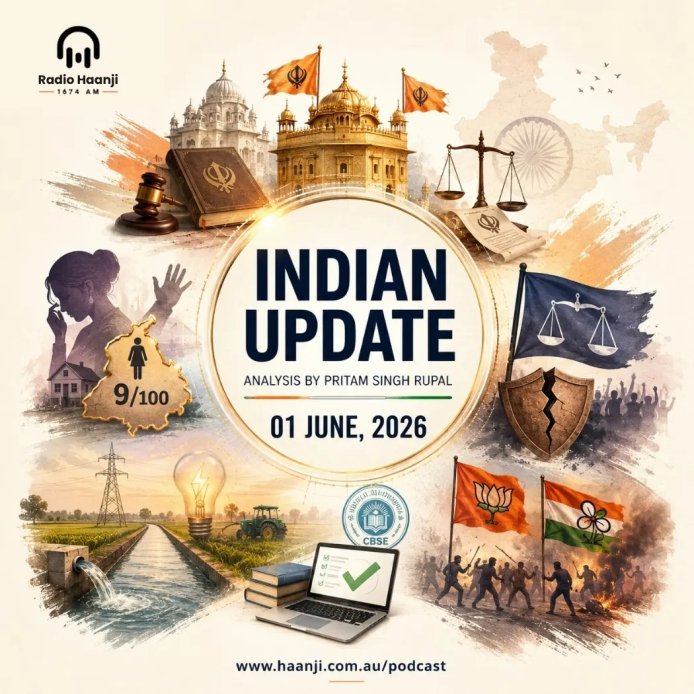
Catch the latest Indian Updates on Radio Haanji with Pritam Singh Rupal. Dive deep into the Gurdwara Act controversy, the political crisis within Shiromani Akali Dal, Punjab paddy sowing updates, and West Bengal unrest.
The socio-political landscape of Punjab is witnessing significant shifts, marked by intense religious debates, systemic political restructuring, and crucial agricultural declarations. On the latest edition of the Indian Updates show on Radio Haanji 1674 AM, prominent host Pritam Singh Rupal delivered an extensive breakdown of these developing stories, offering deep insights for the global Punjabi diaspora.
From the corridors of religious authority in Amritsar to the shifting dynamics of regional political parties, this update covers the core issues affecting the community today. If you want to keep up with daily global and local happenings, you can tune into our regular Today Updates broadcast for real-time reporting.
The Sikh Gurdwaras Amendment Act Controversy
A major point of contention has emerged between the current Punjab state government and premier Sikh religious institutions. The focus of the friction is a series of proposed legislative changes to the historic Gurdwara Act. Sikh leadership, including representatives from the Shiromani Gurdwara Parbandhak Committee (SGPC), has voiced strong opposition to the moves.
The Akal Takht Jathedar explicitly condemned the proposed amendments, characterizing the legislative intervention as sweet poison designed to weaken the autonomous fabric of panthic administration. Religious authorities argue that management of these sacred institutions should remain strictly within the community, free from secular state machinery intervention.
This modern legislative standoff does not exist in a vacuum. The debate is heavily weighed down by historical grievances and unresolved past events, most notably the sacrilege incidents of Bargari and Nakodar. The perceived failure of successive administrative regimes to deliver comprehensive justice in these matters has deepened mistrust, making any state-led attempt to alter institutional frameworks highly sensitive. For analytical discussions on socio-political changes, make sure to follow the dedicated Indian Updates archive.
Political Restructuring and the Crisis in Shiromani Akali Dal
The electoral fallout in Punjab has triggered an internal political crisis within the Shiromani Akali Dal (SAD). Once a dominant force rooted deeply in the rural and traditional panthic belts of the state, successive electoral defeats have severely fractured the party's foundational support base.
An internal rebellion is currently gaining momentum among senior leaders and regional party workers. There are growing demands for a complete organizational overhaul, with explicit calls for the current party president, Sukhbir Singh Badal, to step down from leadership to facilitate a path toward recovery.
Political analysts observing the region indicate that without immediate, fundamental changes to its leadership structure, the party faces an uphill battle to regain its footing before the pivotal 2027 assembly elections. The vacuum created by the weakening of traditional regional structures has already paved the way for various breakaway panthic groups, fundamentally altering the traditional multi-party system in Punjab. For casual discussions and community conversations outside the hard news domain, listeners often explore programs like Boys Meetup to understand broader societal perspectives.
Social Dynamics: Domestic Violence Survey and Agriculture
Beyond politics, critical social indicators and economic plans were highlighted in the broadcast. Data extracted from the recent National Family Health Survey (NFHS) brought forward sobering realities regarding domestic safety. The report indicates that 9 out of 100 women in Punjab have reported experiencing domestic violence. While this statistic highlights an ongoing social challenge that demands localized community and institutional action, it sits well below the broader national average, which currently stands at 22.3% following a marginal downward trend.
On the economic front, the Punjab government has issued official assurances to the state's vital agricultural sector. Ahead of the crucial paddy sowing season, administrative bodies have committed to ensuring an uninterrupted supply of canal water and adequate electricity to agricultural feeders. Meeting these utility targets is critical for farmers attempting to optimize crop cycles without incurring unsustainable fuel costs from private tube wells.
Meanwhile, on an administrative level, the Central Board of Secondary Education (CBSE) confirmed that its technical teams have successfully identified and resolved localized software flaws within its online evaluation portal, streamlining operations for educational institutions.
National Updates: Political Tension in West Bengal
Shifting focus to national current affairs, the broadcast highlighted ongoing political volatility on the eastern side of the country. Post-election political violence continues to disturb public order in West Bengal.
Frequent street-level clashes between workers of the Trinamool Congress (TMC) and the Bharatiya Janata Party (BJP) have been reported across multiple districts. While central and state leaders from both factions have publicly issued statements condemning the violence, both sides continue to actively trade blame regarding the instigation of the unrest.
Exploring More Content on Radio Haanji
Radio Haanji serves as a vital cultural and informational bridge for the global Punjabi community. Beyond our current affairs segments, we provide a diverse lineup of audio content tailored to various interests:
-
For deep dives into scientific phenomena, cosmic discoveries, and species exploration, visit The Deep Talk.
-
To experience rich storytelling and engaging narratives, explore our audio fiction section at Kitaab Kahani.
-
If you need a break with lighthearted humor and comedic relief, listen to the latest Laughter Therapy episodes.
-
For personal stories, thoughts, and reflective daily journals, browse through the Notebook collection.
Frequently Asked Questions (FAQs)
Why is the Akal Takht opposing the Gurdwara Act amendment?
The Akal Takht and the SGPC view the proposed changes as an infringement by the state government on the independent administrative rights of Sikh panthic institutions, calling the intervention harmful to the community's autonomy.
What is causing the internal rebellion within the Shiromani Akali Dal?
Following consecutive electoral setbacks, particularly the loss of traditional rural support bases, party members are demanding a complete change in leadership, specifically asking president Sukhbir Singh Badal to step down to rejuvenate the party before the 2027 elections.
What does the latest NFHS data say about domestic violence in Punjab?
According to the National Family Health Survey data discussed in the show, 9% of women in Punjab reported experiencing domestic violence, which is notably lower than the national average of 22.3%.
What infrastructure promises did the Punjab government make for the paddy season?
The state government has committed to providing continuous and adequate electricity supply along with sufficient canal water resources to support farmers through the high-demand paddy sowing period.
What's Your Reaction?