





























































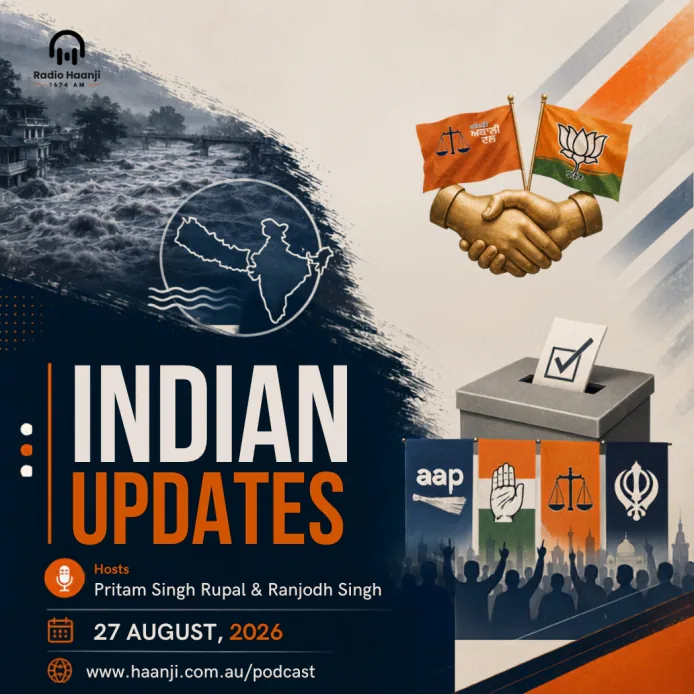
27 Aug - Indian Updates - Nepal Floods Alert & Punjab Politics - Pritam Singh Rupal
Host:-
 Krishna Bhardwaj
 Pritam Singh Rupal
Listen to Indian Updates on Radio Haanji with Pritam Singh Rupal and Ranjodh Singh. In-depth analysis of Nepal flash floods, North India flood alerts, and the shifting SAD-BJP alliance dynamics in Punjab.
The latest edition of Indian Updates on Radio Haanji 1674 AM covers crucial developments shaping both regional climate emergencies and state politics in India. In this broadcast, host Ranjodh Singh and analyst Pritam Singh Rupal unpack the devastating flash floods originating in Nepal and their direct impact on Northern Indian states, followed by a comprehensive breakdown of the shifting political alignments in Punjab ahead of the next assembly elections.
For regular political analysis, regional affairs, and community updates, check out the full lineup of our daily shows on Indian Updates and stay informed with morning headlines across Today Updates.
Nepal Flash Floods Trigger High Alert Across Northern India
Torrential downpours and sudden cloudbursts in Nepal have resulted in catastrophic flash floods, causing widespread loss of life, displacement, and severe infrastructural damage across low-lying valleys. Official reports indicate that around 170 people have lost their lives, with more than 750 individuals missing, including over 100 Indian nationals who were visiting or working across the border.
Downstream Repercussions for Uttar Pradesh and Bihar
Due to the geographical layout and natural river systems connecting Nepal to the plains of India, downstream water runoff has created an urgent flood threat. Major tributaries and rivers such as the Gandak are flowing near or above danger marks. Consequently, disaster management authorities in Bihar and eastern Uttar Pradesh have been placed on high alert, activating evacuation protocols for vulnerable riverside settlements.
The crisis also brings to light the interconnected cross-border socio-economic reality between India and Nepal, where open borders facilitate daily commuting, extensive seasonal labor migration, and religious tourism. Relief and rescue teams continue coordinated efforts to locate missing persons on both sides of the border.
Punjab Politics: Seat Negotiations and the BJP-Akali Dal Equation
Shifting focus to regional politics, the political corridors of Punjab are witnessing intense activity as rumors and backchannel talks regarding an alliance between the Bharatiya Janata Party (BJP) and the Shiromani Akali Dal (SAD - Badal) gather pace. However, the dynamics of this potential tie-up differ markedly from historical arrangements.
The Seat-Sharing Impasse
Historically, the BJP contested as a junior partner in Punjab, traditionally running on 23 assembly seats while SAD contested the remaining 94. However, citing changed ground realities and its performance across 23 assembly segments in previous general elections, the state leadership of the BJP is pushing for a much larger share—reportedly seeking between 45 and 55 seats.
This demand creates a complex challenge for SAD leadership under Sukhbir Singh Badal, which must balance internal cadre morale against the strategic imperative of consolidating urban and rural voting blocs.
CM Bhagwant Mann Criticizes Akali Dal Over Alliance Moves
Reacting to these developments during a public gathering in Majitha's Chowinda Devi area, Punjab Chief Minister Bhagwant Mann launched a sharp critique against the Akali Dal. Mann stated that the Akali leadership has reached a stage where it is actively seeking alliances to maintain political relevance in the state.
The Aam Aadmi Party (AAP) leadership continues to position its governance record directly against both traditional parties, asserting that repeated alliance maneuvers reflect political vulnerability rather than public interest.
Factional Realignment and the Rise of Panthic Politics
Another major theme highlighted in this episode is the internal ideological battle within the Sikh political sphere. During a recent rally in Malout, Sukhbir Singh Badal adopted an aggressive posture against splinter factions and independent Panthic leadership, particularly critiquing the narrative led by the Waris Punjab De faction.
Historical Parallels: Reflections of 1989
Pritam Singh Rupal noted that the current resurgence of independent Panthic sentiment among youth draws distinct parallels to the 1989 Lok Sabha elections. During that period, traditional Akali factions faced significant disruption as a wave of alternative Panthic candidates swept parliamentary seats. Today, with shifting voter allegiances, Panthic and youth votes represent a volatile dynamic that neither the established regional parties nor national outfits can take for granted.
Punjab Heading Toward a Four-Cornered Contest
With the ruling AAP consolidating its welfare outreach, the Congress party attempting structural cohesion through state-wide outreach, the prospective SAD-BJP combine working through seat friction, and independent Panthic groups staking a distinct claim, Punjab is steadily heading toward a multi-polar, four-cornered electoral contest.
Explore more engaging content, insightful discussions, and storytelling from Radio Haanji by visiting The Deep Talk Show, enjoying reflective narratives on Kitaab Kahani, relaxing with Laughter Therapy, or catching community dialogues on Boys Meetup and Notebook.
Frequently Asked Questions
What caused the flood alerts in Uttar Pradesh and Bihar?
What is the core issue in the SAD-BJP alliance discussions?
How is the political landscape in Punjab shaping up for upcoming elections?
Where can I listen to daily episodes of Indian Updates?
What's Your Reaction?