





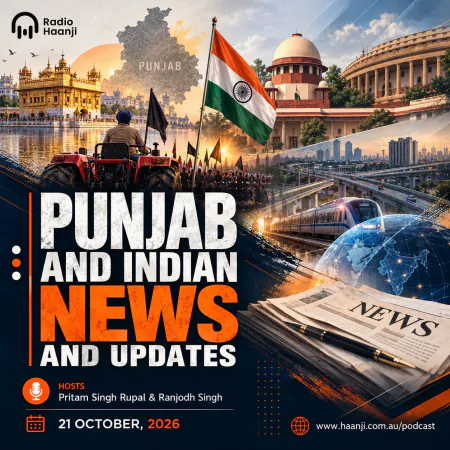























































Punjab's budget and BJP's solo run in Moga — Pritam Singh Rupal explains the politics behind the headlines. Free weekdays on Radio Haanji.
Indian Updates - 12 March 2026 - Punjab Budget Passed, LPG Crisis and BJP's Solo Run - Analysis on Radio Haanji
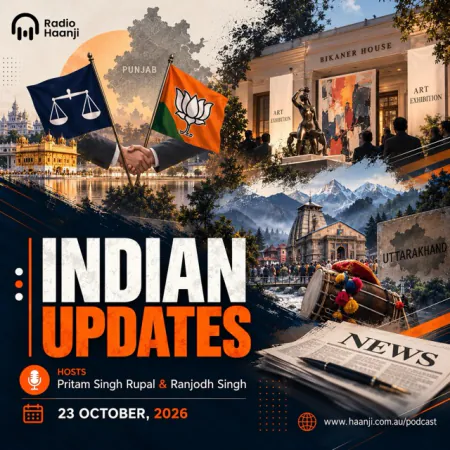
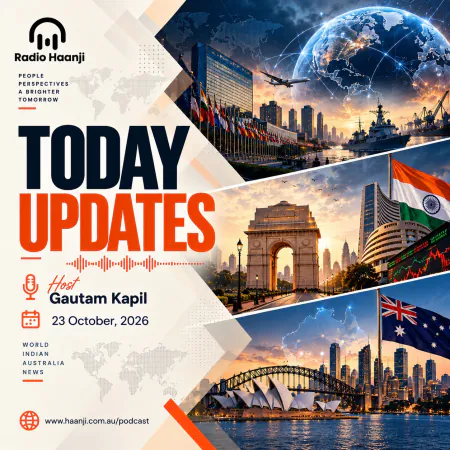
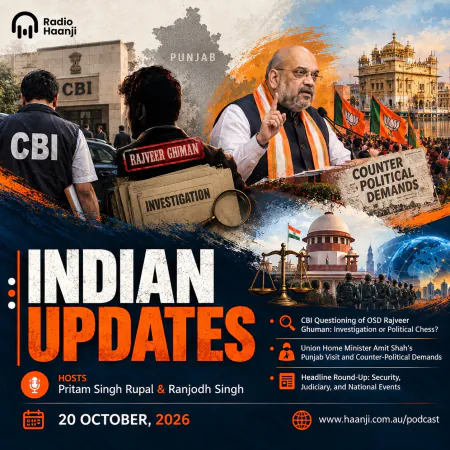
Thursday's Indian Updates on Radio Haanji 1674 AM brings together four stories from Punjab and New Delhi that, read alongside each other, sketch a clear picture of where Indian politics stands right now — pressured, contested and moving fast. Today's episode features a special format, with host Ranjodh Singh joined by respected India-based journalist Preetam Singh Rupal, who brings his characteristic depth and political fluency to a set of stories that will resonate strongly with Punjabi families across Melbourne.
Punjab's Budget Passes — But the Absence of Congress and the Shadow of Sukhpal Khaira Loom Large
The Punjab Vidhan Sabha has passed the state budget, but the manner in which it happened matters as much as the fact that it did. Congress legislators were absent from the session — a boycott that raises pointed questions about the opposition's strategy and its ability to hold the AAP government accountable through parliamentary means rather than simply stepping away from the chamber.
An opposition that absents itself from a budget vote forfeits the opportunity to shape the public record of that session. Whatever the reasoning — protest, political calculation, internal disarray — the optics of an empty Congress bench during one of the legislature's most consequential sittings will be difficult to defend to voters who sent those representatives to Chandigarh precisely to participate in moments like this one.
Running alongside the budget story is a controversy around a statement made by senior Congress leader Sukhpal Khaira. Without the specific content of the statement in hand, what can be said with confidence is that Khaira is a figure whose words routinely generate political heat in Punjab — he is too experienced a politician for his statements to be accidental, and the controversy around whatever he said this week will have been calibrated. Whether it serves Congress's interests or further complicates a party already struggling to find its footing in post-AAP Punjab is the question worth watching.
For Punjabis in Australia following this story, the budget's passage represents a moment of political consolidation for the AAP government. The opposition's absence, however, is a reminder that Punjab's legislature remains a site of intense rivalry, and that the coming months — as the budget's allocations begin to be tested against delivery — will tell a more complete story than any single session vote.
LPG in Punjab — A Supply Crisis With Political Consequences
The LPG gas crisis unfolding in Punjab is the kind of story that travels quickly from headlines to kitchen tables. When cooking gas becomes difficult to source or unaffordable, it stops being a policy issue and becomes a daily frustration for millions of households — and for a government that came to power on promises of practical, citizen-first governance, a domestic fuel crisis is a vulnerability it can ill afford.
Punjab is not alone in facing LPG supply and pricing pressures. The broader global energy market has been destabilised by the ongoing conflict in the Middle East, and those pressures are finding their way into the domestic supply chains that Indian state governments manage. The distinction that matters politically, however, is between a crisis that a government inherits and one that it fails to anticipate or address. Opposition parties in Punjab will draw no such distinction, and the LPG issue will be pressed hard in the days and weeks ahead.
For the Punjabi diaspora in Australia, the LPG crisis is a reminder that the energy disruptions rippling out of the Middle East conflict are not abstract geopolitical developments — they are arriving in the homes of family members back in Punjab. Preetam Singh Rupal's analysis on Indian Updates places this local crisis in its full international context, connecting the dots between global energy markets and the daily lives of people in the state that most of Melbourne's Punjabi community calls home.
The Supreme Court and Harish Rana — A Judgment That Opens a Profound Debate
The Supreme Court of India's decision to allow Harish Rana to exercise his wish for self-determined death is a landmark moment in Indian legal history, and one that deserves more careful attention than a headline allows. The right to die with dignity has been a contested question in Indian jurisprudence for years, and the Court's willingness to engage with it in a specific, named case rather than only in the abstract signals a continued evolution in how India's highest court understands personal autonomy and constitutional rights.
Cases of this nature do not resolve easily. They sit at the intersection of law, medicine, ethics and deeply held cultural and religious beliefs about life and death — beliefs that vary significantly across India's population. The Supreme Court, by allowing Rana's wish in this instance, has not necessarily settled the broader question. What it has done is extend the principles established in earlier right-to-die judgments into a more specific human context, and that extension will be examined carefully by legal scholars, healthcare professionals and advocates on all sides of the debate.
For Indians in Australia thinking about how the legal frameworks governing end-of-life decisions compare between their home country and their adopted one — Australia has its own complex and evolving landscape on this question — this judgment offers a point of genuine reflection. Indian Updates is the kind of Indian current affairs podcast that takes these nuanced judicial stories seriously rather than reducing them to a single sentence.
BJP Prepares for Punjab Alone — The Moga Rally and What It Signals
The BJP's announcement that it will contest Punjab's local body elections independently, without an alliance partner, and its preparations for a major rally in Moga, represent a strategic statement that merits careful reading. The BJP has historically struggled in Punjab, where its electoral base is narrower than in most other large Indian states. The decision to go it alone — rather than seek the kind of coalition that delivered the party stronger results in alliance arrangements elsewhere — is either a sign of confidence or a sign that acceptable alliance options are not available.
The Moga rally is a significant mobilisation effort. Moga sits in the Malwa belt, a region that has been central to Punjab's political contests and that the AAP government drew heavily from in its 2022 landslide. If the BJP believes it can make inroads in Malwa without an alliance partner, it is making a bet on its own organisational strength and on the possibility that some AAP voters are open to reconsidering. That is a credible hypothesis in some pockets of the region, but it is also one that requires very effective ground-level campaigning to translate into results.
For NRIs watching Punjab politics from Melbourne, the BJP's independent stance is a development that reshapes the competitive landscape ahead of local elections. A three or four-cornered contest — AAP, Congress, BJP and possibly Akali Dal in various configurations — produces very different outcomes than a straight two-party race, and the Moga rally is an early signal that the BJP intends to be a serious participant rather than a spectator in whatever political contests Punjab faces next.
Why Indian Updates on Radio Haanji Is Essential Listening for the Indian Diaspora
There are plenty of ways to follow Indian news from Australia. What is harder to find is the kind of sustained, intelligent analysis that takes complex political situations seriously and explains them with the depth they deserve. Indian Updates on Radio Haanji 1674 AM fills that gap consistently and credibly, and today's special episode — with Preetam Singh Rupal joining host Ranjodh Singh — is a good example of how the programme elevates its coverage when the stories demand it.
For Punjabis in Melbourne who care deeply about what is happening back home, shows like Indian Updates and The Insight Report on Radio Haanji offer something that no news aggregator or social media feed can replicate: editorial judgment. Someone who knows the terrain, understands the context and can tell you not just what happened but what it means. That is the kind of journalism the diaspora deserves, and it is available free every weekday at haanji.com.au/podcast.
The Indian community in Australia is politically sophisticated and genuinely engaged with events back home. Indian Updates meets that engagement with the seriousness it warrants — which is why it has built the loyal audience it has among NRIs across Melbourne and beyond.
Listen to Indian Updates - Free, Every Weekday on Radio Haanji
Indian Updates is available free every weekday across all major platforms.
Listen on Spotify — Follow the show on Spotify and get every new episode delivered directly to your library.
Listen on Apple Podcasts — Subscribe on Apple Podcasts for uninterrupted access on any Apple device.
Download the iOS app — Stream Radio Haanji live and browse the full episode archive on your iPhone or iPad.
Download the Android app — The full Radio Haanji experience is available free on Google Play for Android users.
Preetam Singh Rupal and Ranjodh Singh return tomorrow for the next edition of Indian Updates on Radio Haanji 1674 AM — with Punjab's political season accelerating and the budget's real test now beginning, the analysis will be as important as ever.
Radio Haanji 1674 AM | Punjabi Podcast | Broadcasting from Melbourne, Australia
Listen free at haanji.com.au | Available on Spotify & Apple Podcasts
Serving the Punjabi community across Melbourne · Sydney · Brisbane · Australia · Worldwide
What's Your Reaction?