
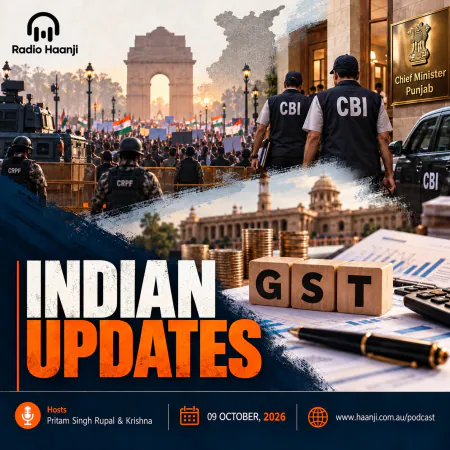








































03 June - Indian Updates - CBSE Leadership Overhaul and Punjab Political and Economic Reforms - Pritam Singh Rupal and Ranjodh Singh
Host:-
 Pritam Singh Rupal
 Ranjodh Singh
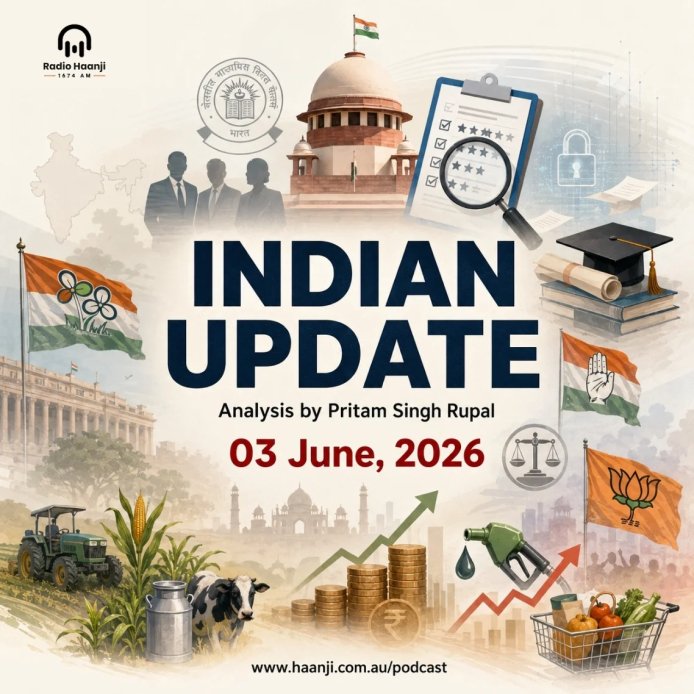
Listen to Radio Haanji Indian Updates with Pritam Singh Rupal and Ranjodh Singh. Breaking down the CBSE leadership overhaul, West Bengal political friction, Punjab Congress decisions, and crucial agricultural crop loan reforms.
An essential administrative restructuring has taken place at the Central Board of Secondary Education (CBSE). The central government has replaced both the Chairman and the Secretary of the board amid ongoing conversations surrounding evaluation systems and academic management.
On this episode of Indian Updates on Radio Haanji 1674 AM, hosts Pritam Singh Rupal and Ranjodh Singh break down these administrative shifts alongside significant political and economic developments in West Bengal and Punjab.
Central Government Restructures CBSE Leadership Amid OSM Scrutiny
The central government has executed an immediate leadership transition at the highest tier of the Central Board of Secondary Education (CBSE). Former Chairman Rahul Singh and Secretary Himanshu Gupta have been reassigned out of the national board. To take their places, the Union Government has appointed senior IAS officers, with Lokhande Prashant Sitaram stepping in as the new CBSE Chairperson and Varun Bhardwaj taking over as the Secretary.
Digital Evaluation and Persistent Challenges
This strategic overhaul occurs alongside the formation of a specialized committee directed to analyze issues tied to procurement and implementation within the On-Screen Marking (OSM) online digital evaluation platform. While technical transparency regarding digital grading services has dominated recent public attention, the program highlights that systemic pressures—including past paper leaks and the overall standardization of large-scale educational management—remained persistent areas of concern under the previous leadership structure.
The Evolution of Educational Governance
The episode features an analytical discussion regarding the broader structural trajectory of the Indian educational landscape. Historically classified as a State List subject under the Constitution of India, education was moved to the Concurrent List via the 42nd Amendment. The hosts observe that the central government has steadily advanced its policy footprint and oversight over structural frameworks, moving the pivot of administrative control closer to the Center.
Political Developments in West Bengal and Punjab
West Bengal: Administrative Friction in the Legislative Assembly
Internal friction within the ruling Trinamool Congress (TMC) has surfaced in West Bengal. Reports from the state capital indicate that the Speaker’s office has declined to formally accept a specific letter concerning the status or designation of the Leader of the Opposition. This development signals emerging procedural gridlocks and shifting power dynamics within the state’s legislative machinery.
Punjab Congress: Central Leadership Rules Out Immediate Transition
Speculation regarding an organizational shake-up within the Punjab Pradesh Congress Committee (PPCC) has built up considerable momentum. Rumors circulated widely that senior leader Vijay Inder Singla was under consideration to assume the state party presidency, while former Chief Minister Charanjit Singh Channi was tipped to head the campaign committee for the 2027 state assembly elections.
However, AICC Punjab affairs in-charge Bhupesh Baghel officially clarified the high command's stance following high-level meetings in New Delhi. Baghel stated definitively that no immediate leadership modifications are taking place. The state unit will contest the upcoming 2027 assembly elections under a unified collective framework guided by Congress President Mallikarjun Kharge and senior leader Rahul Gandhi, with Amarinder Singh Raja Warring remaining securely in place as the state party president.
BJP Punjab: New Guard Meets Internal Skepticism
The state unit of the Bharatiya Janata Party (BJP) in Punjab is navigating its own internal adjustments following the appointment of Keval Singh Dhillon as the new state president. The decision has drawn public skepticism from veteran political figure Captain Amarinder Singh. The former Chief Minister openly questioned the strategic direction of the appointment, raising concerns over whether this leadership course aligns with the structural expansion needed for the party to gain independent ground in Punjab.
Agricultural and Economic Reforms in Punjab
Maximum Credit Limit (MCL) Expansion for Diversification
The Punjab Government has introduced key modifications to the Maximum Credit Limit (MCL) structures governing institutional crop loans. Tailored to cushion small and marginal farmers from mounting seasonal financial stress, the reformed credit framework expands beyond traditional wheat and paddy cycles.
The updated system integrates provisions for a broader variety of alternative crops, such as:
-
Mung bean (green gram)
-
Maize (corn)
-
Allied agricultural portfolios, including dairy farming, animal husbandry, and related rural infrastructure.
By expanding credit availability for these alternative domains, the policy attempts to provide practical financial backing for agricultural diversification away from water-intensive cultivation patterns.
Statistical Reductions in Agricultural Distress
Citing data analyzed by Punjab Agricultural University (PAU) and the National Crime Records Bureau (NCRB), the Chief Minister highlighted a measurable decrease in farmer suicide rates across the state when contrasted against historical statistics recorded since 2017. While deep-rooted agrarian vulnerabilities remain a core policy issue, the downturn in these critical indicators offers a degree of measured relief to rural communities and administrative bodies working on rural debt relief frameworks.
Macroeconomic Pressures: Fuel and Inflation Costs
On the economic front, consumers and logistical operators face sustained inflation pressures. Fuel prices have maintained an upward trajectory, directly increasing baseline transportation and distribution overheads across the region. Because surface logistics underpin the supply chain for consumer markets, these rising transport inputs are actively filtering down into retail prices, driving up the daily cost of essential commodities and basic household items.
Frequently Asked Questions (FAQs)
Who has been appointed as the new Chairman of the CBSE?
Lokhande Prashant Sitaram, a senior Indian Administrative Service (IAS) officer, has been officially appointed as the new Chairperson of the Central Board of Secondary Education (CBSE).
Why was the top leadership of the CBSE replaced?
The central government initiated the administrative transition following intense scrutiny and public concerns regarding the procurement and execution of services for the board's On-Screen Marking (OSM) digital evaluation system. A dedicated one-member committee has been set up to investigate the matter thoroughly.
Is the Congress party changing its state president in Punjab?
No. AICC Punjab affairs in-charge Bhupesh Baghel has formally clarified that Amarinder Singh Raja Warring will continue to serve as the Punjab Congress President. The party plans to approach the 2027 state elections under a collective leadership strategy led by Mallikarjun Kharge and Rahul Gandhi.
What changes have been made to Punjab's crop loan system?
The Punjab Government has revised the Maximum Credit Limit (MCL) guidelines for crop loans. The updated framework expands credit coverage to small farmers cultivating alternative crops like mung and maize, and provides explicit funding lines for allied sectors like dairy farming.
Where can I listen to more regular updates from Radio Haanji?
You can stream all the latest episodes of Indian Updates online by visiting the official audio repository at Radio Haanji Today Updates and Radio Haanji Indian Updates.
Discover a diverse array of engaging audio content across our specialized programming lines. For lighthearted entertainment and daily smiles, tune into our Laughter Therapy Episodes. If you appreciate rich narrative traditions and literary adaptations, explore our curated collection to Listen to Audio Stories on Kitaab Kahani. For deep dives into scientific discoveries, cosmic anomalies, biology, and historical explorations, don't miss The Deep Talk Show. You can also catch up on daily talk formats via our popular community segments on the Radio Haanji Notebook and the weekend panel discussions on Boys Meetup.
What's Your Reaction?