


























































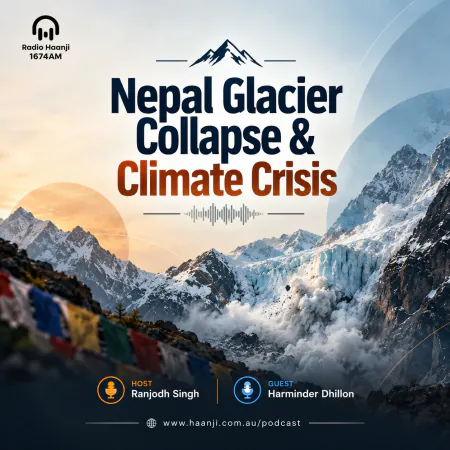





























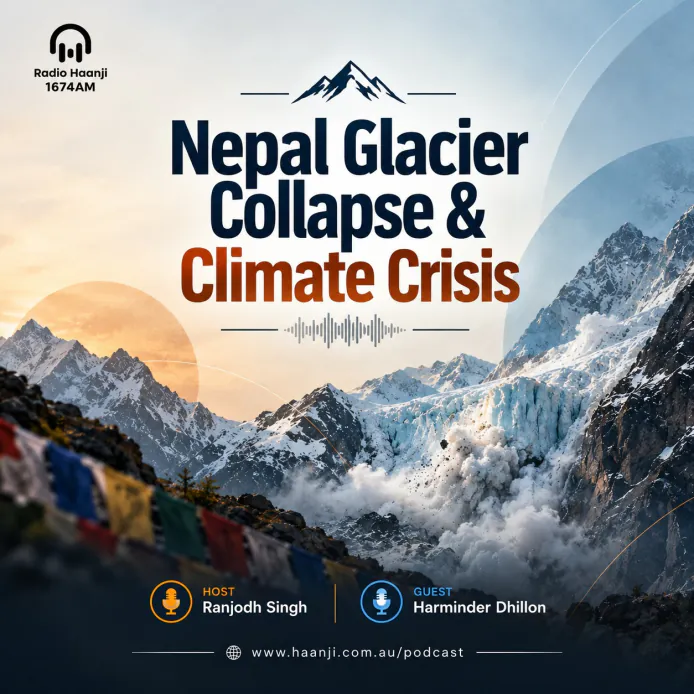
Nepal Glacier Collapse & Climate Crisis - Harminder Dhillon - Ranjodh Singh
Host:-
 Harminder Dhillon
 Ranjodh Singh
Unpack the recent Nepal glacier collapse and unfolding climate crisis on Radio Haanji with Harminder Dhillon and Ranjodh Singh. Listen to the full episode.
A sheer mass of ancient glacial ice breaking loose high in the mountains does far more than reshape local geography—it sends shockwaves felt across international seismic networks. In this edition of the Climate Change Special on Radio Haanji, hosts Harminder Dhillon and Ranjodh Singh unpack the recent Nepal glacier collapse climate crisis. Moving past vague generalisations about shifting weather, the hosts connect volatile seasonal patterns in Western nations directly to the catastrophic structural failures unfolding in the high Himalayas.
Harminder Dhillon, a key contributor to Radio Haanji's environmental and community programming, offers an evidence-grounded look at the mechanics behind high-altitude disasters. Together, Dhillon and Singh trace the sequence of events that transformed a detached ice formation into a lethal, high-speed wall of water and silt. Their dialogue moves from the immediate physical devastation to the broader ethical dilemma of worldwide carbon accountability.
Understanding the Nepal disaster requires examining the interplay between rising global temperatures and structural alpine degradation. As ancient ice thins and detaches from precipitous mountain faces, communities situated in downstream valleys face immediate threats to their lives, infrastructure, and livelihoods. Dhillon and Singh lay bare the reality that these tragedies are not detached natural anomalies, but the direct cost of global environmental inertia.
Where to Listen
Stream the full broadcast of the Climate Change Special hosted by Harminder Dhillon and Ranjodh Singh on Radio Haanji. Explore insightful environmental breakdowns, community updates, and weekly global discussions across your preferred streaming apps:
Episode Highlights: The Nepal Glacial Crisis
The episode opens with reflections on unpredictable seasonal volatility across regions like Canada and northern India before turning directly to the recent disaster in Nepal. Dhillon and Singh detail how a massive glacial section—covering roughly 60 acres and half a mile thick—sheared off a high ridge, falling over 1,200 meters into a mountain lake. The impact registered as a 5.4-magnitude seismic event, instantly generating a violent, 300-foot-high inland surge traveling at speeds close to 170 km/h.
The broadcast explores the staggering human toll, with missing persons counts in the thousands and hundreds of dam construction workers trapped within flooded diversion tunnels. Dhillon highlights how this sudden rupture pushed regional rivers to critical levels, endangering downstream dams as far as Bihar, India. The hosts draw a sharp line between the microscopic carbon footprint of Nepal's populace and the unchecked emissions of major industrial nations, urging listeners to treat the disaster as an urgent wake-up call for personal and collective responsibility.
What Caused the Catastrophic Nepal Glacier Collapse?
The Nepal glacier collapse was caused by sustained atmospheric warming that progressively weakened the structural bonds anchoring a multi-acre ice slab to the mountainside. Rising temperatures caused meltwater to lubricate the bedrock beneath the formation, ultimately triggering a clean structural break under gravitational strain.
When this detached block—estimated at roughly 60 acres in surface area and half a mile deep—plummeted over 1,200 meters, the kinetic impact violently displaced the entire alpine lake beneath it. This was not a slow seasonal overflow; it was a sudden inland tsunami. The kinetic transfer converted millions of tonnes of ice, water, and pulverized stone into a fast-moving slurry.
Traveling through steep mountain corridors at speeds reaching 170 km/h, the resulting 300-foot wave stripped mountainsides clean of vegetation, roads, and settlements. Downstream populations received practically no advance warning, as the sheer velocity of the surge eliminated typical evacuation windows.
How Does Global Warming Accelerate Glacial Melting Rates?
Global warming accelerates glacial melting rates by sustaining prolonged above-average temperatures, preventing snowpack from refreezing while doubling historic ablation rates. Over recent decades, this rapid heat buildup has systematically thinned high-altitude ice masses, leaving them fractured and prone to sudden structural failure.
In the Himalayas, glaciers that formed over millennia are losing volume at unprecedented speeds. As discussed in the broadcast, the specific glacier involved in the Nepal event had lost over 30 feet in thickness across the past few decades alone. This consistent loss strips the structural integrity of ancient ice walls, exposing inner cracks to summer heat.
Furthermore, as ice margins recede, dark mountain rock is exposed to solar radiation. The heat absorbed by the surrounding rock creates localized thermal micro-climates that melt glaciers from below and along the sides, accelerating mechanical detachment far faster than surface melting alone.
Why Do Low-Emitting Nations Like Nepal Bear the Brunt of Climate Disasters?
Low-emitting nations like Nepal bear the brunt of climate disasters because global atmospheric systems distribute heat universally, while steep, vulnerable topographies concentrate the physical fallout along populated mountain river valleys. This dynamic leaves communities with minimal emissions profiles exposed to extreme high-altitude hazards.
Dhillon emphasizes this stark inequality throughout the program. The everyday carbon footprint of a resident in Nepal is negligible, barely registering on global emissions charts. Yet, because these communities sit directly downstream from destabilizing ice caps, they suffer catastrophic human and economic losses.
In contrast, roughly 70% of global greenhouse gas emissions originate from a handful of major industrial powers, including China, the United States, India, the European Union, Russia, and Japan. This disparity leaves developing mountain populations at the mercy of industrial consumption models operating thousands of miles away.
Downstream Vulnerabilities: Dam Failures and Regional Flood Risks
When high-altitude glacial surges race down alpine gorges, civil infrastructure downstream faces severe structural damage. Rather than carrying pure water, glacial outburst flows transport thousands of tonnes of thick sediment, shattered boulders, and uprooted forests.
During the Nepal crisis, this dense slurry inundated hydroelectric facilities, completely blocking diversion tunnels and trapping approximately 800 workers underground. The sheer density of the debris chokes intake gates, leaving reservoir operators unable to release water safely or regulate upstream surges.
As the floodwaters push beyond mountain valleys into flatter agricultural regions, such as the plains of Bihar in India, regional barrages and dams are pushed toward their structural limits. Managing these cross-border environmental emergencies requires continuous international transparency and early-warning networks to prevent cascading dam breaches.
Key Takeaways
-
The recent Nepal disaster was triggered by a massive 60-acre glacial detachment that plunged over 1,200 meters into an alpine lake bed.
-
The kinetic force of the impact generated a 5.4-magnitude seismic reading and a 300-foot-high debris wave traveling at nearly 170 km/h.
-
Over recent decades, rising average temperatures have doubled melting rates across Himalayan glaciers, stripping tens of feet of thickness from major ice sheets.
-
Hundreds of infrastructure workers were trapped in diversion tunnels, with downstream flood risks escalating across river networks into neighboring regions like Bihar.
-
Addressing accelerating climate breakdowns demands simultaneous systemic emissions reductions from major industrial powers and proactive changes in personal energy consumption.
Frequently Asked Questions
What triggered the recent Nepal glacier crisis?
How big was the flood surge produced by the Nepal glacier break?
Did the Nepal glacier collapse cause an earthquake?
Why were hydroelectric dams heavily impacted in the Nepal crisis?
What proportion of worldwide emissions comes from the top industrial economies?
Can individuals take practical steps to help curb global warming?
What's Your Reaction?