





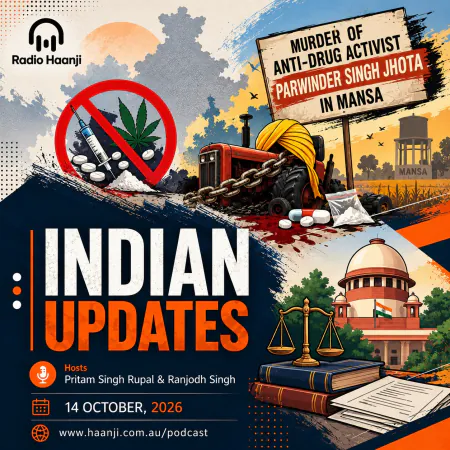







































Indian Updates 11 Mar 2026 - LPG Crisis & Punjab Trade
Host:-
 Amrinder Gidda
 Pritam Singh Rupal
LPG crisis deepens, Punjab weighs in on India's trade deal and the Lok Sabha speaker row — expert analysis free on Radio Haanji.
Indian Updates - 11 March 2026 - LPG Crisis, Punjab's Trade Defiance and India's Constitutional Crossroads
India is navigating a week of extraordinary pressure — from empty gas cylinders in restaurant kitchens to a historic showdown in Parliament, from a state assembly challenging the centre's sovereignty in trade negotiations to the nation's highest court reopening one of its most enduring constitutional debates. On Wednesday, 11 March 2026, Indian Updates on Radio Haanji 1674 AM brought together host Amrinder Gidda and special guest journalist Preetam Singh Rupal for a deep and unsparing analysis of events that speak directly to the lives of every Indian — whether in India or in the diaspora. As one of the most trusted Indian current affairs podcasts reaching the Punjabi and Indian community in Australia, the show brought the kind of context and consequence that headlines alone cannot carry.
When the Kitchen Goes Cold - India's LPG Crisis and What It Reveals About Energy Vulnerability
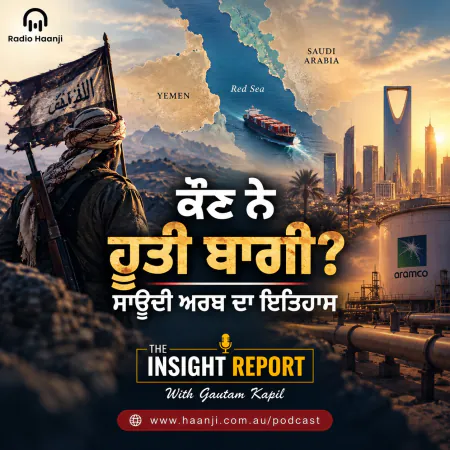
The war in West Asia has come home to India in the most immediate way possible — not through diplomatic notes or economic forecasts, but through empty gas cylinders and shuttered restaurant kitchens. Since the US-Israel strikes on Iran began on 28 February, disruptions to shipping through the Strait of Hormuz have choked India's supply of liquefied petroleum gas, a fuel on which tens of millions of Indian households and hundreds of thousands of commercial establishments depend every single day.
India is the world's second-largest importer of LPG, and approximately 85 to 90 per cent of its LPG imports pass through the Strait of Hormuz. With that route now severely disrupted, the consequences have moved with extraordinary speed. Commercial LPG supply has been halted or sharply reduced across Karnataka, Maharashtra, Punjab, Tamil Nadu, Rajasthan and other states. Hotel and restaurant associations have warned of large-scale closures. In Mumbai alone, an estimated 8,000 establishments have been affected. In Tamil Nadu, nearly 10,000 eateries face shutdown. The Bengaluru Hotels Association has said that operations cannot continue without supply restoration.
The central government has responded by invoking emergency powers, ordering all oil refineries to divert propane and butane production exclusively toward LPG for domestic use. State oil giants including Indian Oil Corporation, Bharat Petroleum and Hindustan Petroleum have been directed to prioritise household supply. The government has also introduced stricter booking intervals of 21 to 25 days to prevent hoarding. Yet authorities simultaneously insist there is no actual shortage for domestic households — a position that sits uneasily alongside visible queues, rising black market prices and cylinders selling for as much as Rs 3,000 in some parts of Bengaluru where the regulated price is Rs 1,950. The domestic cylinder price itself has risen by roughly Rs 60 since 7 March.
The deeper question this crisis raises is one that India's policymakers have long deferred: the country's structural dependence on Gulf energy imports, and the absence of strategic LPG reserves that could buffer against exactly this kind of disruption. For Indian families in Australia, many of whom are still in regular financial contact with relatives back home, a sudden and sustained rise in household energy costs is not an abstract policy concern. It lands directly on kitchen budgets and small business margins.
Punjab Speaks First - A State Assembly's Challenge to the India-US Trade Deal
In a development with profound implications for Indian agriculture and federalism, the Punjab Vidhan Sabha on Tuesday, 10 March 2026, unanimously passed a resolution condemning the proposed India-US trade agreement. Punjab becomes the first state in India to formally pass such a resolution, and the significance of that distinction should not be underestimated.
Chief Minister Bhagwant Mann framed the issue starkly. The proposed agreement would open India's agricultural markets to American produce at a time when the average farm size in Punjab is 2.5 acres and the average in the United States is 500 acres. Competing on anything approaching equal terms, Mann argued, is not a question of policy — it is structurally impossible. He warned that the deal could deal a blow to Punjab's efforts at crop diversification, threatening maize, cotton and Narma cultivation that the state has been trying to develop as alternatives to its heavily water-intensive wheat and paddy cycle. The agreement, he said, was more dangerous to Indian farming than the three farm laws that triggered the historic farmers' movement of 2020-21.
The opposition within the assembly was equally pointed. Congress leader Sukhpal Khaira and others raised the question of why the central government had negotiated the agreement without consulting state governments, particularly those with the largest agricultural footprints. Several members also raised the spectre of the Epstein files — making the extraordinary allegation that political pressure from the United States may have influenced the pace and terms of the deal. The assembly speaker, Kultar Singh Sandhwan, went further, calling the deal not a bilateral agreement but what he described as coercion by a foreign power.
For the Indian community in Australia, this story carries particular weight. Many Punjabi families here have relatives who are farmers, or who come from farming districts where these debates are not academic. The question of whether India's political leadership is consulting its own states on decisions of this consequence — and whether the country's agricultural sovereignty is being traded away under pressure — is one that resonates across borders. The Indian Updates podcast on Radio Haanji has regularly covered the intersection of India's trade decisions and their direct consequences for rural communities, giving the diaspora the deeper analysis it deserves.
The Speaker in the Dock - A Constitutional Clash in the Lok Sabha
In what will be remembered as one of the more dramatic episodes of India's current parliamentary session, the Lok Sabha on Tuesday took up a resolution seeking the removal of Speaker Om Birla from office. This is only the third time in the Lok Sabha's history that such a resolution has been admitted — a fact that alone underscores the severity of what unfolded.
The Congress-led opposition, backed by 118 signatories and supported by at least 50 members who stood in the House, moved the resolution on four main grounds: that Birla had denied the Leader of the Opposition, Rahul Gandhi, the time to conclude his speech during the motion of thanks to the President's address; that eight Congress MPs had been suspended; that objectionable personal attacks by a ruling party MP went unaddressed; and that the absence of a Deputy Speaker — a vacancy that has now persisted for seven years — has left the House without a constitutionally envisioned check on the Speaker's powers. The irony that BJP MP Jagdambika Pal, himself appointed to the panel of chairpersons by Birla, was chosen to preside over the debate on Birla's removal was not lost on the opposition, and it generated significant procedural confrontation.
The government defended the arrangement and pushed back strongly. Parliamentary Affairs Minister Kiren Rijiju rejected claims that Pal lacked authority. Home Minister Amit Shah accused the opposition of misreading constitutional provisions. And BJP MP JP Nadda characterised the opposition's walkout as irresponsible at precisely the moment when the government was ready to respond. Speaker Birla himself vacated the chair voluntarily while the resolution was debated. The resolution requires a simple majority to pass; the government's numbers suggest it is unlikely to succeed, but the political consequences of the episode extend well beyond arithmetic. The fact that this debate is happening at all speaks to a House whose institutional relationships are under sustained strain. For those listening to Indian Updates on Radio Haanji, our earlier interview on parliamentary affairs provides useful background context.
The Court Points Parliament Toward Uniform Civil Code - A Debate Without Easy Answers
On the same day that Parliament was consumed by internal conflict, India's Supreme Court made an observation that will echo through the country's political and legal landscape for some time to come. While hearing a petition challenging provisions of the Muslim Personal Law (Shariat) Application Act, 1937, a bench led by Chief Justice of India Surya Kant — with Justices Joymalya Bagchi and R Mahadevan — remarked that the time has come for a Uniform Civil Code in India.
The petition, brought by advocate Prashant Bhushan on behalf of petitioners seeking equal inheritance rights for Muslim women, asked the court to strike down provisions of the 1937 Act that grant women a smaller share of inheritance than male heirs. Justice Bagchi noted that the court has previously and repeatedly recommended that Parliament enact a Uniform Civil Code. Chief Justice Kant, however, was precise about the limits of judicial power here: striking down the 1937 Act without an alternative legislative framework would create a legal vacuum that could leave Muslim women worse off, not better. The court invited the petitioners to amend their plea to include alternative legal suggestions and was explicit that this is a matter for Parliament, not for judicial orders.
The UCC has been one of the most politically charged questions in Indian public life for decades. It touches the boundaries between religious identity, women's rights and the constitutional vision of a secular democratic republic. Goa and Uttarakhand are the only states currently operating under a Uniform Civil Code. The Supreme Court's remarks do not compel Parliament to act, but they substantially raise the political temperature around a legislative issue that both the ruling party and the opposition approach with caution for different reasons. What makes Tuesday's observation notable is that it came from a bench that was not asked to comment on the UCC — the remarks arose organically from the court's own reasoning about the limitations of purely judicial remedies in the face of deeply embedded personal law structures.
Why Indian Updates on Radio Haanji Is Essential Listening for the Diaspora
For Indians living in Australia, the stories that emerge from back home are rarely simple background noise. They shape conversations with family, inform decisions about remittances and investments, and connect directly to a sense of identity that does not dissolve with the miles. Indian Updates on Radio Haanji 1674 AM exists precisely to serve that need — not with bulletins, but with genuine analysis delivered by journalists who understand the texture of Indian public life from the inside. As one of the most substantive Indian current affairs podcasts available to the diaspora, it brings the kind of clarity that even frequent news readers often miss.
Whether it is understanding what India's LPG vulnerability means for households beyond the headline, why a state assembly resolution on trade matters for Indian federalism, or how a Supreme Court observation on the Uniform Civil Code connects to Article 44 of the Constitution, Indian Updates provides the depth that allows listeners to engage as informed citizens rather than passive spectators. For Punjabi families in Melbourne and across Australia who care about what is happening in India — in their villages, in their states, and in their Parliament — this show is a daily obligation worth keeping.
Listen to Indian Updates - Free, Every Weekday on Radio Haanji
Indian Updates is available for free on all major podcast platforms. Subscribe and never miss a morning episode:
Radio Haanji 1674 AM | Punjabi Podcast | Broadcasting from Melbourne, Australia
Listen free at haanji.com.au | Available on Spotify & Apple Podcasts
Serving the Punjabi community across Melbourne · Sydney · Brisbane · Australia · Worldwide
What's Your Reaction?