














































































Gain deep clarity on Lahore place names and the NEET scam with journalist Pritam Singh Rupal. Free weekday analysis on the Radio Haanji podcast.
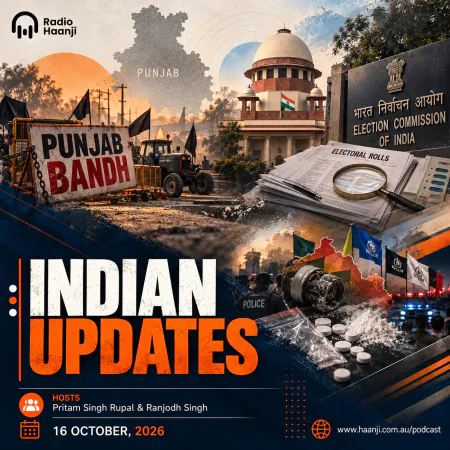
In today's edition of Indian Updates on Radio Haanji 1674 AM, Ranjodh Singh is joined by Senior Journalist Pritam Singh Rupal — whose decades at All India Radio and deep roots in Punjabi journalism bring rare clarity to stories that demand more than headlines. The discussion centers on the administrative, judicial, and cultural transitions reshaping local governance and national institutions. For politically and socially aware members of the Punjabi and Indian diaspora in Australia and Singapore, this episode goes beyond surface reporting to evaluate the true long-term consequences of these actions.
Lahore Reclaims Forgotten Past with Restoration of Pre-Partition Names
The West Punjab government in Pakistan, led by Chief Minister Maryam Nawaz under the direction of former Prime Minister Nawaz Sharif, formally approved a massive urban conservation project to restore pre-partition names to several historical streets, neighborhoods, and alleys in Lahore. Over the past several decades, successive administrations had systematically replaced British-era, Hindu, and Sikh place names with Islamic or nationalist designations. This newly sanctioned policy signals a significant cultural shift, explicitly aiming to preserve and honor the multi-layered historical identity of undivided Punjab.
Under this comprehensive heritage project, major urban localities that were previously altered are returning to their original historical nomenclature. The prominent neighborhood of Islampura is officially reverting to its centuries-old title of Krishna Nagar. Similarly, Sunnat Nagar is being changed back to Sant Nagar, and iconic areas such as Dharampura, Ram Gali, Laxmi Chowk, and Jain Mandir Road are receiving their historical designations. The Lahore Heritage Areas Revival project is also restoring traditional cricket grounds and the historic wrestling arenas where legendary joint-Punjab athletes like Gama Pehalwan used to train.
Senior journalist Pritam Singh Rupal notes that while name changes within contemporary Indian politics—such as Allahabad to Prayagraj or Gurgaon to Gurugram—are often calculated political maneuvers to appease specific voter bases, this unique move in Lahore functions as a rare bridge of bilateral goodwill. Despite decades of official state rewriting, local residents have informally continued to use these historic names in everyday conversation. Reinstating these names on state signboards represents an institutional acknowledgment of ancestral history, offering a progressive framework for regional cultural diplomacy that resonates deeply with the global Punjabi diaspora.
Central Bureau of Investigation Arrests Latur Coaching Operator in NEET Scandal
Systemic corruption within India's competitive examination framework faced severe institutional scrutiny following the arrest of a prominent coaching center owner in Latur, Maharashtra. The Central Bureau of Investigation apprehended Professor Shivraj Raghunath Motegaonkar, the founder of Renukai Chemistry Classes, as part of an expanding crackdown on a nationwide examination malpractice syndicate. Federal investigators executed targeted searches at the institute, recovering physical documentation and digital evidence linking the operator to leaked examination question papers well ahead of the actual national test.
This high-profile arrest exposes the compromised core of a multi-billion-dollar commercial coaching industry that routinely charges exorbitant fees. The investigation highlights a toxic pattern where institutional operators buy leaked academic papers to artificially manufacture high state ranks, leveraging those results for aggressive marketing campaigns. As public indignation intensifies, opposition political factions are demanding full institutional accountability, calling for the immediate resignation of the Central Education Minister, Dharmendra Pradhan.
The repeated compromise of high-stakes national assessments carries severe societal consequences, severely demoralizing meritorious, hardworking students who rely purely on fair competition. This recurring systemic failure places immense psychological pressure on young Indian aspirants, frequently driving student depression and compelling families to actively seek alternative educational migration pathways to countries like Australia and Singapore. While law enforcement agencies claim progress with these initial arrests, historical trends suggest that public attention often fades once high-level operators secure bail, leaving the structural vulnerabilities of the testing system unaddressed.
Supreme Court Formally Reaffirms That Bail Is the Fundamental Rule
In a landmark judicial intervention, a two-judge bench of the Supreme Court of India strongly re-established the foundational legal principle that bail is the rule and jail is the exception. While granting bail to Handwara resident Syed Iftikhar Andrabi in a high-profile case investigated by the National Investigation Agency, Justices BV Nagarathna and Ujjal Bhuyan clarified that stringent statutory provisions cannot be weaponized to validate indefinite pre-trial incarceration. The court ruled that Section 43D(5) of the Unlawful Activities Prevention Act must always operate subject to the constitutional guarantees of personal liberty enshrined under Articles 21 and 22.
The apex court explicitly disapproved of a separate lower-strength bench ruling in the Gulfisha Fatima case regarding the Delhi riots, noting that it had failed to properly apply the binding legal precedent established in the 2021 Union of India v. KA Najeeb case. In that landmark ruling, the judiciary recognized that prolonged delays in completing a trial constitute absolute constitutional grounds for granting legal relief, irrespective of the severity of the statutory charges. The bench emphasized that the presumption of innocence remains the absolute cornerstone of any civilized society governed by the rule of law.
Host Ranjodh Singh observes that this explicit clarification serves as a vital check on trial courts and high courts that frequently bypass constitutional protections when handling complex state security cases. By declaring that the KA Najeeb precedent is absolute and cannot be diluted or circumvented, the Supreme Court has restricted the arbitrary, long-term weaponization of investigative custody. This judgment reinforces institutional checks and balances, safeguarding citizens against indefinite detentions without a proven conviction.
Punjab Concludes Nomination Scrutiny for High-Stakes Municipal Elections
The democratic framework of Punjab moved into its final phase of preparation as the State Election Commission concluded the formal scrutiny of nomination papers for the upcoming local body elections. The state election authority confirmed that the model code of conduct is strictly operational across all districts, with voting scheduled to take place on May 26, 2026. This comprehensive local exercise spans eight municipal corporations, seventy-five municipal councils, and twenty-one nagar panchayats.
The official counting of votes and subsequent declaration of political results will occur on May 29, 2026. This election cycle functions as a vital political barometer, reflecting current public sentiment toward regional governance, local administrative performance, and the state's handling of rural and urban infrastructure. The high number of nominations filed and contested during the scrutiny phase illustrates the intense competition among regional factions looking to secure territorial influence ahead of broader legislative alignments.
Controlling these local bodies is vital for regional political parties because municipal governance directly dictates the distribution of development funds, localized public welfare programs, and urban town planning. Consequently, the upcoming elections have mobilized the state's political machinery, ensuring an intense campaign period as local leaders attempt to consolidate their grassroots voter bases.
Kerala Cabinet Finalizes Distribution of Portfolios Under Chief Minister VD Satheesan
In southern political developments, the newly elected United Democratic Front alliance in Kerala finalized its ministerial structure ahead of the official swearing-in ceremony. Chief Minister-designate VD Satheesan successfully presented a 20-member council of ministers to Governor Rajendra Arlekar after concluding complex internal negotiations with coalition allies. Notably, the historic Indian Union Muslim League secured five crucial cabinet portfolios, underscoring their influential role in the alliance's major electoral victory.
The cabinet composition reflects a deliberate effort to maintain socio-economic, regional, and communal balances within the incoming administration. Senior Congress leader Ramesh Chennithala is slated to assume charge of the critical Home and Vigilance portfolios, while Chief Minister Satheesan is expected to directly manage the Finance department. Additionally, senior legislator Thiruvanchoor Radhakrishnan has been designated for the Speaker's chair, with Shanimol Usman serving as the Deputy Speaker.
This smooth cabinet formation follows a decade of political exile for the United Democratic Front in Kerala, marking a significant transition in the state's legislative approach. The inclusion of experienced hands alongside a targeted push for younger representation indicates that the incoming government plans to prioritize systematic administrative reforms and economic stabilization. The alliance's ability to build internal consensus early will be crucial as they move to execute their primary governance agenda.
Why Indian Updates on Radio Haanji Is Essential for the Indian Diaspora
For the politically and socially aware Indian and Punjabi diaspora residing in Australia and Singapore, keeping track of these fast-moving, multi-layered domestic developments is a persistent challenge. Mainstream media reports frequently present news as disconnected daily bulletins, omitting the essential historical context, legal precedents, and structural consequences that shape the subcontinent's future. This analytical deficit makes specialized, independent current affairs programming indispensable for non-resident Indians who preserve deep connections with their homeland.
The Indian Updates podcast effectively bridges this information gap by synthesizing raw data into objective, measured editorial columns. By providing rigorous coverage of landmark Supreme Court rulings, systemic educational reforms, and grassroots regional elections, the program respects the intelligence of its audience, allowing listeners to understand the underlying currents driving Indian society. Tuning into this dedicated Radio Haanji podcast ensures that the global community remains accurately informed through trusted, verified journalism. Sat sri akal, and welcome to an unmatched source of clarity and insight.
Listen Free — Today Updates on Radio Haanji
Catch the full episode of Today Updates for more details on these stories and other global affairs. Our daily news roundup is designed for the busy professional and community member who wants the facts without the fluff.
Radio Haanji 1674 AM is Austalia's Punjabi community radio station.
Listen free at haanji.com.au | Spotify | Apple Podcasts | iOS App | Android App
Serving the Punjabi community in Australia, Canada, Singapore and world wide.
What's Your Reaction?