
















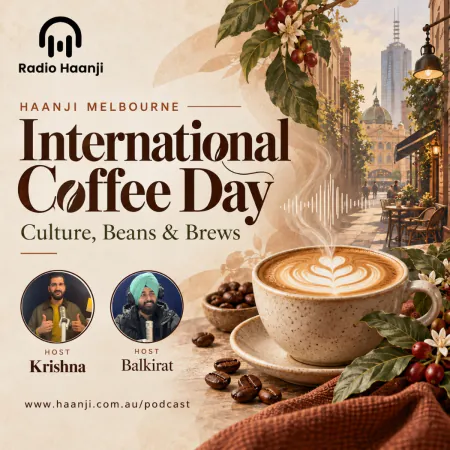










































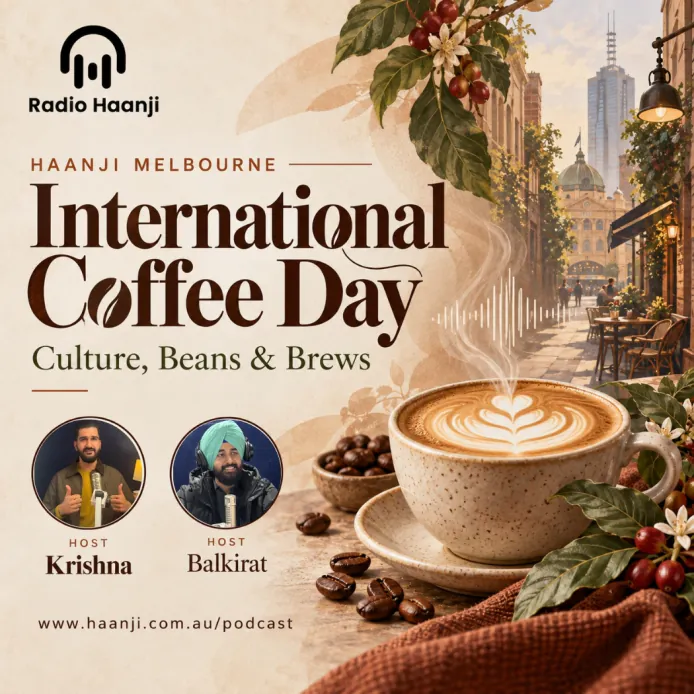
International Coffee Day: Culture, Beans & Brews - Haanji Melbourne
Host:-
 Balkirat Singh
 Krishna Bhardwaj
Explore Melbourne coffee culture, bean science, and travel tales with Krishna and Balkirat on Radio Haanji. Listen to the full episode now!
A steaming cup of coffee represents far more than an early morning caffeine delivery; for millions of people, it serves as an indispensable daily ritual and a cornerstone of urban identity. Marking the occasion of International Coffee Day Melbourne residents and coffee aficionados across the globe turn their attention to the craft, agricultural science, and community routines that define modern cafe culture. On a recent broadcast of the Haanji Melbourne program on Radio Haanji, hosts Krishna and Balkirat unpacked this global obsession, contrasting Australia's meticulous specialty standards with international habits while exploring the science that separates your daily cup from an ordinary brew.
The conversation went beyond the surface-level appreciation of cafe aesthetics, grounding the discussion in economic realities, roasting profiles, and the shared human experiences that unfold around hot beverages. From the precise brewing ratios that make local barista counters famous worldwide to the comedic misadventures that happen when traveling far from your neighborhood cafe, the episode provided an entertaining yet substantive look at why certain cities develop such an intense relationship with the coffee bean.
Where to Listen
Catch the complete broadcast of Haanji Melbourne hosted by Krishna and Balkirat on Radio Haanji 1674 AM, or stream the show online across your preferred podcast and mobile platforms:
Episode Highlights
The episode opened with an energetic salute to International Coffee Day, where Krishna and Balkirat traced the role of caffeine in kickstarting daily productivity before turning to the broader economic scale of the Australian cafe market. The hosts contrasted standard corporate franchise models with the nation's fierce loyalty to independent, boutique venues, noting that consumer expectations in Victoria demand high-level barista execution rather than standardized automated brewing.
From commercial trends, the dialogue shifted toward bean origins and brewing anatomy, methodically breaking down bean genetics, caffeine ratios, and the exact milk-to-espresso compositions found on local cafe menus. As listeners called in to contribute their favorite orders and morning routines, the broadcast expanded into a lively community storytelling session. The hosts shared personal travel mishaps—ranging from confusing road rules and improvised police interactions on holiday to multi-day airport flight cancellations—demonstrating how shared stories and lighthearted diversions connect broadcasters with their audience.
Why Is Melbourne Considered the Coffee Capital of the World?
Melbourne is recognized globally as a coffee capital due to its fiercely independent cafe ecosystem, high consumer standards, and rejection of standardized commercial chains. Australian consumers spend roughly $8 billion annually on coffee, supporting an overall market valuation of nearly $10 billion dominated by artisan roasters and specialized neighborhood baristas.
Unlike many international metropolises where multinational fast-food franchises control the breakfast trade, the Victorian capital built its reputation on European post-war migration and independent operator craftsmanship. Local consumers actively seek out specialty roasting profiles, single-origin varietals, and customized extraction times. This consumer discernment makes the local market notoriously difficult for generic multinational chains to penetrate, as residents prioritize personal relationships with local baristas and unique cafe atmospheres over standardized commercial convenience.
The economic scale of the sector reflects this cultural dedication. With billions flowing through boutique cafes, espresso bars, and roasteries each year, coffee functions as a major pillar of Victoria’s hospitality industry. Going out for coffee in this market serves as a primary social engine, a professional meeting format, and a daily lifestyle benchmark that influences hospitality trends across the entire country.
What Is the Difference Between Arabica and Robusta Coffee Beans?
Arabica beans account for approximately 60 percent of global coffee production, offering a smoother, sweeter, and more aromatic cup with subtle fruit and sugar notes. In contrast, Robusta beans comprise around 40 percent of the market, yielding a stronger, more bitter profile with 50 to 60 percent more caffeine.
The biological differences between the two primary commercial species dictate how they are cultivated, priced, and consumed across different markets. Arabica plants require specific elevations, temperate climates, and careful agricultural stewardship to avoid pests, resulting in complex flavor profiles prized by specialty baristas. Because it produces higher acidity and delicate tasting notes ranging from floral to chocolatey, Arabica forms the base of premium cafe espresso blends across high-end establishments.
Robusta, true to its name, is a far hardier crop that thrives at lower altitudes and resists disease much more effectively. The significantly higher caffeine content acts as a natural chemical defense against insects during the growing cycle, but it also introduces a distinct bitterness and heavier body into the cup. While specialty venues often dismiss commercial-grade Robusta, high-quality iterations remain favored in traditional Italian espresso blends to produce a thick, long-lasting crema, as well as in traditional Vietnamese drip preparations designed to cut through sweetened condensed milk.
Types of Coffee Drinks Explained: From Espresso to Melbourne Magic
Coffee beverage varieties are defined by their ratio of espresso, water, steamed milk, and microfoam. While an espresso delivers a concentrated, unadulterated shot, adding hot water creates an Americano, and combining steamed milk with microfoam produces drinks ranging from the rich, milky latte to Melbourne’s distinct "Magic" brew.
Navigating a specialty chalkboard menu requires an understanding of how milk texture and espresso volume alter the palate. An espresso shot provides the raw baseline of flavor, crema, and body. Diluting that extraction with hot water yields an Americano, retaining the nuanced aromatic notes while softening the initial intensity. When milk is introduced, texture becomes the primary variable:
-
Espresso: A concentrated single or double extraction served straight, delivering maximum flavor intensity and natural oils.
-
Americano: Hot water combined with espresso to lengthen the beverage without muting its foundational flavor notes.
-
Cappuccino: An equal balance of espresso, steamed milk, and a dense, thick layer of foam, often finished with a dusting of chocolate.
-
Latte: A milder preparation featuring a dominant volume of steamed milk layered beneath a thin cap of silky microfoam.
-
Flat White: A staple of Australian coffee culture that incorporates finely textured microfoam folded evenly throughout the beverage, offering a stronger coffee-to-milk ratio than a standard latte.
-
Mocha: A traditional latte infused with chocolate syrup or powder, creating a bridge between espresso and hot chocolate.
-
Magic: A Melbourne specialty crafted with a double ristretto base topped with steamed milk in a smaller five-to-six-ounce vessel, delivering a sweet, punchy flavor profile without excessive bitterness.
Beyond these staple drinks, regional preparation methods continue to gain popularity in multicultural hubs. Styles like Turkish coffee—boiled finely with water and sugar in an open pot—and Vietnamese coffee, brewed slowly through a metal filter over ice, showcase how different societies adapt the same base ingredient to their local traditions.
Contrasting Coffee Cultures: Australian Cafes vs. Traditional Indian Brews
The divide between Australian and Indian coffee cultures centers on usage, timing, and brewing technique. While Australians treat specialty espresso as an essential morning necessity sourced from neighborhood cafes, traditional Indian coffee culture often leans toward evening social gatherings, household instant preparations, and spiced or sweet filter decoctions.
In mainstream urban India, tea has historically remained the ubiquitous morning staple, positioning coffee as an occasional indulgence, a specialty dessert, or an evening social beverage enjoyed at cafes with friends. When coffee is prepared in domestic kitchens outside southern India, it frequently involves whisking instant coffee powder with sugar and boiling milk until it forms a frothy, comforting beverage. Wedding receptions and catering events often feature specialized frothing machines that produce a distinctive, sweet, steaming cup associated with seasonal winter celebrations.
Southern India, conversely, boasts a heritage of authentic filter coffee (kaapi), where finely ground beans blended with chicory are steeped in a traditional stainless-steel percolator. The resulting dark decoction is poured back and forth with boiling milk and sugar using a dabarah and tumbler, creating an airy froth and an intense flavor profile that rivals European extractions. While modern espresso bars are steadily proliferating in India's major urban tech corridors, the daily lifestyle relationship with morning takeaway cups remains a defining characteristic of Australian metropolitan life.
When Travel Plans Unravel: Road Trip Realities and Unplanned Adventures
Even the best-planned trips can unravel due to unforeseen local regulations, rental confusion, or logistical delays. True travel memories frequently stem from improvised problem-solving during moments of chaos, whether negotiating unexpected paperwork checkpoints or waiting out cancellations at regional transit hubs.
During the broadcast, the hosts reflected on how unpredictable travel can be once you leave your regular routine behind. One highlighted story involved a youthful road trip to Goa, where a group of friends unknowingly hired a private-registered vehicle rather than a certified commercial self-drive car. Upon being flagged down by local traffic police, the group faced confusing compliance checks, ultimately settling the matter with an informal on-the-spot fee. To ensure the car would not be stopped repeatedly by other units down the road, the officer marked the driver’s wrist with permanent ink as an ad-hoc signal that the vehicle had already been checked.
A subsequent detour toward Dudhsagar Falls led the party across state administrative lines without proper interstate permits, sparking frantic phone calls from the vehicle's owner. Similar logistical headaches can strike anywhere, as shown by another anecdote recounting a multi-day airport delay in Amritsar. Successive flights were grounded after essential cabin equipment failed inspection, stranding passengers across multiple days as replacement aircraft had to be sourced. These shared travel experiences, while stressful in the moment, inevitably become enduring memories revisited with laughter years later.
Key Takeaways
-
Australia's retail coffee expenditure stands at approximately $8 billion annually, contributing to a total market valuation of roughly $10 billion led by independent venues.
-
Arabica and Robusta beans represent roughly 60 percent and 40 percent of global supply respectively, with Robusta containing 50 to 60 percent more caffeine than Arabica.
-
Beverage strength and character depend heavily on extraction volumes and milk textures, spanning short black espressos, flat whites, and double-ristretto Melbourne "Magic" pours.
-
Cultural beverage customs vary dramatically across borders, contrasting Australia's early morning takeaway cafe routine with India's historic preference for evening coffee meetups and home-style whipped preparations.
-
Travel unpredictability often creates lasting personal memories, as seen in improvised holiday driving mishaps and protracted regional flight cancellations.
Whether you rely on a single, precisely pulled flat white to conquer your morning commute or enjoy an occasional iced beverage on a weekend stroll, the ritual of coffee serves as a universal connector across cultures and continents. Tune in to the full episode of Haanji Melbourne with Krishna and Balkirat on the Radio Haanji App, Spotify, or Apple Podcasts to hear more cultural insights, listener call-ins, and humorous community banter. Be sure to subscribe, leave a review, and share your favorite local coffee order with the station on the next live broadcast.
Frequently Asked Questions
What makes Melbourne's coffee culture unique compared to other cities?
How does the caffeine content compare between Arabica and Robusta beans?
What is a "Magic" coffee order in a Melbourne cafe?
Why do some people prefer black coffee before a workout?
How is traditional filter coffee made in South India?
Are commercial drive-thru chains popular in Australian coffee culture?
What's Your Reaction?