
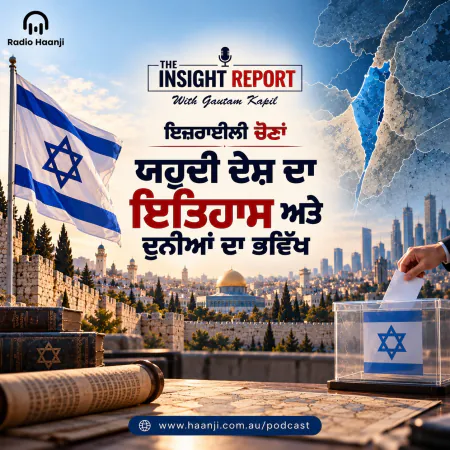


















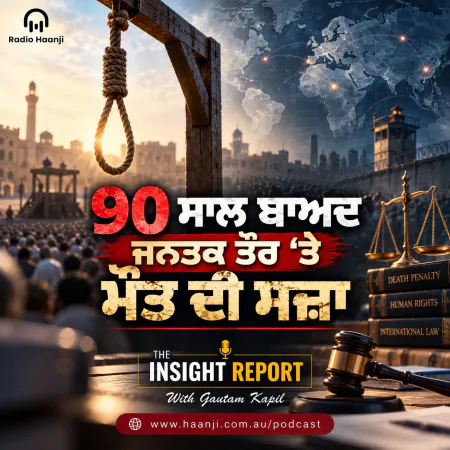
































































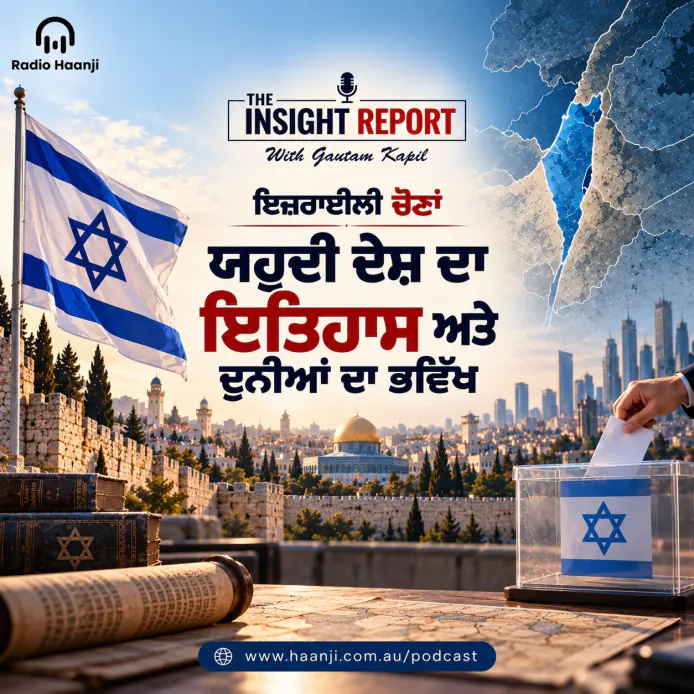
ਇਜ਼ਰਾਈਲੀ ਚੋਣਾਂ: ਯਹੂਦੀ ਦੇਸ਼ ਦਾ ਇਤਿਹਾਸ ਅਤੇ ਦੁਨੀਆਂ ਦਾ ਭਵਿੱਖ- The Insight Report - Gautam Kapil
Host:-
 Gautam Kapil
 unpacks Israel's ancient roots, the 1948 establishment, modern political dynamics, and Benjamin Netanyahu's leadership on The Insight Report.
The political landscape of Israel represents one of the most volatile and closely watched democratic environments in global affairs. On the Insight Report podcast, host Gautam Kapil provides a comprehensive Israel election breakdown, examining the deep historical foundations, unique parliamentary frameworks, and high-stakes security concerns that drive the national vote.
Understanding Israeli politics requires stepping beyond individual political figures to examine an intricate electoral structure. With a single nationwide constituency and strict proportional representation, the race for power reveals how ancient lineages, modern wartime traumas, and fragile coalitions converge inside the Knesset.
Kapil anchors the discussion in the broader timeline of the region, tracing how ancient texts, twentieth-century mandates, and regional conflicts have shaped the modern state since 1948. This historical trajectory sets the stage for an intense election marked by questions of national defense, leadership accountability, and regional realignments.
Where to Listen
Catch the full discussion and analysis on Insight Report, hosted by Gautam Kapil and broadcast via Radio Haanji.
Episode Highlights
-
Origins and Etymology: Tracing the roots of Judaism and the patriarchs, exploring the theological and linguistic origins of the name Israel, and outlining the early biblical territories associated with Judah and Jerusalem.
-
Antiquity Through the Ottoman Era: The dispersion of Jewish communities following Roman rule, the renaming of the territory to Palestine, and centuries of administrative shifts under Christian, Mamluk, and Ottoman rule.
-
The Modern Zionist Movement and Statehood: The late nineteenth-century rise of Zionism, land acquisitions in Palestine, the 1917 Balfour Declaration, the British Mandate under the League of Nations, post-Holocaust migration, and the establishment of Israel on 14 May 1948.
-
The 1948 Arab-Israeli War: The immediate conflict following David Ben-Gurion's declaration of independence, involving Egypt, Syria, Jordan, and Iraq, which established the territorial borders of the early state.
-
Knesset Governance Mechanics: The structure of Israel's unicameral 120-seat parliament, the 3.25 percent electoral threshold, the party-list proportional voting method, and the constitutional requirement of a 61-seat majority.
-
Key Election Issues: Domestic debates surrounding state commission inquiries into the 7 October attacks, mandatory military conscription exemptions for Haredi (ultra-Orthodox) populations, judicial reforms, economic fallout, and broader foreign relations.
-
The Contenders and Blocs: The political positioning of Benjamin Netanyahu's Likud, centrist challenges led by Gadi Eisenkot's Yashar party, alliances involving Naftali Bennett and Yair Lapid, and the decisive role of smaller right-wing and Arab parties.
-
Regional and Geopolitical Fallout: How election outcomes intersect with United States administration policies, potential escalations involving Iran, and operational strategies concerning Hamas, Hezbollah, and the Houthis.
How Does the Knesset Electoral System Work in Israel?
The Israeli Knesset operates as a 120-seat unicameral parliament elected through a nationwide system of proportional representation. Voters cast ballots for closed party lists rather than individual candidates. To win parliamentary representation, a party must cross an electoral threshold of 3.25 percent of the total vote, after which seats are distributed proportionally.
Unlike federal democracies that divide seats into distinct geographic electorates or geographical districts, Israel functions as one single constituency. Every eligible citizen votes for a political party list. If a party secures ten percent of the valid national vote, it generally receives ten percent of the legislative seats, equating to 12 seats in the 120-member chamber.
The 3.25 percent electoral threshold plays a critical role in determining which political factions survive. For instance, in an election where a large turnout occurs, a faction falling just short of that percentage threshold receives zero seats, nullifying all votes cast for that slate. This mechanism heavily penalises fractured alliances and forces smaller ideologically aligned movements to combine their lists prior to election day.
Once parliamentary elections conclude, the official results determine the seat allocation for each qualified list. The President of Israel then consults with the elected parties to designate the party leader who holds the highest likelihood of forming a viable government to assemble a functioning majority.
Why Does Israel Always Rely on Coalition Governments?
Israel always relies on coalition governments because no single political party in the nation's history has ever won the 61-seat majority required to govern alone. Prime ministers must assemble legislative alliances across multiple disparate factions, resulting in highly negotiated governing pacts and frequent political instability.
The requirement to command at least 61 seats in the 120-member parliament forces larger factions to partner with specialised smaller parties. While this structure ensures broad representation for distinct religious, ethnic, and socio-economic demographics, it frequently grants outsized leverage to minor alliance partners. Smaller factions often hold the power to collapse a governing administration by withholding support or defecting on key legislative votes.
This structural reality explains why Israeli administrations face recurring snap elections. Since the formal founding of the state, every ruling bloc—whether left-leaning, centrist, or right-leaning—has depended on coalition negotiations. Consequently, leaders must constantly balance broad strategic policy against specific concessions demanded by coalition partners to maintain power.
What Are the Core Issues Influencing Israeli Voters?
Israeli voters are primarily influenced by security failures surrounding the 7 October attacks, the potential appointment of a state commission of inquiry, mandatory military conscription for the ultra-Orthodox (Haredi) community, contentious judicial reform efforts, and mounting economic strain resulting from prolonged regional warfare.
The security environment remains central to public debate. The entry of militant fighters into Israeli communities on 7 October 2023—which resulted in approximately 1,200 civilian and military deaths and roughly 250 hostages taken—shattered long-held assumptions regarding national defence systems, including the Iron Dome. Calls for a fully transparent state commission of inquiry to establish operational failure and institutional culpability remain a defining political demand.
Simultaneously, long-standing social exemptions have fractured the domestic consensus. The exemption from compulsory military service historically granted to the Haredi (ultra-Orthodox) community has sparked intense public controversy during a period of sustained armed conflict. Proponents of military reform demand equal conscription burdens across all sectors of Israeli society.
Beyond defence, domestic policy fractures persist around the government's previously introduced judicial reforms. Economic challenges, direct military costs, and fluctuating international alignments further shape voter sentiment at the ballot box.
Key Contenders in the Race for Prime Minister
The current political race centers on seasoned incumbents, former military figures, and dynamic political alliances contending for legislative dominance.
Benjamin Netanyahu, leading the right-wing Likud party, seeks to secure his seventh term as prime minister. As Israel's longest-serving head of government, Netanyahu campaigns on hardline security deterrence, framing his continued leadership as vital to resisting regional threats and confronting adversarial regimes. However, his coalition faces pressure from opinion polls showing erosion across fringe right-wing partners struggling to surpass the 3.25 percent threshold.
A primary centrist challenge emerges from Gadi Eisenkot, leader of the Yashar party (a Hebrew word translating to "honest" or "straightforward"). A former Chief of General Staff of the Israel Defense Forces (IDF), Eisenkot brings extensive military credentials to his political campaign. His family experienced personal tragedy in the Gaza conflict through the combat deaths of his son and nephew. Eisenkot promotes political transparency, the immediate establishment of a state commission of inquiry, and military recruitment equality, presenting a direct challenge to the incumbent administration.
Other prominent leaders shape the contest, including former prime ministers Naftali Bennett and Yair Lapid, who have previously partnered to form alternative governing coalitions. The political spectrum also features influential figures such as Avigdor Lieberman, Itamar Ben-Gvir, and Bezalel Smotrich, alongside various Arab political parties whose parliamentary seats remain critical in blocking or confirming a 61-seat ruling majority.
The Historical Path from Antiquity to 1948
The background of the modern state of Israel is rooted in ancient religious texts, centuries of imperial domination, and twentieth-century international agreements. Biblical records tracing back roughly 2,000 years prior to Christianity describe the patriarchal origins of Abraham, Isaac, and Jacob. Jacob, also called Israel, fathered twelve sons who established early regional tribes, with the tribe of Judah historically tied to the region of Jerusalem.
The sacred Jewish scriptures, known collectively as the Tanakh, comprise 24 distinct books categorised into the Torah (associated with Moses), the Nevi'im (Prophets), and the Ketuvim (Writings). Following military confrontations and rebellions against the Roman Empire, Roman rulers expelled and scattered Jewish populations across the globe, subsequently applying the designation "Palaestina" to the territory.
Over the succeeding centuries, governance shifted among Islamic rulers, Christian Crusader forces, Mamluk dynasties, and ultimately the Ottoman Empire, which administered the region for approximately four centuries. During Ottoman rule, the territory was inhabited predominantly by Muslim and Christian Arab populations, with a small Jewish minority.
The late nineteenth century witnessed the formal emergence of Zionism, an international movement advocating for a distinct Jewish homeland. Jewish communities began purchasing land in the region. During World War I, British forces gained control of the territory, and the British government issued the 1917 Balfour Declaration, supporting the establishment of a national home for the Jewish people in Palestine.
Following the war, the League of Nations endorsed the British Mandate for Palestine. During the 1930s and 1940s, widespread persecution and the murder of European Jews during the Holocaust intensified migration toward the mandate territory, escalating communal strife. On 14 May 1948, Jewish leaders led by David Ben-Gurion proclaimed the establishment of the State of Israel, ending the British Mandate. The following day, on 15 May 1948, armed forces from Egypt, Syria, Jordan, and Iraq intervened, initiating the 1948 Arab-Israeli War. Israel's victory in that conflict consolidated its initial sovereign borders, reshaping the Middle East.
Geopolitical Repercussions Across the Middle East
The domestic outcome of the Knesset elections holds direct consequences for geopolitical balances across the wider Middle East. Israel's security posture is heavily framed by multi-front regional challenges involving military engagements with Hamas in Gaza, Hezbollah in Lebanon, and Houthi forces operating in Yemen, alongside overarching confrontation with Iran.
The strategic relationship between Israel and the United States remains an essential pillar of foreign policy. The leadership structure in Jerusalem directly influences military planning, regional defence agreements, and crude oil market stability. Political determinations regarding strikes on strategic installations or diplomatic dialogues with regional Arab partners, including Saudi Arabia, depend on whether a hawkish or centrist coalition takes power.
Domestic Israeli leadership choices dictate whether regional strategies prioritise immediate tactical confrontation or broader long-term political reorganisations, ensuring that voting outcomes reverberate far beyond national borders.
Key Takeaways
-
The Knesset is a 120-seat unicameral parliament governed by strict proportional representation and a nationwide 3.25 percent entry threshold.
-
No single political party in Israel's history has ever attained an outright 61-seat majority, making multi-party coalition pacts mandatory for governance.
-
Primary domestic electoral concerns include accountability inquiries for the 7 October attacks, Haredi military draft exemptions, and judicial reforms.
-
Incumbent Prime Minister Benjamin Netanyahu faces major centrist opposition from former IDF Chief of Staff Gadi Eisenkot and allied reform figures.
-
Modern Israel was established on 14 May 1948 following the British Mandate, after centuries of Roman, Ottoman, and regional transitions.
-
The outcome of the election carries direct geopolitical significance for broader confrontations involving Iran, regional proxy networks, and global energy stability.
Frequently Asked Questions
How is the Prime Minister of Israel chosen under the current political system?
What role did the 1948 transition play in the creation of modern Israel?
Which political parties dominate the Israeli parliamentary landscape?
How do religious texts inform modern Israeli national identity?
What's Your Reaction?