







































07 Sept - Indian Updates - Punjab Opposes High Court Chief Justice Choice - Pritam Singh Rupal & Ranjodh Singh
Host:-
 Pritam Singh Rupal
 Ranjodh Singh
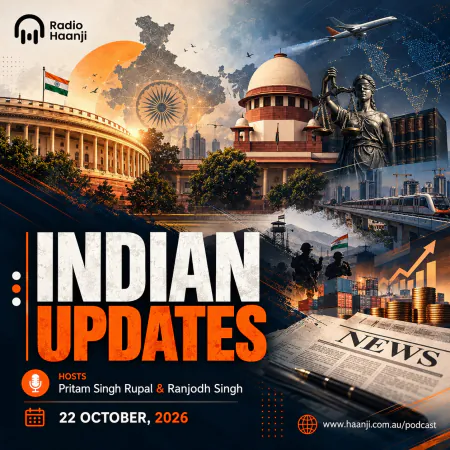
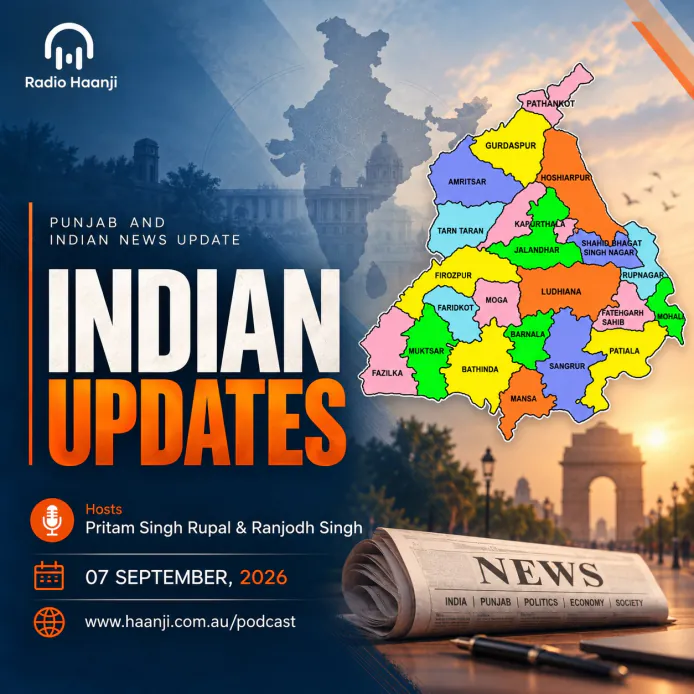
Radio Haanji unpacks Punjab's cabinet resolution against the new High Court Chief Justice appointment, the Chandigarh farmer morcha, and the IIT Mandi row.
Why Punjab Opposes the New High Court Chief Justice: Inside the Center-State Rift
A sharp constitutional and political debate has erupted across northern India after the Punjab Cabinet passed an emergency resolution challenging the central government over judicial appointments. At the centre of the dispute is the notification elevating Justice Ashwani Kumar Mishra as the Chief Justice of the Punjab and Haryana High Court, a move the state government argues bypassed mandatory constitutional consultation.
On Radio Haanji 1674 AM’s Indian Updates, host Ranjodh Singh and political commentator Pritam Singh Rupal unpacked the multi-layered implications of this confrontation. Their discussion highlighted that the dispute is not simply about an individual judicial posting, but reflects a widening rift between regional state administrations and New Delhi over jurisdictional balance, fiscal autonomy, and local representation.
Episode Snapshot
-
Show: Indian Updates
-
Broadcaster: Radio Haanji 1674 AM
-
Broadcast Date: 7 September 2026
-
Speakers: Ranjodh Singh (Host) and Pritam Singh Rupal (Commentator)
-
Platforms: Spotify | Apple Podcasts | Radio Haanji App
The Constitutional Friction Over Judicial Appointments
The central controversy originates from Article 217(1) of the Constitution of India, which stipulates that the Chief Justice of a High Court is appointed by the President after consultation with the Chief Justice of India and the Governor of the state. Because the Governor acts on the aid and advice of the state council of ministers, state governments have historically expected meaningful consultation regarding who presides over their highest appellate bench.
Finance Minister Harpal Singh Cheema and Chief Minister Bhagwant Mann announced that the state cabinet unanimously passed a resolution opposing the decision. They argued that the central government executed the notification unilaterally, undermining federalism.
On Indian Updates, Pritam Singh Rupal pointed out that while the Supreme Court Collegium recommends judicial elevations, practical administrative harmony has traditionally relied on reciprocal consensus. The state administration views this appointment through the lens of political centralisation, citing broader grievances such as ₹9,000 crore in withheld Rural Development Funds (RDF) and unpaid flood-relief allocations from the Centre. In contrast, central representatives, including Additional Solicitor General Satya Pal Jain, dismissed the state’s objections, noting that the Collegium’s recommendations had been on the table for weeks and arguing that the state government is manufacturing an artificial controversy after the process concluded.
Farmer Agitations and the Chandigarh Negotiations
Beyond the courtroom, Indian Updates explored the ongoing farmer agitation staged at the Chandigarh–Mohali border. In response to mounting pressure from protesting farm unions, a delegation of Punjab cabinet ministers and senior administrative officials held talks with union leaders to negotiate their demands.
The Punjab government indicated plans to convene a special legislative session to address river water agreements and explore debt-relief mechanisms for cooperative bank loans. However, the commentary on Radio Haanji highlighted significant fragmentation within farm union leadership:
-
Diverse Coalitions: Groups led by veteran figures like Balbir Singh Rajewal and Harinder Singh Lakhowal maintain independent tactical approaches from other major blocs such as BKU (Ekta Ugrahan).
-
Non-Political Fronts: Blocs operating under the Samyukt Kisan Morcha (Non-Political) umbrella have continued distinct demonstrations at state borders.
-
Electoral Pressures: With the 2027 Punjab Assembly elections approaching on the political horizon, political analysts suggest farm leaders are navigating a fine line between grassroots mass mobilisation and avoiding past electoral missteps.
While protests remain disciplined, internal factionalism makes unified bargaining increasingly challenging.
Institutional Scrutiny: The IIT Mandi Poster Row
The broadcast also addressed a cultural controversy at the Indian Institute of Technology (IIT) Mandi in Himachal Pradesh. An inquiry was ordered after an informational poster titled “Bhagavad Gita – The Timeless Wisdom” was displayed outside the institute’s auditorium during Janmashtami celebrations. The poster categorized society into four traditional groups, explicitly describing the role of Shudras as serving higher classes.
The display sparked widespread outrage among student bodies and civil society organisations, who condemned the language as regressive caste discrimination. IIT Mandi Director Laxmidhar Behera issued a statement distancing the administration from the display, asserting that the poster reflected an unapproved student interpretation and was not endorsed by the institute. A formal inquiry committee comprising faculty and representatives from Scheduled Castes and Other Backward Classes was constituted to investigate how the materials were cleared.
During the broadcast, Rupal noted that critics and educational commentators view incidents of this nature as symptomatic of ideological shifts within premier scientific institutions, raising concerns that traditional social stratifications are creeping into secular, technical education spaces.
Local Civil Rights Pushback in Sangrur
Closing out the current-affairs roundup, the episode reported on regional tensions in Sangrur, where opposition parties and local activist groups established the "Mohan Jeet Committee." The committee was formed in response to an incident where a protester was assaulted by officials after attempting to wave a protest flag during a chief ministerial visit. Cross-party leaders held a joint rally to demand formal criminal charges against the personnel involved, demonstrating how hyper-local civic demonstrations continue to influence broader state political dynamics.
Key Takeaways
-
Federal Tensions: The Punjab Cabinet's resolution highlights deep resistance to central appointments when formal state consultation is perceived as bypassed.
-
Dual Perspectives on Process: While the state frames the judicial appointment as unconstitutional central overreach, Union representatives maintain that established Collegium procedures were followed.
-
Farm Union Dynamics: Negotiations in Chandigarh offer temporary reprieve, but leadership splits among major unions create uneven pressure on agricultural policies.
-
Academic Governance: The inquiry at IIT Mandi highlights sensitive debates around preserving secular, constitutional equality inside India's premier technical institutes.
Tune In to the Full Broadcast
Radio Haanji 1674 AM delivers direct, in-depth commentary on political and social developments affecting Punjab, India, and the worldwide diaspora. To hear the complete Punjabi-language analysis and commentary from Ranjodh Singh and Pritam Singh Rupal, stream the episode on your preferred platform:
-
Listen on Spotify
-
Listen on Apple Podcasts
-
Stream live via the Radio Haanji Official App
4. Sources and Further Reading
-
LiveLaw / Bar and Bench (September 2026): Coverage detailing the Punjab Cabinet’s unanimous resolution objecting to the elevation of Justice Ashwani Kumar Mishra as Chief Justice of the Punjab and Haryana High Court without state consultation.
-
The Times of India / Hindustan Times (September 2026): Investigative reports covering the inquiry launched by IIT Mandi Director Laxmidhar Behera regarding the controversial Bhagavad Gita-themed caste poster displayed during Janmashtami.
-
Constitution of India (Article 217): Text on the appointment and conditions of the office of a Judge of a High Court.
Related Radio Haanji Content
5. Editorial Notes
-
Judicial Verification: The audio discussion referred to the appointment of the new Chief Justice as "Ashwini Kumar Sharma/Mishra." Fact-checking verified that the recent resolution passed by the Punjab Cabinet specifically contested the appointment of Justice Ashwani Kumar Mishra. The spelling has been clarified in the written text.
-
Paraphrasing Notice: Spoken remarks by Ranjodh Singh and Pritam Singh Rupal in Punjabi have been translated and paraphrased into analytical English to serve as a comprehensive companion piece.
-
Source Verification for IIT Mandi: Verification confirmed that Director Laxmidhar Behera set up a three-member inquiry committee after the poster controversy on 6 September 2026, stating that the poster was student-initiated and not endorsed by the institute.
Frequently Asked Questions
Why did the Punjab government oppose the appointment of the new High Court Chief Justice?
What was the outcome of the Punjab government’s meeting with protesting farmer unions in Chandigarh?
What caused the controversy surrounding the poster display at IIT Mandi?
What is the Mohan Jeet Committee formed in Sangrur?
What's Your Reaction?