



























































































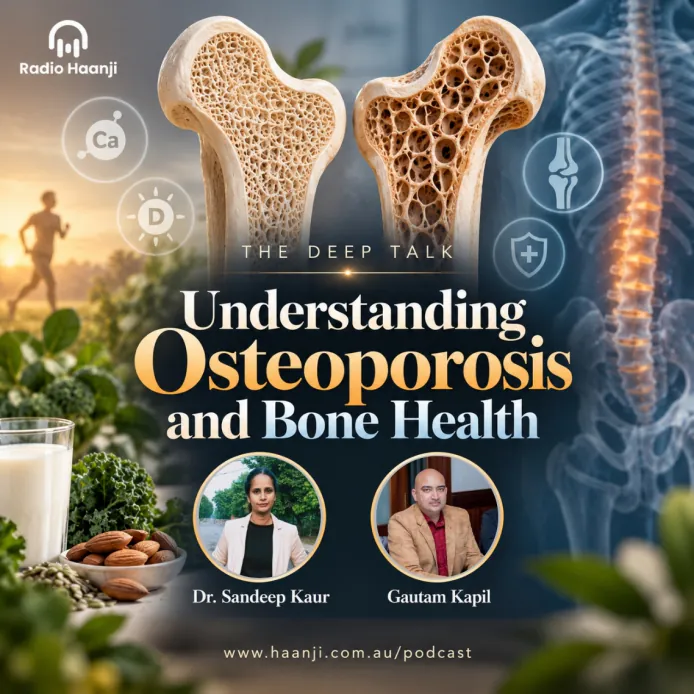
Understanding Osteoporosis and Bone Health - The Deep Talk - Dr. Sandeep Kaur - Gautam Kapil
Host:-
 Dr. Sandeep Kaur
 Gautam Kapil
Join host Gautam Kapil and expert guest Dr. Sandeep Kaur on Radio Haanji as they unpack World Osteoporosis Day, bone density science, crucial risk factors, prevention strategies, and diagnostic tests. Explore bone health in Punjabi. Tune in via haanji.com.au/podcast/the-deep-talk, download the Radio Haanji App, or listen on Spotify and Apple Podcasts. #TheDeepTalk #GautamKapil #DrSandeepKaur #RadioHaanji #ScienceInPunjabi #PunjabiPodcast #HistoryExplained
Bone tissue is a living, dynamic structure that constantly renews itself, yet millions of people remain unaware that their skeletal framework may be quietly deteriorating. On a special broadcast of the Deep Talk Show on Radio Haanji 1674 AM, host Gautam Kapil sat down with Dr. Sandeep Kaur to unpack the critical realities surrounding osteoporosis symptoms and prevention in honor of World Osteoporosis Day. The discussion cut through common misconceptions,highlighting that bone health is not merely an elderly concern, but a lifelong biological investment.
Marked internationally on October 20 and established by the International Osteoporosis Foundation in Switzerland,World Osteoporosis Day serves as a global call to action. As Dr. Kaur explained during the broadcast, our bones require active maintenance from early childhood through our senior years. Understanding how bone mineral density shifts over time allows individuals to take decisive preventative action long before a minor slip turns into a debilitating fracture.
Through a detailed clinical yet accessible discussion, Dr. Kaur and Gautam Kapil explored the biology of living bone tissue, diagnostic dual-energy X-ray absorptiometry (DEXA) scans, hormonal transitions, and targeted nutritional strategies. Whether you are managing joint discomfort, navigating post-menopausal health changes, or caring for aging parents, the insights from this episode provide a clear, evidence-based roadmap to protecting your skeletal foundation.
Where to Listen
Catch the full conversation between host Gautam Kapil and Dr. Sandeep Kaur on Radio Haanji 1674 AM's Deep Talk Show across your preferred podcast streaming platforms:
-
Listen on Spotify
-
Listen on Apple Podcasts
-
Stream live and access on-demand audio via the Radio Haanji App
Episode Highlights
The episode explored the hidden mechanics of progressive bone loss, breaking down complex skeletal biology into actionable public health knowledge. Dr. Sandeep Kaur highlighted that while bone health often enters personal conversations only after an elderly family member sustains a fall, bone building reaches its peak early in life, making proactive awareness essential across all age groups.
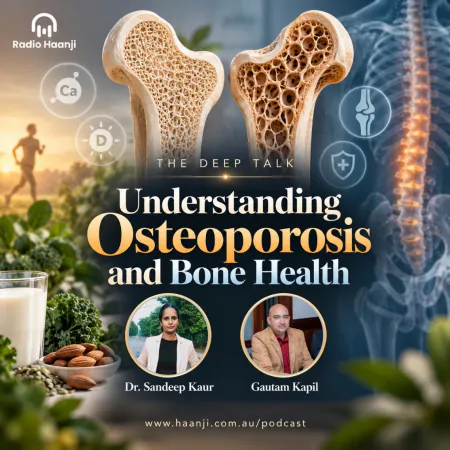
The broadcast detailed the difference between healthy internal bone architecture and porous, weakened bones,comparing microscopic bone structures to a honeycomb. Gautam Kapil and Dr. Kaur examined the role of collagen and calcium matrices, the significance of estrogen reduction during menopause, and why routine diagnostic checks such as DEXA scans are crucial before sudden physical trauma occurs.
What Is Osteoporosis and How Does It Develop?
Bones are living organs made of collagen protein networks, calcium, and phosphorus, functioning as protective shields for vital organs while enabling joint and muscle movement. Inside every healthy bone lies a complex cellular network resembling a honeycomb. Within this network, bone tissue continuously remodels itself: old bone tissue is broken down and resorbed, while new bone tissue is formed.
During adolescence and early adulthood, the human body creates new bone faster than it removes old bone. Peak bone mass is typically attained around 19 to 20 years of age, remaining relatively stable until around age 30, when the resorption rate gradually outpaces new tissue deposition. In osteoporosis, this equilibrium shifts significantly. The microscopic pores within the bone honeycomb widen, overall bone mineral density declines, and the structural integrity of the skeleton becomes brittle and fragile.
Prior to the onset of severe osteoporosis, individuals often pass through an intermediate stage known as osteopenia.Osteopenia indicates that bone density has dropped below normal levels, but has not yet reached the diagnostic threshold of full osteoporosis. Recognizing this transitional state is critical, as it provides an early window to halt further deterioration before bone porosity leads to unexpected structural fractures.
Why Is Osteoporosis Called a Silent Disease?
Osteoporosis is called a silent disease because progressive bone loss occurs without pain, visible inflammation, or noticeable physical symptoms until a weakened bone fractures. Unlike diabetes or cardiovascular conditions that frequently trigger early clinical markers, skeletal thinning develops quietly inside the body over decades.
Because bone remodeling happens at a microscopic cellular level, an individual can lose substantial bone density while feeling perfectly healthy. Gautam Kapil noted that public health discussions often prioritize visible ailments, leaving asymptomatic bone deterioration unaddressed until an emergency occurs.
The reality of this silent progression becomes apparent when a routine slip, a low-impact fall, or even a sudden forceful cough produces a fracture in the spine, hip, or wrist. In older adults, sustaining a major fragility fracture carries severe consequences, with studies showing that an estimated 40 percent of elderly individuals face life-threatening complications or fatal health declines within one year of a hip or major bone break.
What Are the Early Symptoms and Warning Signs of Osteoporosis?
Early warning signs of osteoporosis include unexplained persistent back pain caused by micro-fractures in the spine, a measurable loss of height exceeding 4 centimeters, a stooped or hunched posture, and bones that break from minor pressure or simple coughing fits.
While osteoporosis remains primarily silent, subtle physical changes often manifest as the spine and supporting joints lose structural density:
-
Persistent Back Pain: Fractures or compressed vertebrae in the spine can cause chronic back discomfort, which is frequently mistaken for routine muscular strain.
-
Measurable Height Loss: A gradual reduction in overall standing height of 4 centimeters or more occurs as vertebrae compress and shorten.
-
Postural Shifts (Kyphosis): Weakened spinal bones can cause the upper back to curve forward, creating a visible hunch or stooped appearance.
-
Low-Impact Fractures: Breaking a bone from a minor stumble, a light impact, or severe coughing indicates advanced skeletal vulnerability.
Paying close attention to these biomechanical changes allows individuals and their doctors to investigate potential bone thinning before a catastrophic fall occurs.
Who Is Most at Risk of Developing Osteoporosis?
Individuals most at risk for developing osteoporosis include women aged 40 to 45 and older due to declining estrogen levels, men over 50 to 60, people with a BMI under 19, those with a family history of fractures, and individuals with hyperthyroidism or diabetes.
Globally, osteoporosis affects approximately one in three women and one in five men over the age of 50. While both sexes face age-related skeletal thinning, women experience a much higher rate of accelerated bone loss following menopause. Estrogen is a key hormone that protects skeletal tissue by regulating inflammation and suppressing excessive bone breakdown. When estrogen drops naturally during perimenopause and menopause, bone density diminishes rapidly.
In men, bone loss usually begins later, becoming clinically prominent after age 50 or 60. Beyond age and gender,several medical and biological factors increase vulnerability:
-
Low Body Mass Index (BMI): A BMI below 19 indicates lower overall bone mass and reduced mechanical cushioning, significantly increasing fracture risks.
-
Family History: Having a mother or father who suffered from osteoporosis or hip fractures increases genetic predisposition.
-
Endocrine and Metabolic Disorders: An overactive thyroid gland (hyperthyroidism) and poorly managed diabetes indirectly impair bone remodeling and weaken the immune and muscular systems, increasing fall risks.
-
Medical Treatments: Prolonged use of cancer therapies, thyroid medications, and certain prescription drugs can accelerate bone mineral depletion.
How Is Osteoporosis Diagnosed with a Bone Mineral Density Test?
Osteoporosis is diagnosed using a Dual-Energy X-Ray Absorptiometry (DEXA) scan, a painless, low-dose X-ray examination that measures bone mineral density in high-risk areas including the spine, hips, and wrists, comparing the patient's bone mass against standard healthy young adult benchmarks.
Unlike conventional X-rays, which often reveal bone thinning only after a significant percentage of bone mass has already vanished, a DEXA scan provides precise measurements of skeletal density. The procedure involves no injections or surgical incisions; the patient simply lies still while a scanning arm passes overhead to assess bone mass in the lumbar spine, hip, and wrist joints.
The scan produces a comparative score evaluated against standard parameters:
-
Normal Bone Density: Scores that align closely with healthy adult peak bone density ranges.
-
Osteopenia Range: Scores showing moderate bone depletion (typically measured up to -2.5 standard deviations), indicating elevated vigilance and intervention are required.
-
Osteoporosis Range: Scores falling at or below -2.5 standard deviations, confirming a clinical diagnosis of osteoporosis that requires medical treatment and lifestyle management.
In Australia, DEXA scans are frequently subsidized under the Medicare Benefits Schedule (MBS), covering 75% to 80% of radiology costs for qualifying patients, particularly those aged 70 and older or those referred by a general practitioner or specialist due to pre-existing conditions or prior fractures. In India, accessible private and hospital radiology clinics offer these diagnostic scans at affordable rates.
How Can You Prevent Bone Loss Naturally Through Daily Habits?
Preventing bone loss naturally requires regular weight-bearing exercises to stimulate bone remodeling, maintaining a balanced diet rich in calcium and vitamin D, obtaining safe sunlight exposure, quitting smoking, and moderating alcohol consumption.
Skeletal strength operates much like a biological bank account: the density built during childhood, adolescence, and early adulthood serves as a vital reserve during later years. However, individuals of any age can strengthen bone tissue and protect against mobility loss by integrating healthy lifestyle habits:
-
Targeted Physical Activity: Regular walking, jogging, and controlled strength-training exercises create mechanical tension that stimulates living bone cells to deposit new mineral matrix. For individuals already diagnosed with osteoporosis, low-impact movements designed by a physiotherapist protect joints while improving balance.
-
Nutritional Support: Calcium from dairy products (milk, yogurt, cheese), lactose-free alternatives, fortified products, fish (such as salmon and mackerel), eggs, and leafy greens maintains the primary mineral scaffold of the skeleton. Over-the-counter calcium supplements should always be reviewed with a physician to avoid improper intake.
-
Safe Vitamin D and Sunlight: Vitamin D is critical for intestinal calcium absorption. Because dietary sources are limited, brief early-morning or late-afternoon sun exposure without sunscreen (for 10 to 15 minutes) stimulates natural vitamin D synthesis. For those with deficiencies, fat-soluble vitamin D supplements taken alongside healthy meals containing dietary fats improve absorption.
-
Eliminating Toxins: Smoking and excessive alcohol intake accelerate bone resorption, weaken the immune system, and directly damage osteoblast function.
-
Home Fall Prevention: For elderly adults, non-slip floor tiles, sturdy stair railings, clear walking corridors, and proper lighting substantially lower the risk of domestic falls and sudden fractures.
Key Takeaways
-
Osteoporosis is a progressive skeletal disease characterized by widened microscopic pores in living bone tissue and reduced bone mineral density.
-
Peak bone mass is developed by age 19 to 20, remains stable until roughly age 30, and then gradually declines as resorption outpaces bone deposition.
-
Known as a silent disease, osteoporosis typically progresses without pain until a sudden fracture occurs in the spine, hip, or wrist.
-
Approximately one in three women and one in five men over age 50 experience osteoporosis, with women facing accelerated risk after menopause due to declining estrogen.
-
A Dual-Energy X-Ray Absorptiometry (DEXA) scan is the gold-standard diagnostic tool for quantifying bone density and detecting osteopenia before a fracture happens.
-
Proactive prevention requires weight-bearing physical movement, safe sunlight exposure for vitamin D synthesis,balanced calcium-rich nutrition, and removing home fall hazards.
Frequently Asked Questions
What is osteoporosis according to Dr. Sandeep Kaur?
When does human bone mass typically reach its peak?
Why is osteoporosis called a silent disease?
How can individuals prevent bone density loss?
What's Your Reaction?