









































































03 March 2026 Indian Updates | Bengal Election, Punjab Crisis | Preetam Singh Rupal | Radio Haanji
Host:-
 Pritam Singh Rupal
 Ranjodh Singh
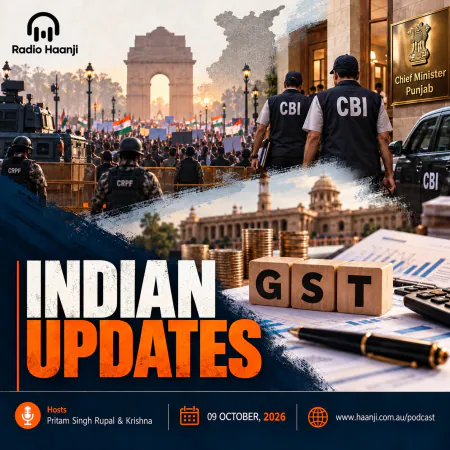
Preetam Singh Rupal analyses Bengal polls, Hola Mohalla, Haryana budget, Gurdaspur encounter court orders & Punjab helpline for stranded Punjabis — Radio Haanji 1674 AM.
Indian Updates — Tuesday, 3 March 2026 | Bengal's Electoral Battlefield, Hola Mohalla, Haryana's Budget and Punjab's Crisis Response — Analysis on Radio Haanji 1674 AM
Today's edition of Indian Updates on Radio Haanji 1674 AM brings together five stories that, on the surface, look entirely unconnected — but which, taken together, paint a revealing picture of the forces that are defining India's political and social landscape in early 2026. Journalist Preetam Singh Rupal, who covers Indian politics and community affairs closely, unpacks each of them with the context and consequence they deserve. This is not a bulletin. This is Indian current affairs analysis — for the community that cannot afford to miss what is happening back home.
West Bengal 2026 — Shah's Parivartan Yatra and the Battle That Will Define Indian Politics This Year
With West Bengal assembly elections less than six months away, Union Home Minister Amit Shah has launched the BJP's most intensive statewide electoral campaign in the state's history — a sprawling Parivartan Yatra covering more than 5,000 kilometres, 63 major rallies and 282 smaller gatherings, culminating in a grand Modi rally at Kolkata's Brigade Parade Ground. Shah's visit to South 24 Parganas and multiple other districts this week signals that the BJP is treating Bengal 2026 not as an opportunity but as an obligation — a mission it believes it is four to five percentage points away from delivering.
The political arithmetic Shah cited is worth understanding carefully. The BJP's trajectory in Bengal has been steep: from 2 Lok Sabha seats in 2014 to 18 in 2019, from 3 assembly seats in 2016 to 77 in 2021, and 12 seats with 39 per cent vote share in the 2024 general election. Shah claims the party is leading in 143 assembly constituencies with over 40 per cent vote share — a foundation from which, with the right swing, a majority becomes arithmetically achievable. He has been equally explicit about what he believes will drive that swing: infiltration, corruption and the alleged dynastic ambitions of Trinamool Congress.
The "Bhaipo" barb — a reference to TMC national general secretary Abhishek Banerjee, CM Mamata Banerjee's nephew — has become the centrepiece of the BJP's narrative. Shah is framing the 2026 election not as BJP versus TMC but as the people of Bengal versus a family that is treating the state as a private inheritance. Whether that framing resonates will depend on whether voters conclude that their anxiety about corruption and infiltration outweighs their reservations about the BJP's own record on governance in the states it controls.
Mamata Banerjee's counter-positioning has been equally sharp. The CM has accused Shah of weaponising religion for electoral gain — citing his attack over the construction of a mosque modelled on Babri Masjid by a recently expelled TMC MLA — while simultaneously inaugurating temples, which Shah mocks as political opportunism. Bengal 2026 is going to be loud, divisive, and consequential. For the Indian diaspora watching from Australia, this is the election that will either confirm or comprehensively shatter the BJP's ambition to transform every major Indian state into saffron territory.
Hola Mohalla and the Question of Faith in Modern Punjab — Dhami Speaks at a Loaded Moment
Hola Mohalla, the great Sikh festival of martial spirit and community solidarity established by Guru Gobind Singh at Anandpur Sahib in 1701, begins its three-day celebration on Wednesday, 4 March 2026. The Punjab government and the SGPC have worked this year to ensure the event remains what it was always intended to be — a spiritual and cultural gathering, kept deliberately free of the partisan political speeches that have increasingly crept into its periphery in recent years, and which were formally banned by the Sikh high priests through a religious edict in 2018.
Against this backdrop, SGPC President Harjinder Singh Dhami — the five-time president of the Shiromani Gurdwara Parbandhak Committee — has issued a statement on the question of religious conversion in Punjab that has drawn fresh attention. Dhami's position, consistent with the SGPC's longstanding institutional concern, is that sustained missionary activity targeting economically vulnerable Sikh families represents a threat that requires both community mobilisation and legal protection. The SGPC has previously campaigned for a Freedom of Religion Act in Punjab — a law that would criminalise coercive or deceptive conversion methods while leaving sincere religious choice undisturbed.
The question of religious conversion is one of the most sensitive and politically volatile in modern Punjab, touching as it does on the community's sense of identity, its history of sacrifice, and its anxieties about the erosion of Sikh numbers and culture. That it is being raised again at the beginning of Hola Mohalla — the festival most deeply associated with Sikh solidarity and martial readiness — is not accidental. For Punjabis in Australia, particularly those with family in rural Punjab where missionary activity is most concentrated, this is a story with direct resonance. The question of how to protect faith without compromising civil liberties is one that no government or religious institution has fully resolved, and Dhami's statement is best understood as the latest intervention in a debate that has no clean resolution.
Haryana Budget 2026-27 — Saini's Rs 2.23 Lakh Crore Vision and What It Means for the Region
Haryana Chief Minister Nayab Singh Saini presented his second full budget as Finance Minister on Monday, tabling a total outlay of Rs 2,23,658.17 crore for 2026-27 — a 10.28 per cent increase over the revised estimate of Rs 2,02,816.66 crore for 2025-26. It is a budget that carries the unmistakable fingerprints of a government that won a third consecutive term against expectation and now faces the task of delivering on a 217-promise manifesto while managing a state whose fiscal deficit is projected at Rs 40,293.17 crore, or 2.65 per cent of GDP.
The headline announcements tell their own story about the government's priorities. A dedicated power distribution company for the agriculture sector — Haryana Agri DISCOM — is the standout structural reform, designed to give farmers more reliable electricity supply independent of urban and industrial demand. A 20 per cent reservation in Haryana Police recruitment for Agniveers returning from the Indian Army signals the state's attempt to address the employment anxieties that the national Agnipath scheme generated when it was launched. A Rs 100 crore Green Climate Resilience Fund and World Bank support totalling Rs 2,716 crore for the Haryana Clean Air Project reflect the growing pressure on state governments to demonstrate environmental commitment. And the establishment of an Anti-Terrorist Squad — with provisions for women commandos — is a law enforcement signal that carries particular weight in a state that shares a long border with Punjab and has its own exposure to cross-border security dynamics.
For the Punjabi-speaking and Haryanvi communities in Australia, the Haryana budget matters most through its agriculture provisions. Additional incentives for farmers who shift away from paddy cultivation, expanded water access and the promise of the Yamuna cleanup mission speak to the rural economy that tens of thousands of Australian families still have deep financial and emotional ties to. Whether the numbers actually reach the people they are intended to reach is a question that every Haryana budget has raised and rarely answered fully.
The Gurdaspur Encounter and the Court That Is Asking the Right Questions
The death of 19-year-old Ranjit Singh in a police encounter near Gurdaspur on 26 February has evolved from a local law enforcement matter into one of the most politically charged accountability questions in Punjab today. A court in Gurdaspur has now issued orders that go to the heart of what happened — directing all police officials involved in the encounter, including the SSP Gurdaspur, the SHOs of Dorangla, Behrmapur and Puranashala, and CIA Incharge Gurmeet Singh, to provide their phone numbers to the investigating officer and telecom companies. The companies have been directed to preserve call data records for 20 to 28 February. The court has also ordered GPS location data to be preserved, CCTV footage near the incident site to be secured, and a three-member medical board to be constituted to examine whether CIA Incharge Gurmeet Singh's gunshot wound was genuine or self-inflicted.
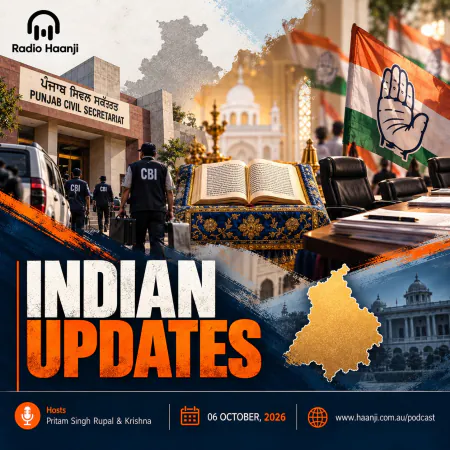
The background to this case is important. On 22 February, Punjab Police ASI Gurnam Singh and Home Guard Ashok Kumar were found dead with gunshot wounds at a checkpost in Adhian village, approximately two kilometres from the Pakistan border. Police subsequently arrested three young men — Ranjit Singh (19), Inderjit Singh (21) and Dilawar Singh (19) — claiming they had acted at the behest of Pakistan's ISI. Ranjit was shot dead in what police described as an encounter after he allegedly escaped custody and opened fire. His family flatly disputes this account. His mother, Sukhjinder Kaur, says her son was picked up from home for questioning and was subsequently shot. The family has refused to accept his body. His uncle has demanded a CBI probe. Congress MP Sukhjinder Singh Randhawa has written to Home Minister Amit Shah, and multiple political parties across the spectrum have called for an independent investigation.
This is a story with layers that go well beyond any single encounter. Near the Pakistan border, in a district with a history of cross-border infiltration and ISI-linked activity, the line between national security justification and procedural opacity can become dangerously thin. The court's decision to order preservation of phone call records, GPS data and CCTV footage before they can be altered or deleted is precisely the kind of judicial intervention that accountability requires. Whether the investigation that follows will be conducted with genuine independence, or whether the outcome will be shaped by the political pressures pulling in multiple directions, remains to be seen.
Punjab's Helpline — A Government That Picked Up the Phone When It Mattered
When Chief Minister Bhagwant Singh Mann — who is currently receiving medical treatment — established a 24x7 helpline and control room for Punjabis stranded in the Middle East war zone, it was a straightforward act of governmental responsibility. But in the context of a crisis this scale, the simplest acts carry the greatest weight.
Punjab has an enormous diaspora in the Gulf. Tens of thousands of Punjabis work in the UAE, Qatar, Kuwait, Saudi Arabia and Bahrain — in construction, hospitality, healthcare and domestic services. When Operation Epic Fury began and flights were suspended, airports closed and roads became dangerous, these families were suddenly stranded without clear options and without a government contact point they could call. Mann's announcement on Monday provided that contact point: 0172-2260042, 0172-2260043, and a WhatsApp number at +91 94787 79112 for immediate support.
NRI Affairs Minister Dr Ravjot Singh confirmed the government was receiving a high volume of calls, particularly from Punjabi tourists stranded in Central Asia and the Gulf. The minister also urged the central government to facilitate evacuation promptly, a call that echoes the position taken by Lok Sabha Speaker Kultar Singh Sandhwan the previous day. For families in Australia with relatives working in the Gulf, this is the number to save and to share. The fact that Punjab's government moved quickly to establish this contact — in a week when New Delhi was still trying to calibrate its diplomatic response — is a moment worth acknowledging.
Why Indian Updates on Radio Haanji Is Essential Listening for the Indian Diaspora
For Punjabi and Indian families settled in Australia, keeping track of India's moving parts — its state elections, its religious festivals, its budget announcements, its court orders, its border encounters — is both a priority and a genuine challenge. The sheer volume of Indian news makes it difficult to know what is significant and what is noise. That is precisely the problem that Indian Updates on Radio Haanji 1674 AM is built to solve.
As Melbourne's premier Indian community radio station and one of the best Punjabi podcasts in Australia for current affairs, Radio Haanji brings you journalism that goes below the headline — analysis that gives you the context to understand, not just the event to react to. The Indian current affairs podcast that knows what matters to the NRI community is not the one with the most stories. It is the one that picks the right stories and tells them with depth and honesty.
Listen on Spotify
Listen on Apple Podcasts
Download the Radio Haanji App on iPhone and iPad
Download the Radio Haanji App on Android
What's Your Reaction?