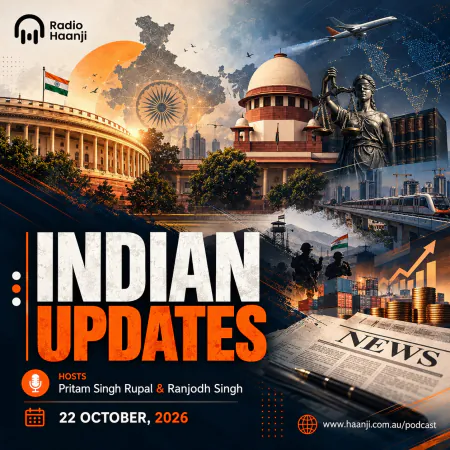







































































Pritam Singh Rupal breaks down Punjab's LPG shortage and what it means for millions of families. Trusted India analysis on Radio Haanji.
Indian Updates - 13 March 2026 - LPG Crisis, Punjab Politics and Investment - Radio Haanji
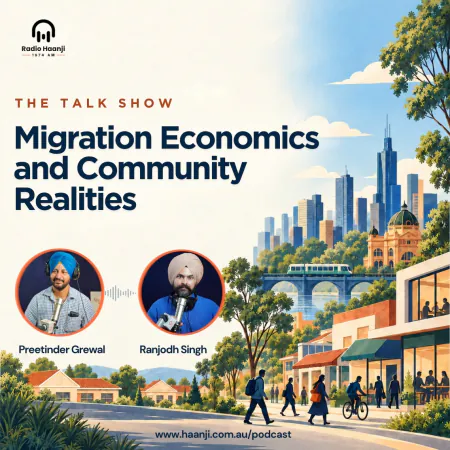
Preetam Singh Rupal, a respected India-based journalist, joined host Ranjodh Singh on Radio Haanji 1674 AM this Friday for Indian Updates - a programme that does not stop at headlines. Today's episode took on three stories that are moving through Punjab and India's political economy simultaneously: a domestic LPG shortage that is hitting ordinary households hard, a sharp statement from Congress leader Partap Singh Bajwa, and the launch of the Partisheel Punjab Niveshak Samelan. Each one has layers worth unpacking.
Punjab's LPG Crisis - When the Gas Runs Out, the Silence Gets Loud
The news that gas agencies across Punjab have shut down online LPG booking and replaced it with long physical queues should not be treated as a logistics story. It is a governance story. When a basic household commodity becomes inaccessible enough to drive people into lines in front of distribution offices, something has gone wrong further up the chain - and the question is whether that failure is administrative, political or structural.
The shortage points to a gap between supply commitments and actual distribution capacity. LPG availability in India has long been tied to government subsidy policy, import volumes, and the efficiency of the last-mile delivery network. When any part of that chain tightens - whether due to global energy prices, import disruption, or distribution mismanagement - it is the domestic kitchen that notices first. In Punjab, where LPG dependency is high across both urban and rural households, the impact is immediate and visible.
For the Indian community in Australia watching this, the practical question is a familiar one. Families back home navigate these shortages with workarounds - relatives standing in queues, informal network bookings, switching fuels temporarily. The systems that were supposed to modernise and simplify access to cooking gas have, in this instance, reverted to something far more inconvenient. Preetam Singh Rupal's analysis today placed this in the context of ongoing questions about state-level energy management and the accountability gaps that allow such shortages to develop without early warning.
Partap Singh Bajwa's Statement - Reading Between the Lines in Punjab's Opposition Politics
Congress leader Partap Singh Bajwa made a statement that Radio Haanji covered today as part of the ongoing conversation around Punjab's political landscape. Bajwa has been one of the more vocal opposition voices in the state, and his public positions tend to signal where the Congress party in Punjab is trying to place itself relative to the AAP government.
Without the full text of the statement, the analytical frame matters more than the specific words. Punjab's opposition politics in 2026 operates in a compressed space. The AAP government remains the dominant force at the state level, and the Congress, despite its history in Punjab, has struggled to rebuild a coherent identity since 2022. Statements from senior figures like Bajwa function partly as positioning - for internal party audiences, for media cycles, and for the community that Indian Updates reaches in Australia.
For NRIs following Punjab politics from Melbourne or Sydney, the significance is real. Many in the Punjabi diaspora have direct stakes in the state's political direction - family land, business interests, electoral connections through relatives. Indian Updates provides the interpretive layer that raw news does not. What is Bajwa's statement about? What is the political calculation behind it? What does it mean for the broader opposition's chances of making ground before the next cycle? These are the questions Preetam Singh Rupal brought to today's episode.
Partisheel Punjab Niveshak Samelan - What the Investment Summit Is Actually Trying to Do
The Partisheel Punjab Niveshak Samelan gets underway today, and it is worth being precise about what these investment summits represent in the current Indian political economy. Punjab has been holding investment gatherings as part of a broader attempt by the AAP government to reframe the state's economic narrative - shifting the conversation from agricultural distress and drug-related challenges toward growth, jobs and private capital.
Investment summits at the state level in India are part political event, part business forum, and part aspirational signalling. The numbers announced in MoUs and letters of intent during these events tend to be the opening bid, not the final score. How much of the committed investment actually materialises over the following years, and in which sectors, tells a more accurate story than the headline figure from day one.
The samelan's launch today puts it directly in the news cycle that Indian Updates is covering, and for the Indian community in Australia, there is a specific angle worth noting. Several in the Punjabi diaspora have investment interest in Punjab - manufacturing, real estate, agriculture-related processing, technology. Events like this are, at minimum, a window into where the state government is directing its economic pitch. Preetam Singh Rupal brought the kind of analytical rigour today that separates Indian Updates from a straight news read - the context of how previous Punjab investment summits have performed, and what the current administration needs this one to deliver.
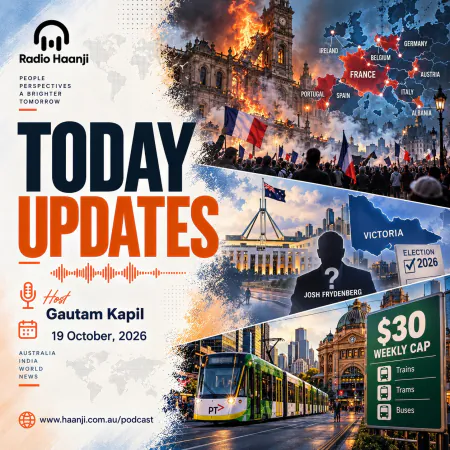
If you want to hear how Indian Updates has approached earlier India stories this year, the Radio Haanji podcast archivehas previous episodes available for free. Shows like Today Updates and The Insight Report cover complementary ground if you are following multiple threads across Indian and global affairs.
Why Indian Updates Is Worth Making Time For Every Weekday
There is no shortage of India coverage online. The problem is almost the opposite - too many sources, too little context, and almost no programming made specifically for Indians who have built their lives in Australia but remain deeply connected to what happens back home.
Indian Updates on Radio Haanji fills a specific gap. It is not a news feed. It is closer to the kind of conversation you would have with a knowledgeable friend who follows Indian politics and economics closely and can tell you not just what happened, but why it matters and what it is likely to lead to. That voice, five days a week, free, on a station that understands its audience, is harder to find than it should be.
For the Indian community in Melbourne especially, the show works because the journalism is credible. Guests like Preetam Singh Rupal bring genuine expertise - they are not reading wire copy with added commentary. The analysis comes from people who are embedded in the stories they cover. The Indian current affairs podcast space in Australia has grown considerably, but Indian Updates remains the programme that takes its audience seriously as a politically and civically engaged community.
Listen to Indian Updates - Free, Every Weekday on Radio Haanji
Every episode of Indian Updates is free to stream the same day it airs.
Monday's episode will bring the next set of stories from India. If today's analysis left you with more questions than answers - which is often the sign of a genuinely complex story - tune in on Radio Haanji 1674 AM and hear what Preetam Singh Rupal and the team make of where things stand.
Radio Haanji 1674 AM | Punjabi Podcast | Broadcasting from Melbourne, Australia
Listen free at haanji.com.au | Available on Spotify & Apple Podcasts
Serving the Punjabi community across Melbourne · Sydney · Brisbane · Australia · Worldwide
What's Your Reaction?