






































































2 March 2026 Indian Updates | India Iran Crisis Analysis | Preetam Singh Rupal | Punjabi Podcast | Radio Haanji
Host:-
 Pritam Singh Rupal
 Ranjodh Singh
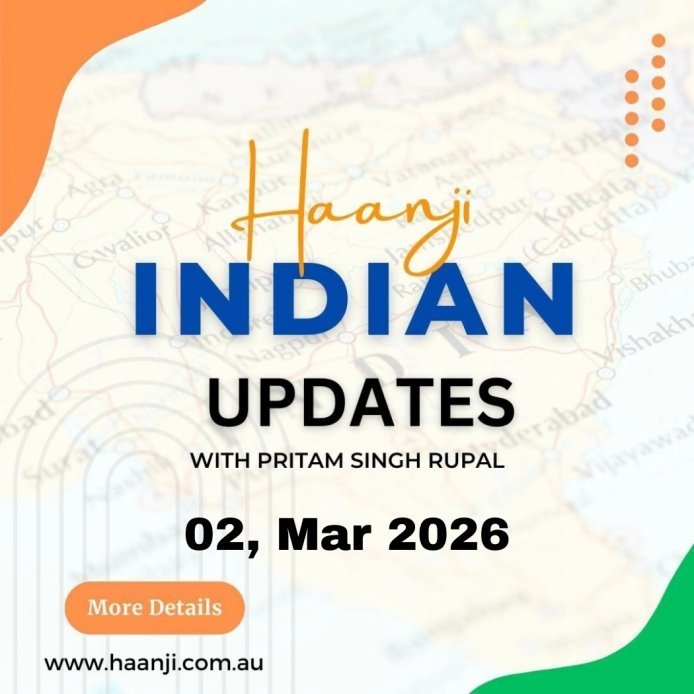
Preetam Singh Rupal analyses Modi's silence on Khamenei, protests across India, rising petrol prices & Ajit Pawar crash probe — Indian Updates, Radio Haanji 1674 AM.
Indian Updates — 2 March 2026 | India's Diplomatic Crisis, Khamenei's Killing and the Ajit Pawar Probe — Analysis on Radio Haanji 1674 AM
India woke up on Sunday to one of the most consequential moments in its post-independence diplomatic history — and today on Indian Updates, respected India-based journalist Preetam Singh Rupal takes the Punjabi and Indian community through what it all means. Broadcasting every weekday on Radio Haanji 1674 AM, Indian Updates is the programme that goes beyond the headlines, asking the harder questions that news bulletins rarely have time for.
The Weight of Silence — Modi Government's Non-Response to Khamenei's Assassination
There are moments in a nation's history when silence itself becomes a statement of foreign policy. The killing of Iranian Supreme Leader Ayatollah Ali Khamenei in joint US-Israel military strikes on Saturday is one of those moments — and India's studied silence in its aftermath has become as politically significant as anything the government might have actually said.
What makes this silence particularly difficult to defend is the context surrounding it. Prime Minister Narendra Modi completed a two-day state visit to Israel on February 25 and 26, during which he addressed the Knesset and described India and Israel as "Fatherland" and "Motherland" respectively. Just two days after Modi's departure from Tel Aviv, Operation Epic Fury began. That timing — so precise, so impossible to ignore — has handed the opposition a narrative that the government is finding it extraordinarily difficult to counter.
India has long maintained what it calls strategic autonomy — a tradition rooted in the Nehruvian foreign policy of non-alignment and calibrated independence from global power blocs. That tradition has allowed India to simultaneously court Israel, maintain working relations with Iran, and preserve deep economic ties across the Gulf. But strategic autonomy, by its very nature, requires the occasional willingness to publicly disagree with allies. When the US and Israel struck Iran — a country that has been a long-standing partner to India on Afghanistan, on the Chabahar Port project, and on the Kashmir question at the OIC — the government's failure to issue any condolence or public statement on Khamenei's death has drawn condemnation from across the political spectrum.
Congress president Mallikarjun Kharge, Congress leader Pawan Khera, CPI(M) general secretary MA Baby, and J&K Chief Minister Omar Abdullah are among the voices who have questioned the government's position. Khera described it as a betrayal of India's foreign policy values and a sign that the country has been reduced to silence on matters that directly affect its interests. Whether one agrees with that characterisation or not, the strategic stakes are real: India's investment in the Chabahar Port — a critical corridor bypassing Pakistan to access Afghanistan and Central Asia — now hangs in an uncertain regional climate. The question is not just moral. It is deeply practical.
A Nation Protests — From Kashmir to Karnataka, Grief Over Khamenei Spills Into the Streets
While New Delhi maintained its careful quiet, ordinary Indians did not. From Lal Chowk in Srinagar to Lucknow's Bara Imambara, from Bihar to Karnataka's Chikkaballapur district — where Khamenei himself once visited in 1986 — India's Shia Muslim community poured into the streets in one of the largest expressions of communal grief seen in years.
In Kashmir, where approximately fifteen lakh Shia Muslims live, protests erupted across Budgam, Bandipora, Anantnag, Pulwama and at Lal Chowk itself. J&K Chief Minister Omar Abdullah made an appeal for calm and confirmed his government was in coordination with the Ministry of External Affairs to ensure the safety of Kashmiri students currently in Iran. The Mirwaiz of Kashmir, Umar Farooq, described Khamenei's killing as brutal and said the people of Jammu and Kashmir collectively condemn the ongoing aggression against Iran.
In Uttar Pradesh's Lucknow, scores gathered near Bara Imambara with photographs of Khamenei. In Delhi, Jharkhand, Bihar and Telangana, similar scenes unfolded. Several Muslim organisations announced multi-day mourning periods, with protests also scheduled for Monday. In Ajmer, the Shia community declared a three-day mourning and suspended all public celebrations. In Karnataka, shops closed voluntarily in Alipura — the village Khamenei visited forty years ago still remembered his presence.
The scale and geographic spread of these protests tells its own story about how deeply the killing has resonated within India's Muslim communities. For the Modi government, these protests create a domestic political pressure that will be difficult to manage alongside its decision to maintain silence at the diplomatic level. It is a tension that Preetam Singh Rupal examines at length in today's episode — the gap between what is happening in India's streets and what is being communicated from India's foreign ministry.
India's Petrol Price Anxiety — The Gulf Crisis Hits the Indian Household
Every geopolitical crisis eventually finds its way to the kitchen table — and the Iran-US war is no exception for Indian families. With global crude oil prices having surged sharply following Operation Epic Fury, and with the Strait of Hormuz — through which roughly a fifth of the world's daily oil supply flows — now under active military threat, economists are warning that Indian petrol and diesel prices could rise significantly in the weeks ahead.
India imports approximately 85 per cent of its crude oil requirements. While India does not import heavily from Iran specifically, it is deeply exposed to global benchmark price movements. Every ten dollar increase in international crude prices translates to a meaningful increase in domestic fuel costs — and with analysts now talking about crude prices potentially approaching and exceeding $100 per barrel, the pressure on Indian households could be substantial. For the Indian diaspora in Australia watching events in both countries simultaneously, this is a moment of double concern: petrol prices here and at home are both in motion, driven by the same conflict.
The government's immediate challenge is twofold. It must manage the economic fallout while simultaneously navigating the diplomatic damage of its silence. Whether it chooses to speak before markets force its hand, or continues its current approach in the hope that the conflict resolves quickly, remains to be seen. Either way, the ordinary Indian family will bear the cost long before any diplomatic statement is issued.
The Ajit Pawar Crash — Jay Pawar Demands Truth as AAIB Report Falls Short
One month after one of the most shocking political tragedies in Maharashtra's recent history, the family of the late Deputy Chief Minister Ajit Pawar is demanding answers that the government's own investigation bureau appears unable to provide — at least not yet.
The Aircraft Accident Investigation Bureau released its preliminary report on Saturday into the January 28 crash at Baramati Airport, in which Pawar, two pilots, a security officer and a flight attendant were killed when their Learjet 45XR came down short of the runway in low visibility and poor conditions. The report confirms what many had feared: the airport was an uncontrolled airfield operating without an Instrument Landing System, without certified meteorological facilities, without a fire unit on standby, and with runway markings that had not been re-carpeted since March 2016. Visibility at the time of landing was reported at three kilometres — well below the five-kilometre minimum required for Visual Flight Rules operations. The cockpit voice recorder captured the words "Oh Sh**t" from the crew in the moments before impact.
Jay Pawar, the son of the late Ajit Pawar, responded to the report on Instagram with barely concealed frustration. He stated that reading the preliminary report caused him deep regret and pain, and that the people of Maharashtra and the families of all five victims deserve not merely formal information but truth, transparency and comprehensive answers. He also raised questions about the Directorate General of Civil Aviation's oversight of VSR Ventures, the charter operator, warning that the problems identified may affect more than just the aircraft involved in this crash.
The AAIB has been clear that the preliminary report assigns no blame and that its purpose is accident prevention. The investigation continues, with flight data and cockpit voice recordings still being analysed with assistance from Honeywell and the United States' NTSB. But for Jay Pawar and for the public watching this case, the preliminary findings have raised more questions than they have answered. How does a VIP government flight end up on an uncontrolled airfield without the infrastructure to safely handle it? Who cleared that airfield for operations on a foggy morning? And is anyone in the civil aviation ecosystem going to be held accountable?
Why Indian Updates on Radio Haanji Is Essential Listening for the Indian Diaspora
For Indians living in Australia, staying connected to what is unfolding back home is both a deeply personal priority and an increasingly complex challenge. The news cycle is relentless. Multiple narratives compete for attention. And it is not always easy to know who is providing context and who is simply generating noise.
Indian Updates on Radio Haanji 1674 AM exists precisely to resolve that problem. As Melbourne's most trusted Indian community radio station and one of Australia's best Punjabi podcasts, Radio Haanji brings in voices from India's journalism community — people who have spent decades covering politics, diplomacy, courts and communities — to give the diaspora a perspective that is grounded, informed and genuinely analytical. This is the Indian current affairs podcast for NRIs who want to understand what is happening, not just be told that it happened.
For the tens of thousands of Punjabi and Indian families who have built their lives in Australia without losing their roots in India, Indian Updates is a daily anchor. Listen free, every weekday morning, and stay connected to the country you came from with the depth and clarity it deserves.
Listen to Indian Updates — Free, Every Weekday on Radio Haanji
Catch every episode of Indian Updates on your preferred platform. Radio Haanji 1674 AM makes it easy to listen live or on demand, wherever you are in Australia or around the world.
Listen on Spotify: https://open.spotify.com/show/5fhykpM6TPzerC2Yr2J1eQ
Listen on Apple Podcasts: https://podcasts.apple.com/us/podcast/radio-haanji-podcast/id1687047958
Download the Radio Haanji App on iPhone and iPad: https://apps.apple.com/in/app/radio-haanji/id1439919649
Download the Radio Haanji App on Android: https://play.google.com/store/apps/details?id=callstem.radio.haanji&hl=en_IN
Join Preetam Singh Rupal and the Indian Updates team again tomorrow morning on Radio Haanji 1674 AM — haanji.com.au — for the next edition of India's most trusted daily analysis for the diaspora.
Radio Haanji 1674 AM | Punjabi Podcast | Broadcasting from Melbourne, Australia
Listen free at haanji.com.au | Available on Spotify & Apple Podcasts
Serving the Punjabi community across Melbourne · Sydney · Brisbane · Australia · Worldwide
What's Your Reaction?