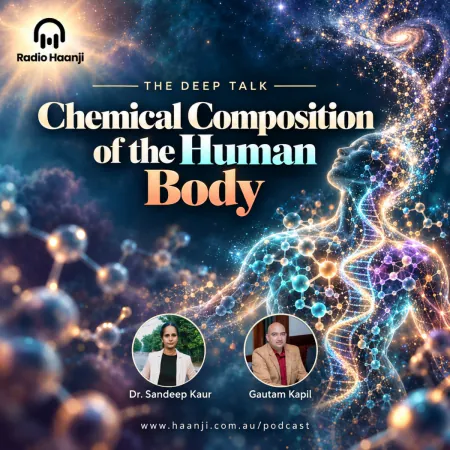





























































































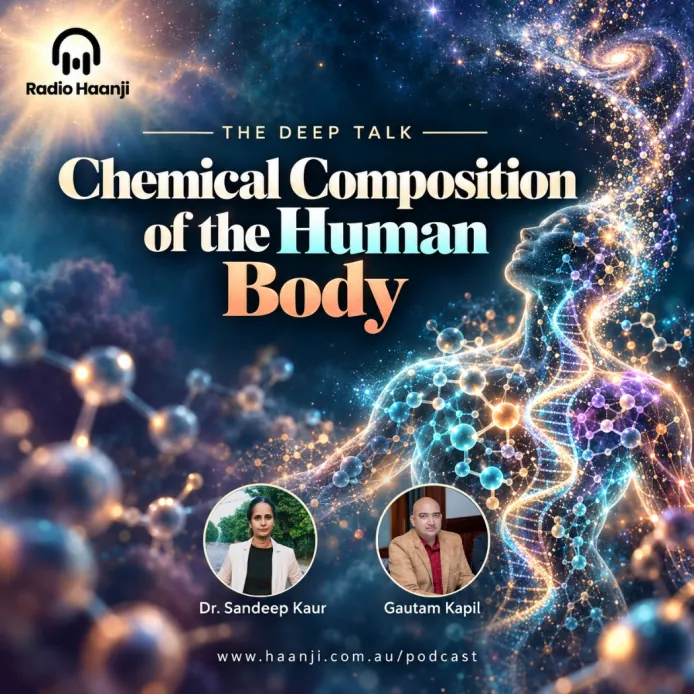
Chemical Composition of the Human Body - The Deep Talk - Dr. Sandeep Kaur - Gautam Kapil
Host:-
 Dr. Sandeep Kaur
 Gautam Kapil
Host Gautam Kapil and guest Dr. Sandeep Kaur unpack the physical structures of human life on The Deep Talk. Explore the chemical elements, DNA mechanics, and cosmic origins shaping human anatomy.
Every living person walking the earth represents a staggering feat of natural chemistry, carrying billions of atoms forged across billions of years. When we step onto a scale or look in the mirror, we see tissue, bone, and skin, yet under the lens of biochemistry, our physical presence breaks down into an intricate molecular architecture. Understanding the chemical composition of the human body reveals not only how our daily biology functions, but also how closely tied our physical makeup is to the wider planet and the cosmos.
On an episode of The Deep Talk Show, broadcast on Radio Haanji 1674 AM, host Gautam Kapil sat down with guest Dr. Sandeep Kaur to unpack the physical structures that assemble human life. Their discussion bridged classical concepts of natural elements with exact biochemical realities, exploring how everything from common soil compounds to atomic fusion inside ancient stars shapes human physiology.
Tracing our anatomy down to basic elements demystifies the biological machinery working constantly beneath our awareness. Whether examining water ratios, genetic strands, or cellular reproduction, looking at the human framework reveals an elegant, self-sustaining chemistry shared with all living systems.
Where to Listen
Catch the complete discussion on human body composition, genetic blueprints, and cosmic origins on The Deep Talk Show hosted by Gautam Kapil with Dr. Sandeep Kaur. Stream the episode across your preferred platform or download the official app:
-
Spotify: Listen on Spotify
-
Apple Podcasts: Listen on Apple Podcasts
-
Radio Haanji Official App: Download the App
Episode Highlights
-
Elemental Foundations of Life: A scientific examination of how the physical body transitions from fundamental chemical building blocks into working cells, muscles, and organs.
-
The Four Major Elements: A breakdown of the primary elements—oxygen, carbon, hydrogen, and nitrogen—that form roughly 96 percent of human body mass.
-
DNA and RNA Mechanics: The functional differences between our master genetic blueprint and the cellular messengers that direct protein production.
-
The Cosmic Connection: An explanation of stellar nucleosynthesis, tracing how elements formed during the Big Bang and within dying stars constitute our physical anatomy today.
What Elements Make Up the Human Body?
The chemical composition of the human body is dominated by four primary elements: oxygen, carbon, hydrogen, and nitrogen. Together, these four basic components make up approximately 96 percent of total human body mass, serving as the foundational building blocks for water, proteins, carbohydrates, amino acids, and nucleic structures.
For an average adult weighing approximately 80 kilograms, the breakdown of these major elements is distinct:
-
Oxygen: Accounts for roughly 43 kilograms, largely due to our high cellular water content.
-
Carbon: Represents around 16 kilograms, providing the structural backbone for organic molecules.
-
Hydrogen: Makes up about 7 kilograms, bonding extensively with oxygen and carbon.
-
Nitrogen: Contributes roughly 2 kilograms, essential for assembling peptides and genetic material.
Water forms approximately 60 to 70 percent of total body weight, explaining the substantial concentrations of hydrogen and oxygen. Because carbon bonds so readily with other atoms, it anchors amino acids, lipids, and sugars, making human physiology fundamentally carbon-based.
Beyond the big four, several essential elements occur in smaller but vital concentrations. Calcium strengthens our skeletal framework, while potassium, magnesium, and sodium regulate cellular hydration, heart rhythms, and neuromuscular firing. Trace elements such as iron, zinc, selenium, copper, and cobalt appear in minute fractions, yet lacking them disrupts metabolic and immune stability. These identical compounds occur throughout ordinary soil and rock, illustrating that human anatomy shares its base chemistry with the terrestrial environment.
What Is the Difference Between DNA and RNA?
DNA functions as a permanent, double-stranded master blueprint storing hereditary genetic information, whereas RNA is typically a single-stranded messenger that copies genetic instructions from DNA to synthesize proteins. DNA stays protected within the cell nucleus, while RNA moves genetic recipes to the cellular machinery where physical actions occur.
DNA (deoxyribonucleic acid) features a structure resembling a winding ladder composed of a sugar molecule and four chemical bases: adenine (A), thymine (T), cytosine (C), and guanine (G). These bases pair strictly—adenine always binds with thymine, and cytosine always binds with guanine. In RNA, thymine is replaced by uracil, which pairs with adenine during cellular transcription.
To understand their interaction, imagine DNA as a master reference cookbook kept securely in a library. RNA acts as a copied recipe sheet taken to the kitchen bench, directing cellular workers to assemble amino acids into functional proteins.
Human cells contain roughly 25,000 genes, yet these protein-coding sequences occupy only about 3 percent of the entire DNA sequence. The remaining 97 percent plays regulatory and coordinating roles. Packed tightly inside a single human cell, an unwound strand of DNA measures approximately two meters in length. Across trillions of cells, the total length of DNA in one person would stretch across our solar system multiple times, reflecting nature's remarkable ability to store massive volumes of biological data within microscopic space.
Are Humans Really Made of Stardust?
Yes, humans are fundamentally made of stardust because nearly every chemical element in our bodies was forged inside ancient stars. Following the Big Bang, the universe contained only hydrogen and helium. Heavier elements like carbon, nitrogen, oxygen, and iron were created through stellar fusion and dispersed across the universe by exploding supernovas.
During the earliest eras of the cosmos, intense heat and pressure fused simple protons into hydrogen and helium. Over millions of years, gravity pulled these light gases together to birth the first generation of massive stars. Deep within stellar cores, nuclear fusion fused lighter nuclei into progressively heavier atoms, including the carbon and oxygen our organs rely on.
When massive stars exhaust their fuel, they collapse and trigger cosmic explosions known as supernovas. These detonations blast newly forged elements across interstellar clouds, which eventually coalesce into new stars, planets, and meteorites.
The iron circulating in our blood, the calcium hardening our teeth, and the phosphorus stabilizing our DNA strands originated directly from stellar life cycles that concluded long before our solar system existed. Every atom in human tissue has circulated through cosmic and geological phases for billions of years, moving through rocks, atmosphere, ancient life forms, and oceans before briefly assembling into our living bodies.
The Hidden Role of Red Blood Cells and Genetic Variance
A common point of curiosity in cellular biology is whether every cell in the human body contains the exact same genetic instructions. While nearly all body cells store a full set of DNA enclosed within a nucleus, mature human red blood cells are a notable exception.
Red blood cells discard their nuclei during maturation to maximize internal storage space for hemoglobin, the iron-rich protein that transports oxygen from our lungs to the rest of the body. Without a nucleus, red blood cells lack nuclear DNA, freeing up room to optimize respiration and flow smoothly through narrow capillary beds.
Genetically, human beings are remarkably uniform. Approximately 99.9 percent of DNA sequences are identical across all human populations. The vast diversity we observe in facial structure, eye color, hair texture, and physical characteristics is governed by a mere 0.1 percent variation in our genetic code. These subtle differences, combined with gene dominance patterns inherited across generations, produce our unique individual traits while leaving our underlying chemical composition universal.
Key Takeaways
-
Four chemical elements—oxygen, carbon, hydrogen, and nitrogen—account for roughly 96 percent of total human body mass.
-
Water makes up approximately 60 to 70 percent of our physical weight, driving high proportions of oxygen and hydrogen atoms.
-
DNA serves as the permanent master genetic blueprint, while RNA acts as the working messenger directing protein synthesis.
-
Packed within a single cell nucleus, coiled DNA measures approximately two meters in length.
-
Mature red blood cells possess no cell nucleus and carry no nuclear DNA, prioritizing physical space for oxygen delivery.
-
Heavy biological elements like carbon, calcium, and iron were forged inside ancient stars and dispersed across space by supernovas.
-
Humans share 99.9 percent of their DNA sequence, with just 0.1 percent driving individual genetic variety.
The elements assembled within us are neither newly manufactured nor temporary anomalies of biology; they are borrowed components of an ancient natural cycle that spans from primordial stellar cores to ordinary soil. Listening to the full conversation on Radio Haanji offers a deeper appreciation for how molecular biology connects our daily vitality to the physical fabric of the universe. Explore the complete broadcast on Spotify, Apple Podcasts, or the Radio Haanji mobile app to dive deeper into the science of human anatomy.
Frequently Asked Questions
Which four elements make up most of the human body?
Why do mature red blood cells lack DNA?
How long is the DNA in a single human cell?
How much water makes up the human body?
What is the primary functional difference between DNA and RNA?
What's Your Reaction?