





















































13 Apr - Indian Updates - Punjab Sacrilege Bill Analysis
Host:-
 Pritam Singh Rupal
 Ranjodh Singh
Understand the legal shift in Punjab and India's women's quota. Pritam Singh Rupal provides clarity for the diaspora, free on Radio Haanji.
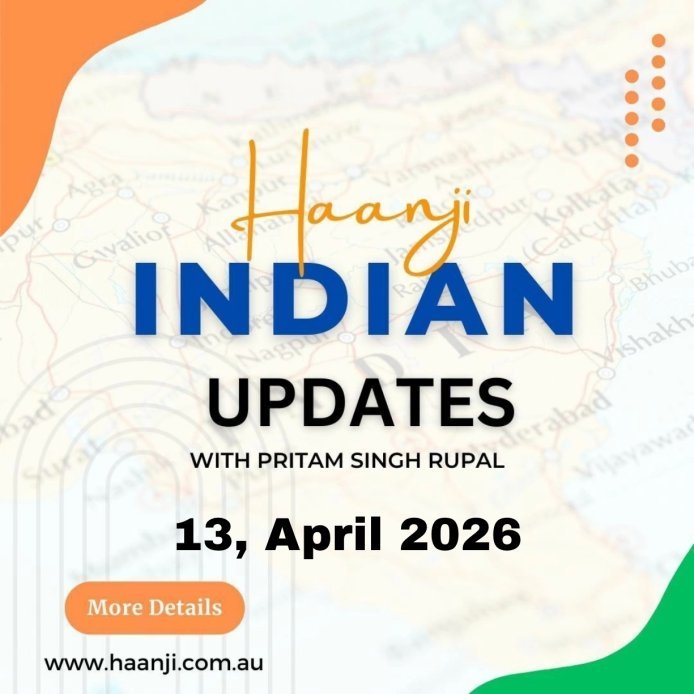
Indian Updates — 13 April 2026 | Punjab’s New Sacrilege Law and Women’s Quota Shifts — Radio Haanji
The political climate in Punjab and across India is shifting rapidly as we head into the middle of April. Today’s episode of Indian Updates on Radio Haanji 1674 AM features the seasoned perspective of senior journalist Pritam Singh Rupal. His decades of experience in Punjabi literary journalism and his history with All India Radio provide a necessary lens for understanding the legislative moves currently making headlines in Chandigarh and Delhi. Along with host Ranjodh Singh, the discussion navigates the complexities of religious protections and the strategic redrawing of India’s electoral map.
The legal weight of the Guru Granth Sahib Satkar Bill
The Punjab Assembly recently convened a special session to address the Jagat Jyot Shri Guru Granth Sahib Satkar (Amendment) Bill 2026. This legislative move is designed to offer a robust legal framework to protect the dignity and "living status" of the Guru Granth Sahib. For the global Punjabi diaspora, this is more than just a legal adjustment; it is an effort to prevent the recurring pain of sacrilege (be-adbi) that has troubled the state for over a decade. The bill clarifies that these protections are specific to the holy scripture, intentionally staying separate from other religious sects or temples to maintain a sharp focus on the sanctity of the Guru.
A significant part of this discussion involves the centralization of printing rights. Historically, private publishers were often criticized for errors in the holy text, which many viewed as a lack of proper respect. Now, the SGPC holds the exclusive rights to print the scripture at the Golden Press in Amritsar. While the government presents this as a step toward dignity and error-free publication, opposition voices from the Congress and Akali Dal have raised concerns. They argue that the bill might serve as a distraction from the fact that many sacrilege cases dating back to 2015 remain unresolved. The debate is no longer just about the law, but about the administrative will to enforce justice.
Redrawing the map for the Women’s Reservation Bill
In New Delhi, the Central Government is preparing to introduce the Women's Reservation Amendment Bill on April 16. The BJP has already signaled the importance of this session by issuing a whip to its members. Prime Minister Modi has been clear that this act should be implemented before the 2029 general elections. However, the true hurdle lies in "delimitation." Because India’s population has grown significantly, the implementation of this quota is tied to the redrawing of constituency boundaries. This process could see the number of Lok Sabha seats rise to over 700.
Opposition parties in West Bengal and Tamil Nadu see the timing of this move as a strategic play to gain favor before upcoming state elections. There is a palpable tension between the promise of representation and the logistical reality of how these seats will be allocated. As Pritam Singh Rupal noted during the broadcast, the mere passing of a law rarely changes ground realities immediately. Similar to laws against other major crimes, the success of the Women's Reservation Bill will depend on how it survives the political maneuvering of delimitation and whether it truly empowers women at the grassroots level rather than just on paper.
Regional shifts and the arrival of Vaisakhi
Beyond the legislative halls, India is seeing significant regional political movement. In West Bengal, the rhetoric is sharpening as Prime Minister Modi and Mamata Banerjee trade accusations over the potential division of the state. Meanwhile, Bihar remains a focal point of leadership uncertainty following Nitish Kumar's move to the Rajya Sabha. The scramble for the Chief Minister’s post involves heavyweights like Samrat Chaudhary, with the BJP sending observers to manage the transition. This level of instability in two key states suggests that the national political landscape is far from settled as we approach the next electoral cycle.
Despite the political friction, the spirit of Vaisakhi has begun to take hold across Punjab. Major festivities have started at Takht Sri Damdama Sahib in Talwandi Sabo and Takht Sri Kesgarh Sahib in Anandpur Sahib. These gatherings serve as a reminder of the cultural and spiritual roots that bind the community together, even when the headlines are dominated by legislative debates and political rivalry. For the diaspora in Australia and Singapore, these updates provide a vital connection to the pulse of their homeland.
Why Indian Updates on Radio Haanji is essential for the Indian diaspora
Staying informed about Punjab and India requires more than just reading headlines; it requires an understanding of the historical context and the likely consequences of today's decisions. For the Punjabi community in Melbourne, Sydney, and beyond, Indian Updates provides that bridge. It is often difficult for those living abroad to keep up with the intricacies of bills like the Guru Granth Sahib Satkar Amendment or the complexities of Bihar’s internal party politics without a trusted guide.
By bringing together the journalistic integrity of Pritam Singh Rupal and the community focus of Radio Haanji, the show ensures that NRIs receive balanced and thoughtful analysis. Whether it is a shift in visa policy or a major cultural event like Vaisakhi, our goal is to provide clarity so you can stay connected to your roots with confidence.
Listen to Indian Updates — Free, Every Weekday
Hear the full analysis of today’s news on Indian Updates with Ranjodh Singh and Pritam Singh Rupal only on Radio Haanji.
What's Your Reaction?