
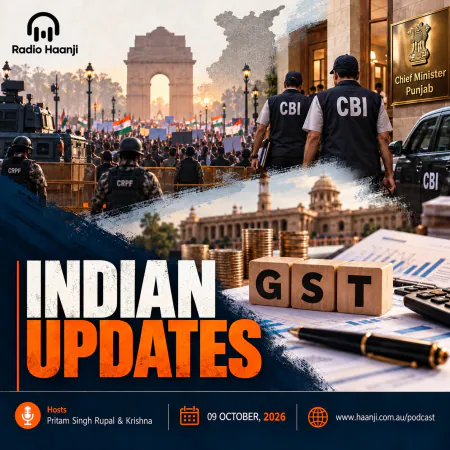














































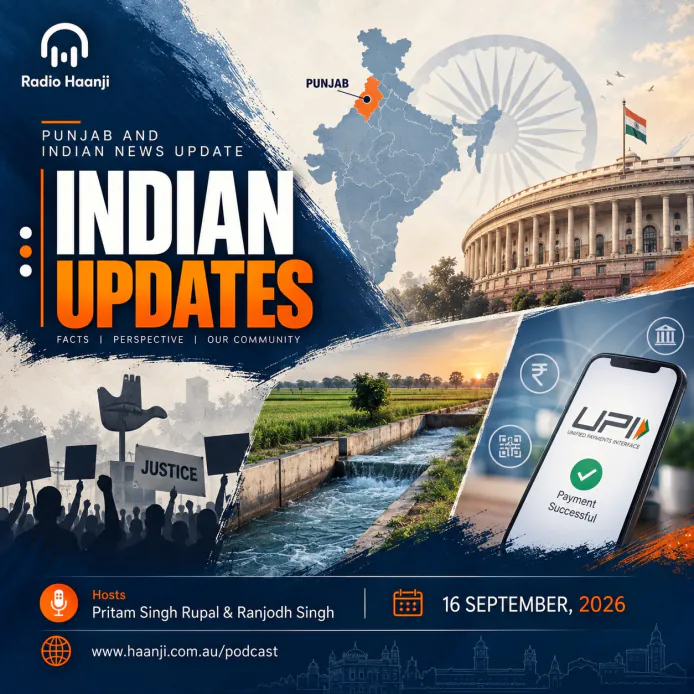
16 Sept - Indian Updates - Modi Tax Row on UPI, Congress Unity Test & Kishau Dam Pact - Pritam Singh Rupal
Host:-
 Pritam Singh Rupal
 Ranjodh Singh
Listen to Indian Updates on Radio Haanji with Pritam Singh Rupal and Ranjodh Singh. Analysis on the UPI 0.4% MDR Modi Tax row, Punjab Congress unity, and Kishau Dam pact.
The landscape of Indian governance, economic policy, and regional politics witnessed critical shifts this week. On today’s edition of Indian Updates on Radio Haanji 1674 AM, hosts Pritam Singh Rupal and Ranjodh Singh unpack the most pressing developments impacting daily life and national headlines. From heated debates around newly announced Merchant Discount Rate (MDR) charges on UPI merchant payments to high-stakes opposition optics in Punjab and historic interstate water agreements, here is the complete breakdown.
To stay updated with broader cultural insights and engaging discussions across our network, tune in to Today Updates, catch deep analytical explorations on The Deep Talk, or revisit insightful life reflections on Notebook.
The UPI MDR Debate: Why the Proposed Fee Has Triggered Political Turmoil
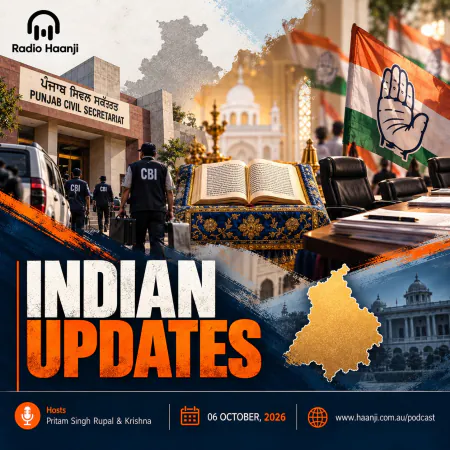
The central talking point across financial markets and political circles revolves around Unified Payments Interface (UPI) merchant fee structures. The central framework introduces a 0.4% Merchant Discount Rate (MDR) on direct Person-to-Merchant (P2M) transactions above Rs 2,000, scheduled to take effect from October 15. The fee structure incorporates specific caveats, including a flat fee of Rs 5 for select recurring or essential merchant services and an overall fee cap of Rs 300 for high-value commercial transactions of Rs 75,000 or more.
Crucially, everyday Person-to-Person (P2P) transfers between individuals, families, and friends remain completely exempt, as do small merchant transactions valued up to Rs 2,000. Regulators have underscored that retail consumers will not be charged directly, and applications are barred from levying consumer convenience fees. However, economic analysts and merchants highlight significant ground realities:
- Impact on Merchant Margins: Small-to-medium retail vendors operate on tight margins. Even a 0.4% cut on transactions exceeding Rs 2,000 creates added operational expenses, raising concerns that traders may nudge consumers back toward cash transactions.
- The Opposition Backlash: The Indian National Congress has fiercely labeled the charge a "Modi Tax," arguing that small traders will inevitably pass these ecosystem processing costs onto end consumers through higher commodity pricing.
- Ecosystem Sustainability vs. Cashless Goals: The administration and banking aggregators maintain that sustaining UPI’s massive technical servers, cybersecurity infrastructure, and cloud data safety requires sustainable operational funding rather than reliance solely on budgetary subsidies.
Punjab Congress Protest in Chandigarh: A Fragile Display of Unity
Chandigarh witnessed high-decibel political mobilization as senior Congress leaders gathered to protest against the Aam Aadmi Party (AAP) government, staging a demonstration outside the residence of Punjab Finance Minister Harpal Singh Cheema. The protest was triggered by the tragic suicide of a laborer in Toor Banjara, located within the minister’s Dirba constituency.
The demonstration was spearheaded by the All India Congress Committee (AICC) in-charge for Punjab, Sachin Pilot, alongside prominent state leaders including Punjab Pradesh Congress Committee (PPCC) chief Amarinder Singh Raja Warring, Leader of the Opposition Partap Singh Bajwa, and former Chief Minister Charanjit Singh Channi.
While the protest demonstrated collective action against the ruling dispensation, political commentators on the show highlighted deeper internal dynamics:
- Symbolic vs. Structural Cohesion: Although top party factions shared a common stage and walked together under Sachin Pilot’s leadership, visible hesitation and competing political ambitions remain apparent beneath the surface.
- Leadership Realignments: Following organizational shifts and the change in state charge from Bhupesh Baghel to Sachin Pilot, various party factions continue positioning themselves for state leadership roles ahead of future electoral cycles.
Interstate Water Cooperation: Historic Breakthrough on Kishau Hydel Project
Ending an eight-year administrative and technical stalemate, six northern states have officially concluded an agreement to advance the ambitious Kishau Multipurpose Hydroelectric Project. Planned on the Tons River along the border of Himachal Pradesh and Uttarakhand, the multi-state undertaking will secure vital water resources and renewable power across northern India.
Under the finalized pact, the Central Government will finance 90% of the project’s water-component expenditure, drastically reducing the fiscal burden on participating states including Haryana, Rajasthan, Uttar Pradesh, and Delhi. The dam will ensure steady drinking water, augmented irrigation canals, and clean hydroelectric power distribution.
Agricultural Infrastructure: Punjab Expands Canal Water Coverage
In another critical update for the agrarian sector, the Punjab Government announced that canal water irrigation coverage across the state has now reached 80% of agricultural lands. State authorities confirmed ongoing canal modernization, desiltation, and tail-end water restoration drives aimed at achieving 100% canal water accessibility for farmers, significantly reducing dependency on groundwater extraction and tube-wells.
For more regional discussions, lively interactions, and community perspectives, check out Boys Meetup, unwind with hearty humor on Laughter Therapy, or immerse yourself in literary heritage with Kitaab Kahani.
Frequently Asked Questions
Will ordinary customers have to pay extra when making UPI transactions?
No. Individual users sending money to friends, family, or making day-to-day peer-to-peer (P2P) transfers do not incur any charges. Routine retail purchases up to Rs 2,000 also remain completely free of any Merchant Discount Rate (MDR).
What transactions are affected by the new 0.4% UPI charge?
The 0.4% MDR applies specifically to Person-to-Merchant (P2M) transactions exceeding Rs 2,000. The charge is paid by the merchant's acquiring bank and payment ecosystem, capped at Rs 300 for large transactions valued at Rs 75,000 and above.
Why did Congress stage a protest outside Punjab Finance Minister Harpal Cheema’s residence?
The protest, led by AICC in-charge Sachin Pilot and Punjab Congress leaders, was organized following the suicide of a laborer in Toor Banjara, Dirba constituency, demanding accountability and financial support for the affected family.
Which states benefit from the Kishau Hydel Dam agreement?
The project involves Himachal Pradesh, Uttarakhand, Haryana, Rajasthan, Uttar Pradesh, and Delhi. It provides hydroelectric power and vital irrigation and drinking water supplies, backed by 90% central funding for the water component.
Frequently Asked Questions
Will ordinary customers have to pay extra when making UPI transactions?
What transactions are affected by the new 0.4% UPI charge?
Why did Punjab Congress leaders stage a protest in Chandigarh?
Which states are part of the Kishau Hydel Project agreement?
What is the current status of canal water supply in Punjab?
What's Your Reaction?