















































































Gain deep clarity on the Punjab river water dispute with Pritam Singh Rupal. Listen to Indian Updates free every weekday on Radio Haanji.
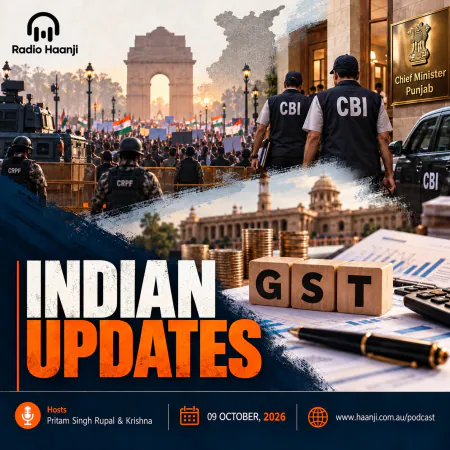
Sat sri akal and welcome to today's edition of Indian Updates on Radio Haanji 1674 AM. Today, host Ranjodh Singh is joined by senior journalist Pritam Singh Rupal, whose decades at All India Radio, Chandigarh, bring rare clarity to complex stories that demand far more than basic headlines. For our Punjabi and Indian diaspora community stretching across Australia and Singapore, these stories hit close to home. They connect us directly to the soil, the families, and the generational realities of our homeland. We step beyond standard news flashes to dissect the underlying history and future impacts of today's key developments.
The Punjab river water dispute and the history of resource mismanagement
The ongoing battle over water rights reached a critical turning point with the field visit of the Ravi-Beas Water Tribunal to the Harike Barrage. Standing right at the confluence where the Sutlej and Beas rivers meet, Punjab Chief Minister Bhagwant Mann reasserted a firm position: the state simply does not have a single drop of surplus water to share. Officials presented clear geographic parameters to the tribunal, pointing out that only Punjab, Himachal Pradesh, and Jammu and Kashmir fall within the actual river basin. The delegation also highlighted immediate environmental struggles, showing how heavily polluted water flows into the Sutlej from leather industries inside Pakistan's Kasur district, adding an extra layer of crisis to local agriculture.
Journalist Pritam Singh Rupal shared an eye-opening historical perspective, showing that the water crisis goes back long before the 1947 partition. The dispute originally began with the construction of the Gang Canal under Maharaja Ganga Singh of Bikaner, an arrangement where water was purchased directly from Punjab. Following the 1966 reorganization of Punjab and Haryana, the conflict transformed into a major political battlefield, paving the way for controversial projects like the Sutlej Yamuna Link Canal. On top of that, structural shifts within the Bhakra Beas Management Board slowly stripped Punjab of its traditional permanent dominance over its own water resources.
For decades, previous administrations completely neglected critical local irrigation infrastructure like the Ranjit Sagar Dam and the Shahpur Kandi project. This stagnation was driven by underground political lobbying from agricultural machinery and tube-well manufacturing networks that profited off groundwater reliance. Fortunately, the current administration is making strides to reverse this by mapping old canals, concrete-lining minor distributaries, and rolling out lift-irrigation systems. These practical infrastructure upgrades are finally bringing canal water to the distant tail-ends of farms, giving fields relief and lowering the farming community's dependency on rapidly failing underground aquifers.
Enforcement Directorate summons and allegations of political enforcement in Mohali
The Enforcement Directorate has escalated its money laundering investigation in Punjab by summoning the chief administrator of the Greater Mohali Area Development Authority. This move comes ten days after federal teams raided locations across Chandigarh and Mohali, zeroing in on prominent real estate developers. The agency is digging into extensive financial fraud involving Change of Land Use approvals for housing developments in the region. Absolute chaos broke out during the initial searches when individuals inside a Mohali high-rise panicked and threw bags packed with currency notes right out of a window, leading to a frantic cash recovery by federal agents on the ground.
At the same time, the central agency summoned the chairman of the Punjab State Power Corporation Limited to hand over records regarding a bank guarantee linked to an enterprise under scrutiny. Host Ranjodh Singh and journalist Pritam Singh Rupal analyzed these sudden federal crackdowns, noting how central investigative bodies face growing criticism for being used as political leverage by the ruling central party. The commentators talked about the visible pattern where specific political figures face intense heat right until they choose to align with the central ruling party, contrasting them with leaders who choose to stand their ground through formal legal arrests.
Formal implementation of the Anand Marriage Act in Sikkim
Starting June 1, 2026, members of the Sikh community living in Sikkim can finally register their marriages under their own traditional legal framework. This long-awaited change follows a formal notification from the Union law ministry, fast-tracked to fix deep administrative gaps. For years, because there were no localized state rules, Sikh couples in Sikkim had to register their traditional Anand Karaj ceremonies under the broader Hindu Marriage Act of 1955. Now, with the Sikkim Anand Marriage Registration Rules officially in place, the state has established a localized administrative process that honors traditional Sikh identity.
CBI secures fourteen-day remand in the NEET paper leak investigation
The Central Bureau of Investigation has hit a major milestone in the high-profile NEET exam paper leak case by securing a fourteen-day remand of a National Testing Agency member and a lecturer named Mandhara. Federal investigators are pushing through intense custodial questioning to uncover the complete network behind the compromise of this vital medical entrance exam. The ongoing probe has sparked massive anger among students and families nationwide, making it clear that national testing operations need immediate structural overhauls to preserve transparency and protect student merit.
Punjab Governor initiates diplomatic dialogue with farmer unions
In a fresh diplomatic move to de-escalate rural tensions, Punjab Governor Gulab Chand Kataria has directly invited various farmer unions for collaborative meetings. This dialogue is aimed at addressing long-pending agricultural grievances, including statutory safety nets for the Minimum Support Price. The invitation is a deliberate effort to clear the air after recent clashes at the Mohali-Chandigarh border, where protesting farmers met heavy police resistance and a lathi charge. By initiating these face-to-face talks, the administration hopes to establish peaceful paths forward for structural farming challenges.
Why Indian Updates on Radio Haanji is essential for the Indian diaspora
For the global Punjabi and Indian diaspora calling Australia and Singapore home, staying connected to our roots means looking past flashy, sensationalized social media clips. Indian Updates delivers the accurate background, history, and raw analysis non-resident Indians need to make sense of regional shifts. Whether tracking river water rights or understanding legal reforms, this daily broadcast closes the geographic distance with honest journalism.
Tuning into these analytical episodes keeps our community truly aware of the socio-political ground realities back home. Radio Haanji 1674 AM remains fiercely dedicated to providing trusted perspectives that build strong community bonds and encourage meaningful conversations across the miles. Shukriya for trusting us as your definitive voice for authentic Punjabi journalism.
Frequently Asked Questions
What is the current status of the Punjab river water dispute?
The Punjab river water dispute remains intense as the Ravi-Beas Water Tribunal recently inspected the Harike Barrage. Chief Minister Bhagwant Mann reiterated that Punjab lacks any surplus water to share with Haryana or Rajasthan, because only Punjab, Himachal Pradesh, and Jammu and Kashmir lie within the actual river basin area.
Why did the Enforcement Directorate summon the GMADA chief administrator?
The Enforcement Directorate summoned the GMADA chief administrator following extensive raids on Mohali builders regarding a fraudulent Change of Land Use scam. Investigators are probing financial irregularities, forged landowner consent letters, and the alleged evasion of substantial development dues owed by real estate developers to the state authority.
When will the Anand Marriage Act be implemented in Sikkim?
The Anand Marriage Act will officially come into force in Sikkim on June 1, 2026. This legal framework allows members of the Sikh community residing in Sikkim to formally register their marriages under traditional Sikh rituals rather than forcing them to register under the broader Hindu Marriage Act.
What is the status of the NEET paper leak investigation by the CBI?
The NEET paper leak investigation has intensified after the CBI secured a fourteen-day remand of a National Testing Agency member and a lecturer named Mandhara. Federal investigators are conducting intense questioning of these primary suspects to uncover the wider network involved in the fraudulent examination leak.
How is the Punjab Governor engaging with protesting farmer unions?
The Punjab Governor Gulab Chand Kataria has invited various farmer unions for collaborative talks regarding pending agricultural issues including Minimum Support Price guarantees. This diplomatic invitation followed recent border tensions and a police lathi charge against protesting farmers at the Mohali-Chandigarh boundary line.
Listen to Indian Updates — Free, Every Weekday
Listen free to the Radio Haanji podcast on your favorite platform.
Radio Haanji 1674 AM is Austalia's Punjabi community radio station.
Listen free at haanji.com.au | Spotify | Apple Podcasts | iOS App | Android App
Serving the Punjabi community in Australia, Canada, Singapore and world w
What's Your Reaction?