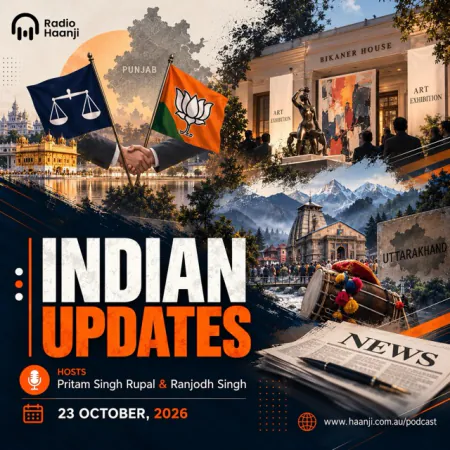



























































































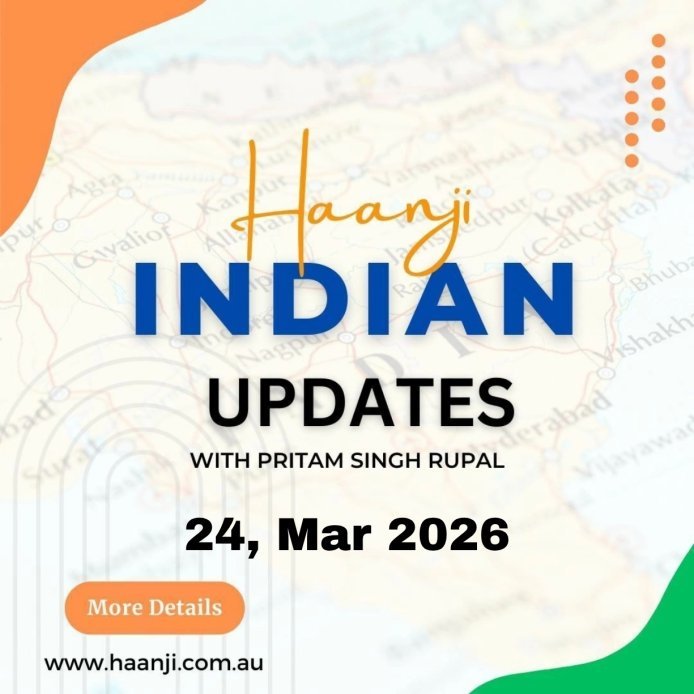
Indian Updates 24 Mar 2026 - Laljit Bhullar Arrest, Arvind Kejriwal in ED custody, IPL Match Update
Host:-
 Pritam Singh Rupal
 Ranjodh Singh
Pritam Singh Rupal analyses the High Court's Bhullar notice and Punjab's hailstorm farm crisis. Deep Punjab journalism, free on Radio Haanji.
Indian Updates — 24 March 2026 | Bhullar in Custody, Courts Watch — and Punjab's Farmers Count the Cost of an Unforgiving Season — Radio Haanji
Punjab's political and agrarian stories rarely run in parallel — but on March 24, 2026, they do. In today's edition of Indian Updates on Radio Haanji 1674 AM, Ranjodh Singh is joined by Senior Journalist Pritam Singh Rupal of All India Radio Chandigarh, whose decades of reporting on Punjab's governance and agricultural economy bring a breadth of perspective to two stories that are, in their different ways, both about accountability — of those who govern, and of the institutions charged with protecting those they govern.
The High Court Holds the Line: What the Bhullar Case Means for Punjab's Institutions
The story that dominated yesterday's edition of Indian Updates has not slowed down. On March 23, former Punjab Cabinet Minister Laljit Singh Bhullar — stripped of his portfolio and resigned from government just two days earlier following the suicide of Punjab State Warehousing Corporation officer Gagandeep Singh Randhawa — was arrested at Mandi Gobindgarh in Fatehgarh Sahib district. But the arrest of one man, while significant, is only one part of the legal picture.
The Punjab and Haryana High Court has now formally entered the proceedings. Issuing notices to both the Punjab government and Bhullar himself, the court has called for a detailed response on the circumstances surrounding Randhawa's death — the FIR registered at Ranjit Avenue police station in Amritsar, the family's allegations of coercion, assault and blackmail at the minister's residence, and the demand by Randhawa's mother for an out-of-state postmortem to ensure the examination is conducted without interference. The court's intervention cannot be overstated. In a case where the primary alleged perpetrators include the minister, his father, and his personal assistant — and where the investigation is necessarily conducted by the Punjab Police, an agency that operates under the same state government Bhullar served — an independent institutional check is not a procedural formality. It is the difference between a genuine investigation and a managed one.
What makes the High Court's role analytically significant — as Pritam Singh Rupal's perspective on Punjab's legal history makes clear — is that the Punjab and Haryana High Court has a long and creditable record of asserting its oversight authority in politically sensitive cases, particularly those involving governance failure or the conduct of ministers. The court's decision to issue notices within 24 hours of the FIR being registered signals that it does not intend to allow this matter to proceed at the government's own pace.
The political implications continue to intensify. The opposition — SAD, Congress, and others — has sustained its demand for a Central Bureau of Investigation inquiry, arguing that any investigation conducted under the Punjab government's administrative umbrella is structurally compromised. Multiple civil society groups have echoed the demand. The AAP government, for its part, has indicated that Chief Minister Bhagwant Mann has ordered a high-level probe led by Chief Secretary K A P Sinha. Whether that internal probe can satisfy either the High Court or public opinion is an open question — and the court's presence in the proceedings suggests that the judiciary has already decided it will not simply defer to the executive's version of events.
For the Punjabi community watching from Australia and beyond, the Bhullar case is not merely a dramatic political episode. It is a test of whether Punjab's institutions — its courts, its police, its civil service — have the structural independence to hold power accountable when that power sits within the very government those institutions serve. The 24 hours since Bhullar's arrest have not answered that question. The weeks ahead will.
Punjab's Farmers Face a Season of Double Loss
A different kind of accountability is under scrutiny in Punjab's agricultural districts, where unseasonal rains and hailstorms have caused widespread damage to standing rabi crops at precisely the moment when the harvest was approaching. The timing — late March, just weeks before the wheat harvest — could not be more damaging for farmers who have spent the preceding months and the cost of inputs, irrigation, and labour preparing for this yield.
The situation in Punjab is part of a broader national crisis. Union Agriculture Minister Shivraj Singh Chouhan convened an emergency review meeting on March 20 as Western Disturbances — the meteorological systems that bring unseasonal precipitation from the Mediterranean across the northwestern Indian subcontinent — generated rainfall levels 66 per cent above normal across key agricultural belts. In Punjab specifically, the damage has been concentrated in districts like Sangrur, Patiala, and Bathinda, where wheat crops have suffered extensive "lodging" — the technical term for flattening of standing crops by rain and wind — a condition that makes mechanical harvesting far more difficult and significantly reduces yield even where the grain itself has not been destroyed.
The Punjab government's announcement of a compensation package for affected farmers is a necessary step, but the gap between announcement and delivery is a long and familiar road in Punjab's agricultural policy history. The state's eligibility criteria, assessment mechanisms, and disbursement timelines have been points of contention in previous years, with farmers frequently reporting that compensation either arrives too late to offset losses, or that the per-acre amounts bear little relation to actual input costs. Under the Pradhan Mantri Fasal Bima Yojana, farmers are required to report crop damage within 72 hours of the loss event — a rule that routinely disadvantages small and marginal farmers who lack the awareness or access to file claims within that narrow window.
The context in which this agricultural crisis is arriving matters greatly. Punjab's farmers are already carrying a significant debt burden — a structural problem that has persisted across multiple governments and is directly linked to the high cost of inputs, water-intensive cropping patterns, and the absence of guaranteed remunerative prices for crops outside the paddy-wheat cycle. When unseasonal weather delivers a body blow to rabi crops in March, it does not simply reduce this year's income. For farmers already operating on credit, it can be the event that tips a manageable debt situation into a genuine financial emergency.
What the Punjab government announces in compensation, and how quickly those funds actually reach the districts worst affected, will be one of the defining tests of its agricultural governance commitments in the weeks ahead. Pritam Singh Rupal has covered Punjab's farming crisis for decades and the pattern — announcement, delay, partial delivery, political dispute over coverage — is one the community knows well. The question for this government is whether it can break that pattern.
Why Indian Updates on Radio Haanji Matters for the Diaspora
The two stories that define today's episode — a minister's arrest and a farming community's distress — are separated by geography and context but connected by a common thread: the question of whether those who hold power in Punjab discharge their obligations to those who depend on them. That is a question the Punjabi diaspora in Australia and Singapore follows with a depth of concern that no news headline can fully convey. Families back home work those fields. Relatives navigate those institutions. The analysis Pritam Singh Rupal brings to the Radio Haanji podcast, grounded in decades of journalism at the heart of Punjab's public life, turns daily news into the kind of genuine understanding that helps the diaspora engage with the reality of the state they carry with them.
Listen to Indian Updates — Free, Every Weekday
Deep analysis of India and Punjab news, delivered with integrity every weekday morning on Radio Haanji 1674 AM.
Radio Haanji 1674 AM is Austalia's Punjabi community radio station.
Listen free at haanji.com.au | Spotify | Apple Podcasts | iOS App | Android App
Serving the Punjabi community in Australia, Canada, Singapore and world wide.
What's Your Reaction?







Related Posts