




















































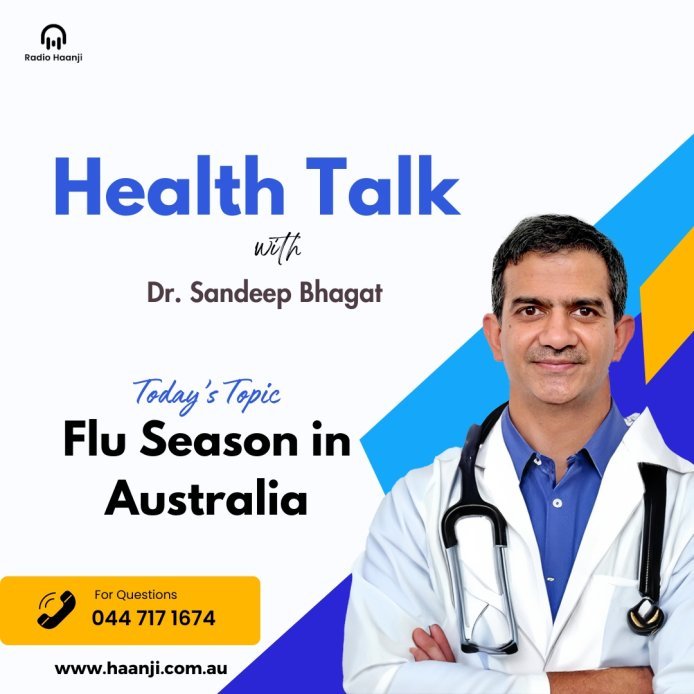

Radio Haanji's Health Talk podcast: Dr. Sandeep Bhagat explains flu vs cold symptoms, vaccine effectiveness, Super K strain & spirometry advice.
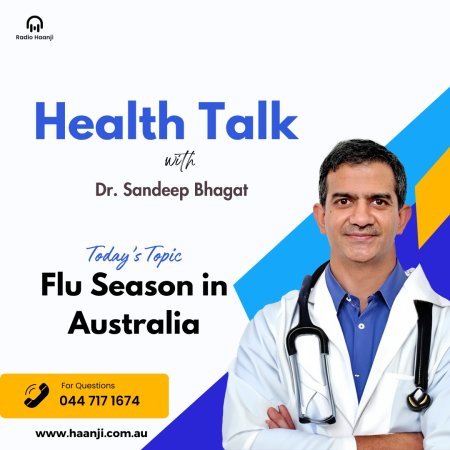
Health Talk: Dr. Sandeep Bhagat on Flu Season, Vaccination & Seasonal Health in Australia
Radio Haanji 1674 AM | Health Talk Podcast
Disclaimer: This article is for general informational purposes only and does not constitute medical advice. Always consult a qualified healthcare professional for personal medical guidance.
As flu season approaches across Australia, many families in the Punjabi and Hindi-speaking community are asking the same questions: Is it a cold or the flu? Should I get vaccinated? What is this "Super K" strain everyone is talking about?
In the latest episode of Health Talk on Radio Haanji 1674 AM, host Ranjodh Singh sat down with Dr. Sandeep Bhagat for a wide-ranging, accessible conversation covering everything from distinguishing hay fever from influenza to spirometry testing for a persistent cough. Whether you are protecting young children, elderly parents, or managing a chronic condition, this episode is essential listening for the entire community.
Hay Fever, Cold, or Flu? How to Tell the Difference
One of the most common points of confusion as the seasons change is knowing exactly which illness you are dealing with. Dr. Bhagat broke it down clearly for listeners.
Hay Fever is seasonal and typically triggered by pollen. The signature symptoms are sneezing and watery eyes. Critically, hay fever does not involve fever or significant body aches — which is one of the clearest ways to distinguish it from an infection.
The Common Cold is caused by various rhinoviruses and tends to be mild in presentation. Expect sneezing, a runny nose, and general stuffiness — but without high fever or breathing difficulties. Most healthy adults recover within a week.
Influenza (Flu) is a different beast entirely. The flu arrives with high fever — often 100°F (38°C) or higher — significant body aches, a persistent cough, and fatigue that can leave you bed-bound for days. The severity is what sets the flu apart from the common cold, and it is why Dr. Bhagat urges the community to take it seriously.
| Symptom | Hay Fever | Common Cold | Influenza |
|---|---|---|---|
| Sneezing | ✅ Common | ✅ Common | Sometimes |
| Watery Eyes | ✅ Common | Rare | Rare |
| Runny Nose | Sometimes | ✅ Common | Sometimes |
| High Fever (38°C+) | ❌ No | ❌ Rare | ✅ Yes |
| Body Aches | ❌ No | Mild | ✅ Severe |
| Persistent Cough | ❌ No | Mild | ✅ Yes |
| Breathing Difficulty | ❌ No | ❌ No | Possible |
Understanding Influenza Strains: A, B, C, and D
Dr. Bhagat explained that influenza is not a single virus — there are four main strains: A, B, C, and D. For the purposes of community health, Strains A and B are the ones that matter most, as these are the primary strains that cause human illness each season.
These are also the two strains targeted by the annual flu vaccination, which is why getting the current year's shot — rather than relying on a previous year's vaccine — is so important. The flu virus evolves, and so does the vaccine.
The Flu Vaccine: How Effective Is It Really?
This is one of the most frequently misunderstood topics in community health, and Dr. Bhagat addressed it directly. The flu vaccine is approximately 60–70% effective — meaning it will not guarantee you avoid the flu entirely. However, that is not the full picture.
Even if a vaccinated person does contract influenza, the vaccine provides a crucial benefit: it significantly reduces the severity of the illness and lowers the risk of serious complications such as pneumonia, which can be life-threatening — particularly in the elderly and those with underlying conditions.
For children who are needle-averse, there is also the Flu Mist — a nasal spray version of the flu vaccine that is just as effective and avoids an injection entirely. Dr. Bhagat noted that Flu Mist is currently free in some Australian states including NSW and Queensland, though it was not yet free in Victoria at the time of recording.
Who Should Definitely Get Vaccinated: High-Risk Groups
Dr. Bhagat was emphatic about vaccination for the following groups, who face the greatest risk of serious flu complications:
- Infants and young children aged 6 months to 2 years
- Older adults aged 65 and above
- People with chronic conditions including diabetes, asthma, heart disease, and obesity
- Aboriginal and Torres Strait Islander people, for whom free vaccination is available under the National Immunisation Program
For the Punjabi and Hindi-speaking community in Australia, many of whom have extended family households spanning multiple generations, Dr. Bhagat's message was clear: protecting one person in the household protects everyone in it.
The "Super K" Strain: What You Need to Know
One of the more alarming topics raised in the episode was the "Super K" sub-strain of influenza, which has been noted for its particularly fast rate of transmission within communities.
While the core symptoms of Super K are similar to standard influenza — fever, body aches, cough — its speed of spread and potentially higher severity make it a cause for extra vigilance. Dr. Bhagat stressed two key responses: firstly, clinical testing through a GP if you suspect you have the flu rather than a cold, and secondly, ensuring vaccination is up to date, as the annual flu shot does offer protection against this sub-strain.
Persistent Cough at Night or Early Morning? Ask Your GP About Spirometry
One of the most practically useful segments of the episode addressed a very common but often ignored complaint: a chronic cough that tends to flare up late at night or early in the morning.
Dr. Bhagat explained that this pattern — particularly when it worsens with seasonal changes — can be a sign of mild, undiagnosed asthma or airway obstructions that are aggravated by cooler air or allergens. His recommendation is simple but important: ask your GP for a Spirometry test.
Spirometry is a quick, non-invasive breathing test that measures how much air you can inhale and exhale, and how quickly. It can identify airway narrowing or obstruction that would otherwise go undetected, allowing for early intervention before the condition worsens.
If you or someone in your family has a persistent cough that never fully resolves across seasons, this test is well worth requesting at your next GP appointment.
Listen to Health Talk on Radio Haanji
Catch Health Talk and all Radio Haanji podcasts anytime on:
- ????️ Spotify
- ????️ Apple Podcasts
- ???? Radio Haanji App — iOS | Android
- ???? haanji.com.au
- ???? Live on Radio Haanji 1674 AM in Melbourne and Sydney
Frequently Asked Questions
What is the difference between the flu and a common cold? T
he flu (influenza) is significantly more severe than a common cold. Key differences include high fever above 38°C, pronounced body aches, and a persistent cough with the flu — symptoms that are absent or very mild in a standard cold. If you are unsure, see your GP for clinical testing.
How effective is the flu vaccine in Australia?
The annual flu vaccine is approximately 60–70% effective at preventing influenza. Even if you do catch the flu after vaccination, the vaccine substantially reduces the severity of illness and lowers the risk of dangerous complications like pneumonia.
What is the Super K flu strain?
Super K is a sub-strain of influenza known for spreading particularly quickly through communities. While its core symptoms are similar to standard flu, its faster transmission rate and potentially higher severity make vaccination and early clinical testing especially important.
What is a Spirometry test and when should I get one?
A Spirometry test is a simple, non-invasive breathing test conducted by a GP that measures lung capacity and airflow. Dr. Bhagat recommends it for anyone experiencing a persistent cough — particularly one that worsens at night or in the early morning — to check for mild asthma or airway obstruction.
Is the Flu Mist nasal spray available in Australia?
Yes. The Flu Mist is a needle-free nasal spray version of the flu vaccine suitable for children. It is free in some states including NSW and Queensland, but was not yet free in Victoria at the time of recording. Check with your GP or pharmacist for current availability in your state.
Who should get the flu vaccine in Australia?
The flu vaccine is strongly recommended for children aged 6 months to 2 years, adults aged 65+, people with chronic conditions (diabetes, asthma, heart disease, obesity), and Aboriginal and Torres Strait Islander people. Free vaccination is available for high-risk groups under the National Immunisation Program.
What is the Health Talk podcast on Radio Haanji?
Health Talk is a podcast series on Radio Haanji 1674 AM hosted by Ranjodh Singh that brings expert medical guests to speak directly with the Punjabi and Hindi-speaking community in Australia. Episodes cover practical, accessible health topics relevant to community life.
What's Your Reaction?







Related Posts