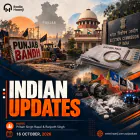















































































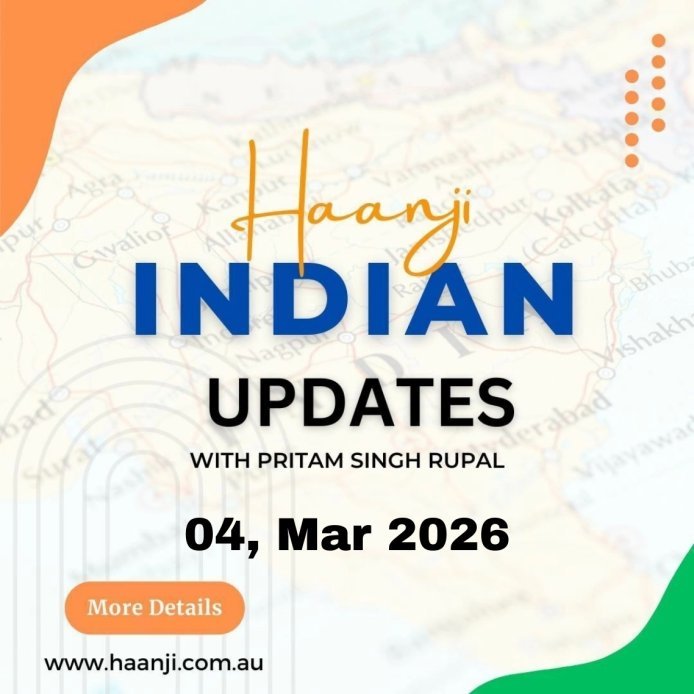
04 March 2026- Indian Updates - -Punjab Debt, Hola Mohalla and Middle East Flights - Radio Haanji
Host:-
 Pritam Singh Rupal
 Ranjodh Singh
Preetam Singh Rupal analyses Punjab finances, Kali Dal revival, India's Middle East evacuation flights and more — Indian Updates, Radio Haanji 1674 AM
Hola Mohalla, Punjab's Finances and the Middle East Crisis - Indian Updates - 04 March 2026
Wednesday, 04 March 2026 — and today's Indian Updates on Radio Haanji 1674 AM covers a broad and significant range of stories from across India and Punjab, each carrying its own weight of political, cultural and humanitarian consequence. Respected India-based journalist Preetam Singh Rupal brings his characteristic depth and precision to the programme, unpacking the headlines that matter most to the Indian diaspora in Australia — from the revival of a historic political movement to Punjab's economic trajectory and the urgent human story unfolding as Indian nationals return home from a Middle East in crisis.
Hola Mohalla and the Kali Dal: When Religious Tradition Meets Political Revival
The announcement of a Kali Dal revival conference timed to coincide with Hola Mohalla is a development that carries far more significance than its cultural surface might suggest. Hola Mohalla — the Sikh martial tradition inaugurated by Guru Gobind Singh Ji at Anandpur Sahib — has always been a space where spiritual observance and political assertion have coexisted. Tying an organisational revival to this occasion is a deliberate and historically resonant choice, and it signals an intent to ground any new political energy in a legitimacy that flows directly from Sikh heritage.
The Kali Dal, for those tracking Punjab's political landscape, represents a strand of Sikh political thought that has historically positioned itself around issues of Panthic identity and sovereignty. Its revival — or at the very least, the ambition to revive — at this particular moment raises important questions about the shifting currents within Punjab's religious and political space. The AAP government in Punjab, which has worked hard to occupy the space of both administrative credibility and cultural respect, will be watching these developments carefully.
For the Indian and Punjabi diaspora in Australia, events at Hola Mohalla are never purely ceremonial. Anandpur Sahib draws Sikhs from across the world, and the political atmospherics there each year tend to reflect deeper conversations happening within the Panth globally. What emerges from this conference, and how it shapes the Kali Dal's agenda and support base, will be worth following closely in the weeks ahead.
250 Buses, a New Colour — and What Punjab's Transport Decision Really Signals
The decision to repaint 250 buses belonging to Punjab Roadways and PRTC is, on one level, an administrative story about fleet management and public transport aesthetics. On another level, it is part of a broader pattern of the AAP government in Punjab using visible, tangible changes to public infrastructure as a way of demonstrating governance to the electorate. The rebranding of public assets — from mohalla clinics to school classrooms — has been a consistent feature of AAP's political communication strategy since it came to power in 2022.
Whether this is effective governance or political optics is a question that Punjab's citizens are best placed to answer. What is clear is that decisions of this kind, modest in budgetary terms but highly visible on the ground, are part of how the AAP government is building — or maintaining — its narrative of change in the state. For the Punjabi community in Australia, many of whom have family members who use these bus services daily, the quality, frequency and reliability of public transport remains a far more pressing concern than its colour scheme.
The PRTC and Punjab Roadways together form the backbone of public transport for rural and semi-urban Punjab, serving communities that have limited access to private vehicles or emerging ride-hailing services. Any investment in this network — even one as visible as a fresh coat of paint — is worth contextualising against the larger questions of route coverage, vehicle condition and operational funding that have historically challenged these services.
Punjab's Debt Narrative: What Harpal Cheema's Four Percent Claim Actually Means
Punjab Finance Minister Harpal Cheema's claim that the state's debt burden has been reduced by four percent during AAP's tenure is the kind of statistic that invites both scrutiny and context. Punjab entered the AAP government's stewardship as one of India's most financially stressed states, carrying a debt load that successive governments had allowed to accumulate over decades. A four percent reduction, if verified by independent financial analysis, would represent genuine progress — though it must be weighed against the scale of the problem and the pace at which it is being addressed.
The political significance of this claim is as important as its economic content. As Punjab approaches its next electoral cycle, the AAP government needs to demonstrate that its model of governance — which promised fiscal discipline alongside substantial social expenditure — is financially sustainable. Cheema's statement is clearly part of that effort: an attempt to reframe Punjab's financial story from one of crisis to one of cautious recovery.
What independent economists and auditors say about these numbers will matter enormously. Debt reduction in absolute terms can be achieved through a range of mechanisms, not all of which reflect structural improvement. Whether Punjab's revenue position, its liability on committed expenditures, and its capacity to invest in long-term infrastructure are all genuinely improving — or whether the state is managing optics while deferring hard choices — is the deeper question that any serious analysis of this claim must engage with.
India's Airlift Response to the Middle East Crisis: Logistics, Diplomacy and the Human Stakes
Indian airlines operating 58 special flights to the Middle East on 04 March 2026 is not simply a logistical story — it is a measure of how serious the situation on the ground has become, and of how seriously the Indian government is taking its responsibility to its diaspora. With an estimated nine million Indian nationals working across the Gulf and broader West Asia, the scale of India's human exposure to any regional conflict is enormous. The decision to mount a coordinated airline response, including the arrival of an Air India flight carrying 149 passengers from Dubai into New Delhi, reflects the early stages of what could become a much larger evacuation and repatriation effort.
India has been through this before — Operation Kaveri in Sudan, Operation Devi Shakti in Afghanistan, Vande Bharat during the pandemic — and each time, the logistical machinery of the Indian government and its aviation sector has been put to the test. What distinguishes this moment is the geopolitical complexity of the Middle East crisis, in which India must manage its relationships with multiple parties — Iran, Israel, the Gulf states and the United States — while keeping the safe return of its citizens as the primary operational objective.
For the Indian and Punjabi community in Australia, this story is deeply personal. A significant portion of the Indian diaspora here has direct family connections to workers in the Gulf. Every flight that lands safely in New Delhi or Amritsar represents a family reunited, and every hour of diplomatic uncertainty in the region is an hour of anxiety for households here in Melbourne and across Australia.
Punjab CM Bhagwant Mann and the Centre's Assurance: What It Means for Punjabi Families
Chief Minister Bhagwant Mann's statement that the central government has assured the safe return of Punjabis from the Middle East adds an important political and administrative dimension to the evacuation story. Punjab has one of the highest concentrations of Middle East migrant workers of any Indian state, and the Chief Minister's intervention — seeking and publicly communicating a central assurance — is both a statement of advocacy for his constituents and a signal to Punjabi families at home and abroad that their government is engaged.
The relationship between the AAP government in Punjab and the BJP-led central government has been characterised by tension on many fronts. That Bhagwant Mann has been able to secure a public assurance from the Centre on this matter, and that he has chosen to communicate it widely, suggests that on the question of citizen safety abroad, both governments are willing to set aside political differences. This is how it should be — and it is worth noting when it happens.
For Punjabis in Australia watching this situation unfold, Mann's statement carries a particular resonance. Many in this community have maintained close ties with Punjab's political landscape, and knowing that both the state and central government are actively coordinating on the safe return of those in the affected region will provide some measure of reassurance during what remains an extremely uncertain period in West Asia.
Why Indian Updates on Radio Haanji Is Essential Listening for the Indian Diaspora
For Indians and Punjabis living in Australia, following events back home is both an emotional imperative and a practical necessity. Families are spread across continents, investments and property ties remain strong, and political developments in India have direct consequences for NRIs — from visa policy to economic conditions that affect those left behind. The challenge is finding analysis that goes deep enough to be genuinely useful, without requiring hours of engagement across multiple news sources. That is precisely the gap that Indian Updates on Radio Haanji 1674 AM is designed to fill.
What distinguishes this programme from a standard news bulletin is its commitment to analysis over description. Each story is not merely reported — it is placed in context, examined for consequence, and interpreted through the lens of what it means for the Indian community living at a distance from home. This is Indian current affairs podcast content built for people who want to understand what is happening, not just know that it happened.
Available free every weekday as part of the Radio Haanji broadcast and as a free Punjabi podcast online across all major platforms, Indian Updates has built its reputation on the credibility of its journalism and the trust of its community. For the Indian diaspora in Australia looking for one daily source that covers India's political, economic and social landscape with genuine authority, this is the programme that delivers.
Listen to Indian Updates - Free, Every Weekday on Radio Haanji
Indian Updates is available to stream and subscribe across all major platforms, completely free, every weekday.
Download the Radio Haanji iOS App
Download the Radio Haanji Android App
Join Preetam Singh Rupal again tomorrow for another in-depth analysis of the stories shaping India — because for the Indian diaspora in Australia, staying informed is not a pastime, it is a responsibility.
Radio Haanji 1674 AM | Punjabi Podcast | Broadcasting from Melbourne, Australia
Listen free at haanji.com.au | Available on Spotify & Apple Podcasts
Serving the Punjabi community across Melbourne · Sydney · Brisbane · Australia · Worldwide
What's Your Reaction?