




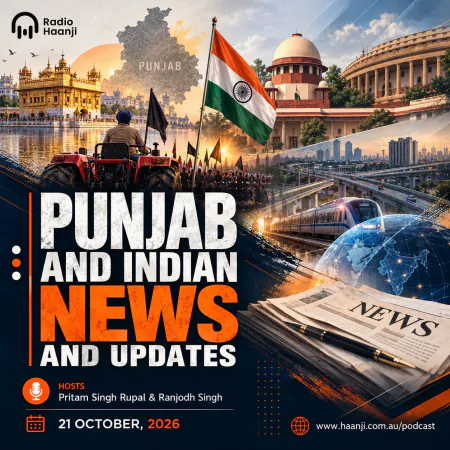
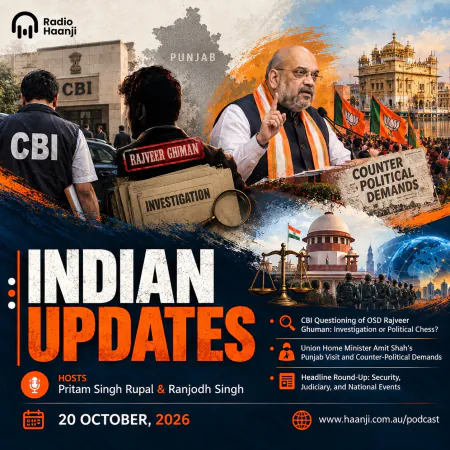



















































CM Bhagwant Mann calls special Punjab Assembly session May 1. Radio Haanji analyzes AAP's Delhi power conflict, defections, and split speculation in Punjab.
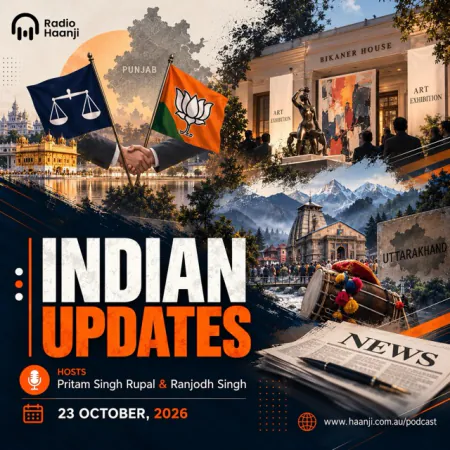
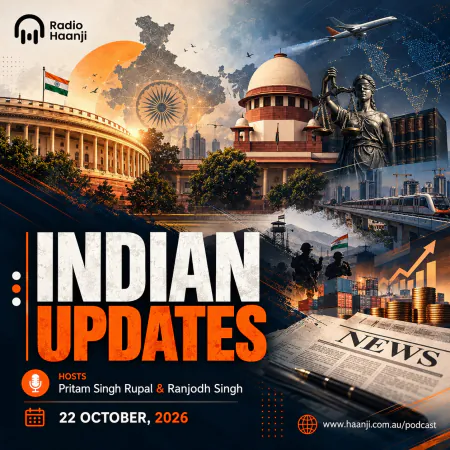
Radio Haanji | Punjab Political Analysis | Hosts: Pritam Singh Rupal & Ranjodh Singh
As Punjab's political landscape grows more turbulent by the day, Radio Haanji's Pritam Singh Rupal and Ranjodh Singh delivered a sharp, unflinching breakdown of the forces shaping the state's future — from a landmark assembly session called for Labour Day to the widening fault line between AAP's Punjab and Delhi wings.
Bhagwant Mann Calls Special Assembly Session on May 1
In a move rich with symbolism, Chief Minister Bhagwant Mann has convened a special session of the Punjab Legislative Assembly for May 1st — International Workers' Day. The session has been explicitly dedicated to honoring Punjab's labor class and working community. The timing sends a deliberate political message: the AAP government in Punjab is positioning itself as the champion of the common worker at a moment when the party's internal unity is under increasing scrutiny.
Alongside this, a significant coordination meeting took place in Jalandhar, bringing together AAP MLAs and block-level observers to align on grassroots political strategy. Such meetings reflect the party's ongoing effort to maintain ground-level organization even as pressures mount from multiple directions.
The "Traitor" War: Defections and BJP's Counter
The episode's sharpest exchanges centered on the wave of defections from AAP to BJP — and the war of words that has followed. AAP leadership did not mince words, publicly labeling those who crossed over as "traitors" to the party and its mission.
BJP leader Ashwani Sharma fired back with characteristic bluntness, arguing that party-switching is an inherent and time-honored feature of Indian politics. His most pointed observation: Chief Minister Bhagwant Mann himself has navigated more than one political home over the course of his career, making the "traitor" label somewhat difficult to sustain without a measure of irony.
Adding texture to the defection story is the figure of Ashok Mittal, Chancellor of Lovely Professional University — one of Punjab's most prominent institutional names — whose positioning within this shifting political landscape has drawn attention and analysis from observers across the spectrum.
The Delhi Shadow: Who Really Runs Punjab?
Perhaps the most consequential portion of the analysis focused on a question that increasingly defines Punjab's political conversation: how much of Punjab is actually governed from Punjab?
Pritam Singh Rupal and Ranjodh Singh took a hard look at the state's Rajya Sabha representation. Of the seven members representing Punjab in the upper house, several — most notably Raghav Chadha and Sandeep Pathak — are widely perceived not as rooted Punjab voices but as Delhi-based operatives installed to serve the central AAP leadership's interests. For many Punjabis, this feels less like representation and more like oversight.
The influence of Raghav Chadha — consistently referred to as "RC" in political circles — reportedly extends well beyond his formal role. The analysts discussed how his reach into the Punjab Secretariat is substantial, with IAS officers and administrative decisions allegedly shaped by directives from Delhi rather than from the elected government in Chandigarh. This dynamic has fueled a slow-burning frustration within the state's own AAP leadership.
Regional vs. Central: The Fracture Line
The hosts identified a clear emerging tension between what they termed the Regional Leadership — Bhagwant Mann, Aman Arora, Harpal Cheema — and the Delhi command structure around Arvind Kejriwal. The central question is simple but loaded: does Punjab's elected government have a genuine free hand, or does every significant decision travel through Delhi first?
This is not merely a structural debate. It carries real electoral consequences. Punjab's voters chose Bhagwant Mann in 2022 with enormous enthusiasm — they elected a local face they trusted, not a Delhi machine. If the perception solidifies that Mann is operating with a shortened leash, that emotional compact between the CM and the public begins to erode.
Could AAP Split in Punjab? The Maharashtra Comparison
The episode gave serious consideration to whether Punjab could witness the kind of vertical party split that tore the Shiv Sena apart in Maharashtra. That rupture, which ultimately produced rival factions and a reconfigured government, remains a cautionary — or inspiring, depending on one's vantage — tale for regional AAP leaders watching their party's center of gravity tilt toward the capital.
The analysts concluded that a full split remains unlikely in Punjab's near term, for two specific reasons. First, Punjab's political character is distinct — the state's electorate is deeply attuned to identity, community, and regional pride in ways that don't map neatly onto Maharashtra's dynamics. Second, and more practically, Bhagwant Mann continues to command a formidable personal rapport with Punjab's public. His individual brand equity — built on years of grassroots presence, humor, and relatability — would be extraordinarily difficult to replicate or transfer. Any breakaway faction would face that reality squarely.
Navjot Singh Sidhu: From Center Stage to the Sidelines
The discussion briefly but meaningfully addressed Navjot Singh Sidhu, once one of Punjab's most electric political personalities. His towering public following and the cultural aura he projected have both diminished considerably. Today, Sidhu sits at the margins of Punjab's active political conversation — a reminder that political capital, however spectacular its peak, is not permanent.
The Bigger Picture
What Pritam Singh Rupal and Ranjodh Singh laid out is a Punjab AAP that remains electorally dominant but internally strained. The BJP is not winning Punjab in the conventional sense — it is positioning itself to benefit from the contradictions AAP is generating from within. Every defection it absorbs, every story of Delhi overreach it amplifies, is a brick in the foundation the saffron party hopes to build for the next election cycle.
Whether the regional leadership in Punjab finds a way to assert greater autonomy, or whether the Delhi centre holds firm, will determine not just the AAP's fate in the state — but the shape of Punjab's politics for years to come.
Catch the full political analysis on Radio Haanji — 1674 AM in Melbourne and Sydney, and streaming live at haanji.com.au. For inquiries, contact 0447 171674 or email info@haanji.com.au.
What's Your Reaction?