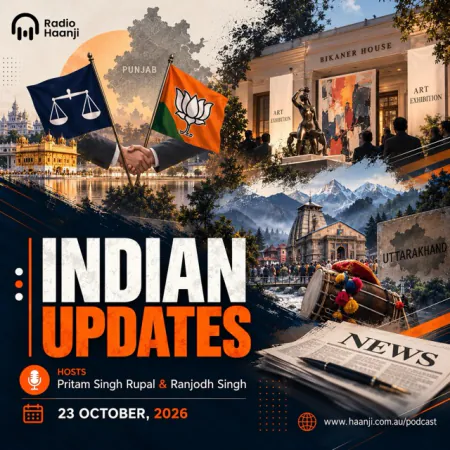













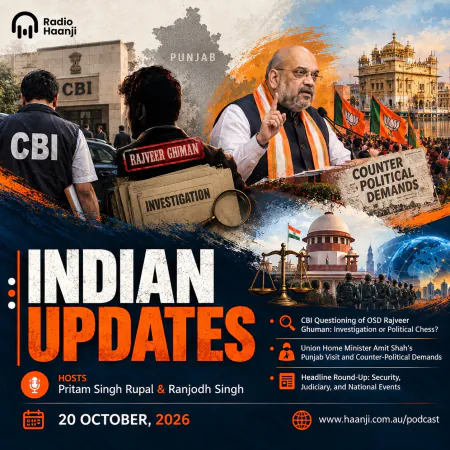



































































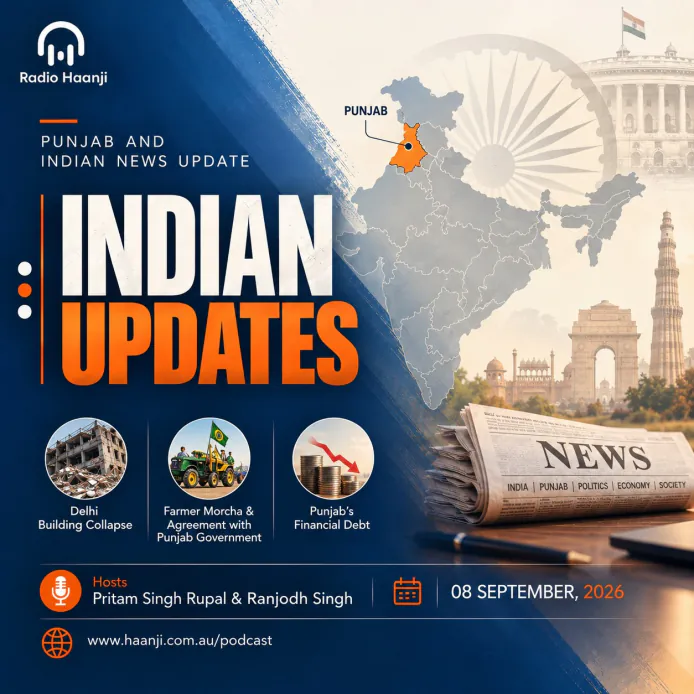
08 Sept - Indian Updates - Punjab Governance & Current Affairs - Pritam Singh Rupal & Ranjodh Singh
Host:-
 Pritam Singh Rupal
 Ranjodh Singh
Radio Haanji breaks down the Delhi PG collapse, Sanjha Kisan Morcha’s border pact, Punjab's ₹2,000 crore debt, and the High Court oath dispute.
The rapid pace of administrative and political events across North India has brought several critical governance issues to the forefront. On Radio Haanji 1674 AM’s Indian Updates, host Ranjodh Singh and veteran analyst Pritam Singh Rupal examined a series of significant developments that highlight the ongoing frictions between state governance, public welfare, and executive accountability.
From the tragic structural collapse of a student accommodation facility in South Delhi to the lifting of a week-long farmer blockade on the Chandigarh–Mohali border, the bulletin cut through political posturing to assess concrete outcomes. Alongside these events, the Punjab government’s decision to tap the open market for additional debt and an unprecedented executive boycott of the Punjab and Haryana High Court Chief Justice’s swearing-in ceremony have sparked intense constitutional and financial debate.
For community members, students, and agricultural families tracking these shifts, understanding the legal and operational realities behind political statements is critical. Rather than treating these news events as isolated headlines, the discussion underscored a common theme: the growing distance between administrative promises and durable governance solutions.
Episode Details
-
Show: Indian Updates
-
Broadcaster: Radio Haanji 1674 AM
-
Host: Ranjodh Singh
-
Analyst: Pritam Singh Rupal
-
Broadcast Date: 8 September 2026
-
Listening Platforms: Radio Haanji Mobile App | Spotify Podcast Directory | Apple Podcasts Directory
Satya Niketan Building Collapse: Seven Dead as Law Enforcement Moves In
Public outrage has intensified in the national capital following the collapse of a five-storey residential building in South Delhi’s Satya Niketan, which claimed seven lives. The structure, situated near South Campus, was operating as an overcrowded commercial paying-guest (PG) accommodation housing outstation college students. Emergency personnel extricated twelve survivors from the debris, while five injured individuals remain under hospital care.
Following the tragedy, Delhi Police launched a multi-state investigation, tracking down and apprehending the 81-year-old property owner, retired Indian Air Force Sergeant Hariram Gupta, in Bhiwadi, Rajasthan. Authorities also arrested his 75-year-old wife, Urmila, in whose name the property was registered, and their 52-year-old son, Mahesh. Investigators revealed that around 15 cramped rooms had been partitioned across the property without adequate safety checks or municipal compliance, yielding over ₹4 lakh per month in rent.
The incident has triggered severe political blowback. Opposition leaders, including Congress MP Rahul Gandhi, criticised urban administrative oversight by pointing out systemic failures in preventing recurring municipal disasters. While civic authorities have suspended several zonal engineers and ordered inspections of unauthorised vertical extensions across Delhi, the tragedy has renewed urgent demands from student bodies and parliamentarians for safe, regulated, and state-backed student housing.
Sanjha Kisan Morcha Calls Off Chandigarh Border Sit-In
Commuters and local businesses on the Chandigarh–Mohali border experienced relief after the Sanjha Kisan Morcha formally called off its week-long protest. The agitation, which had severely disrupted traffic along major arterial junctions near the AISHER roundabout, ended after a two-and-a-half-hour negotiation between farmer union leaders and senior Punjab Cabinet ministers, including Agriculture Minister Gurmeet Singh Khuddian and Health Minister Dr Balbir Singh.
The state government agreed to convene a special session of the Punjab Vidhan Sabha to table resolutions opposing the central Dam Safety Act, the proposed Seed Bill, and the river-water allocation mechanisms outlined under Sections 78, 79, and 80 of the Punjab Reorganisation Act, 1966. Additionally, the administration committed to holding consultative meetings with opposition parties regarding cooperative bank debt relief for small farmers and expediting pending sugarcane arrears from private sugar mills.
During the broadcast, analyst Pritam Singh Rupal offered a critical reading of the agreement. While union leaders hailed the conclusion as a major victory, Rupal questioned whether passing symbolic resolutions in the state assembly would provide meaningful relief to smallholders. Because river-water accords and parliamentary statutes fall strictly within the constitutional remit of the central government, state-level resolutions cannot unilaterally amend or repeal federal legislation. Rupal argued that without binding financial relief or structured interest waivers for marginal cultivators holding less than 2.5 acres, procedural compromises risk becoming political staging exercises rather than permanent agrarian remedies.
Punjab Government Prepares to Raise ₹2,000 Crore in Fresh Market Debt
Against the backdrop of continuing fiscal obligations, the Punjab government announced plans to raise an additional ₹2,000 crore through the auction of state government securities. According to official notifications, the administration will secure ₹1,200 crore via 17-year maturity stock and ₹800 crore via 9-year tenure stock to fund ongoing capital expenditure and balance revenue accounts.
The broadcast noted that this borrowing round pushes the state’s total debt additions for the ongoing financial year toward the ₹40,000 crore mark. During public discussions, state leadership has frequently defended its borrowing levels by drawing comparisons to the larger debt totals carried by populous states such as Uttar Pradesh.
Analyst Pritam Singh Rupal countered this justification, observing that crude debt-volume comparisons ignore fundamental economic scale. Uttar Pradesh possesses significantly higher tax revenues, a larger demographic base, and broader resource generation capacities. For an agrarian economy like Punjab, high-interest market borrowings create heavy long-term debt-servicing burdens, leaving shrinking budgetary headroom for health infrastructure, industrial growth, and rural welfare.
Executive Absence Marks Swearing-In of High Court Chief Justice
A constitutional standoff between the Punjab executive and the judiciary reached an unprecedented stage during the formal swearing-in ceremony of Justice Ashwani Kumar Mishra as the Chief Justice of the Punjab and Haryana High Court. Punjab Governor Gulab Chand Kataria administered the oath of office at Lok Bhawan in Chandigarh, with Haryana Governor Ashim Kumar Ghosh and Haryana Chief Minister Nayab Singh Saini in attendance.
However, the ceremony was marked by an empty front-row chair. Punjab Chief Minister Bhagwant Mann and his cabinet colleagues boycotted the oath-taking, following an emergency cabinet meeting where the state government passed a resolution arguing that the Union Government had notified the judicial appointment without adequately considering Punjab’s inputs.
Opposition parties strongly condemned the boycott. Leaders from the Congress and the Shiromani Akali Dal argued that boycotting a judicial oath-taking undermines institutional decorum and constitutional stability. Commentators also pointed to recent High Court rulings that directed the state administration to clear pending dearness allowance arrears for public employees as a source of underlying executive friction. Rupal noted on air that bypassing a constitutional swearing-in sets a concerning precedent for executive-judicial relations in the state.
Key Takeaways
-
Delhi PG Safety Under Scrutiny: The arrest of the 81-year-old property owner in the Satya Niketan collapse highlights systemic negligence and the critical need for strict enforcement of municipal building codes for student housing.
-
Agrarian Morcha Suspended: While the Sanjha Kisan Morcha ended its border blockade following government assurances, key demands—such as water sharing and central farm acts—depend on federal jurisdiction rather than state assembly resolutions alone.
-
Fiscal Pressures Mounting: A new ₹2,000 crore bond issuance brings Punjab’s market borrowing for the fiscal year close to ₹40,000 crore, raising concerns over long-term debt sustainability.
-
Constitutional Standoff in Chandigarh: The Punjab Cabinet’s deliberate absence from Chief Justice Ashwani Kumar Mishra’s swearing-in marks an unprecedented institutional rift between the state executive and the High Court.
Listen to the Full Analysis
As governance challenges intersect across urban safety, agricultural policy, and judicial independence, critical reporting remains essential for the Punjabi diaspora and local communities alike. The complete discussion on Indian Updatesprovides nuanced, unedited commentary on the structural realities driving North India's current affairs.
Listen to the full broadcast on the Radio Haanji Mobile App, or subscribe to the program on Spotify Podcast Directoryand Apple Podcasts Directory.
4. Sources and Further Reading
-
The Economic Times, Satya Niketan building collapse: Owner Hariram apprehended in Bhiwadi after 7 killed in Delhi (Supports Delhi building collapse details, casualty figures, and owner arrest).
-
The Times of India, Satya Niketan building collapse: 2 more bodies found, toll climbs to 7; owner earned Rs 4L/month (Supports police charges, names of accused family members, and monthly rental operations).
-
ThePrint, Bhagwant Mann’s ‘drunken’ remark adds fizz to Punjab-Centre standoff over new high court chief justice (Supports swearing-in details, executive boycott, and opposition responses).
-
India Today, Amid Punjab govt protest, Justice Ashwani Kumar Mishra takes oath as HC Chief Justice (Supports cabinet resolution details and formal objection to the appointment).
Related Radio Haanji Content
5. Editorial Notes
-
Analyst Attribution Update: The analyst in the broadcast is confirmed as Pritam Singh Rupal. All references to the on-air political commentary, economic critique, and legal observations have been attributed to Pritam Singh Rupal, with Ranjodh Singh as host.
-
Correction of Judicial Figure: In the audio bulletin, the analyst referenced "Ashwini Sharma / Mishra". Fact-checking confirms that Justice Ashwani Kumar Mishra took the oath of office as Chief Justice of the Punjab and Haryana High Court on 7 September 2026. The written article accurately names Chief Justice Ashwani Kumar Mishra.
-
Attribution of Political Claims: Commentary regarding Chief Minister Bhagwant Mann visiting a former minister in jail represents on-air discussion and has been contextualised alongside reported official statements concerning the cabinet's formal boycott.
Frequently Asked Questions
Why was the Satya Niketan PG building collapse considered preventable?
What did the Punjab government agree to during negotiations with farmer leaders?
Why is Punjab’s recent bond issuance under scrutiny?
Why did Punjab’s Chief Minister skip the Chief Justice’s oath ceremony?
What's Your Reaction?







Related Posts