




































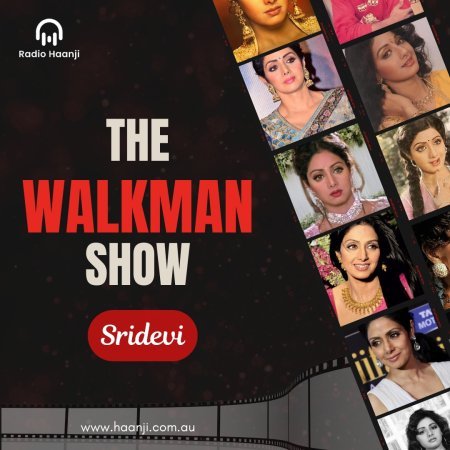












Sridevi: First Female Superstar | Radio Haanji's The Walkman Show With Gautam Kapil
Host:-
 Gautam Kapil
India's first female superstar Sridevi celebrated on The Walkman podcast. Gautam Kapil on Radio Haanji 1674 AM explores Nagina, Chandni, Mr India legacy
Sridevi: India's First Female Superstar – Celebrated on Radio Haanji's The Walkman
On a recent episode of The Walkman on Radio Haanji 1674 AM, host Gautam Kapil took listeners on an unforgettable journey through the life and career of Sridevi—India's first female superstar. For over an hour, the best Punjabi podcast in Australia explored how a four-year-old child artist from Tamil Nadu transformed into Bollywood's most iconic leading lady, ruling the industry for nearly five decades. From her breakthrough performance in Sadma to her triumphant comeback in English Vinglish, Gautam Kapil's thoughtful commentary honored a legend whose influence transcends generations.
About Radio Haanji's The Walkman Show
While The Deep Talk tackles current affairs and social issues, The Walkman represents Radio Haanji's deep dive into Bollywood nostalgia and Hindi cinema heritage. Hosted by Gautam Kapil, the show celebrates the golden age of Indian cinema, featuring retrospectives on legendary actors, classic films, iconic music, and the artists who shaped the entertainment industry. For the Indian and Punjabi community in Australia, The Walkman serves as a cultural bridge—connecting first-generation immigrants with their cinematic roots while introducing younger generations to timeless classics.
What makes The Walkman unique among Punjab podcasts in Australia is its comprehensive approach. Unlike simple music shows, Gautam Kapil combines film history, biographical storytelling, and cultural analysis. When discussing Sridevi, he didn't just play her hit songs—he contextualized her career within the broader landscape of 1980s Bollywood, explained her revolutionary impact on female representation in cinema, and connected her journey to the immigrant experience of pursuing dreams in challenging circumstances.
???? Listen to The Walkman on Radio Haanji
Experience Bollywood's greatest moments through Gautam Kapil's expert storytelling on The Walkman. Stream Radio Haanji 1674 AM 24/7 via mobile app (iOS/Android), tune to 1674 AM in Melbourne and Sydney, or access podcasts on Apple Podcasts, Spotify, Google Podcasts, and Amazon Music. Discover why Radio Haanji is the best Indian radio station in Australia!
Sridevi: The Journey from Child Artist to Superstar
Born as Shree Amma Yanger Ayyapan on August 13, 1963, in Sivakasi, Tamil Nadu, Sridevi entered the film industry at an impossibly young age. Her father Ayyapan, a lawyer, and mother Rajeswari supported her acting ambitions from the beginning. Sridevi made her debut at just four years old in the 1967 Tamil film Kandhan Karunai. By 1969, she was already playing lead roles as a child in films like Thunaivan.
As Gautam Kapil emphasized on The Walkman, what set Sridevi apart was her natural screen presence. Unlike many child artists who struggle with the transition to adult roles, Sridevi seamlessly evolved. Her first adult role came in 1976 at age 13 in the Tamil film Moondru Mudichu opposite Rajinikanth and Kamal Haasan. The breakthrough, however, was 16 Vayathinile (1977), which established her as South Indian cinema's brightest young star.
Early Career: South Indian Cinema Dominance
Before conquering Bollywood, Sridevi was already a phenomenon in Tamil, Telugu, Malayalam, and Kannada cinema. Throughout the late 1970s and early 1980s, she worked with legendary actors including Kamal Haasan (27 films together), Rajinikanth, N.T. Rama Rao, and Krishna. Her versatility shone through—she could handle intense drama in Sigappu Rojakkal (1978), social commentary in Varumayin Niram Sivappu (1980), and pure emotion in Moondram Pirai (1982).
The 1982 Tamil film Moondram Pirai opposite Kamal Haasan became a watershed moment. Sridevi played a woman suffering from amnesia who regresses to childhood after a head injury. Her performance was so nuanced and heartbreaking that the film won the National Film Award for Best Actor for Kamal Haasan and Best Cinematography. More importantly, it caught Bollywood's attention.
Bollywood Conquest: The 1980s and 1990s Reign
Sridevi's Hindi film debut technically came in 1975 as a child actor in Julie, but her first adult Hindi lead role was in Solva Sawan (1979). The real turning point came with Himmatwala (1983) opposite Jeetendra. The film became a massive blockbuster, and suddenly, Sridevi was Bollywood's hottest new star. Filmfare magazine famously declared her "Unquestionably #1" on their cover—unprecedented recognition for a South Indian actress.
The Sadma Phenomenon (1983)
While commercial hits brought fame, critical acclaim came with Sadma (1983), the Hindi remake of Moondram Pirai. Sridevi reprised her role as Nehalata, the child-woman suffering from amnesia. The Indian Express called it "a milestone in her illustrious career." Even though the film underperformed commercially, critics recognized they were witnessing something special—an actress who could disappear completely into a character.
As Gautam Kapil noted on Radio Haanji, Sadma demonstrated Sridevi's incredible range. She transitioned from the traumatized innocence of a mentally regressed woman to brief moments of adult awareness with such subtlety that viewers forgot they were watching a performance. It remains one of Indian cinema's finest acting achievements.
The Jeetendra Partnership
Between 1983 and 1988, Sridevi and Jeetendra became Bollywood's most successful on-screen pair, delivering 16 films together. Hits included Justice Chaudhry (1983), Tohfa (1984), Maqsad (1984), and Ghar Sansar (1986). While these weren't necessarily critically acclaimed films, they solidified Sridevi's box office power and proved she could carry commercial entertainers with ease.
Iconic Films That Defined an Era
Sridevi's Career-Defining Movies:
- Nagina (1986) - Snake fantasy that made her the biggest female star
- Mr. India (1987) - Sci-fi classic with iconic "Hawa Hawai" performance
- Chandni (1989) - Yash Chopra's romantic masterpiece
- ChaalBaaz (1989) - Brilliant double role comedy
- Lamhe (1991) - Emotionally complex mother-daughter dual role
- Khuda Gawah (1992) - Epic opposite Amitabh Bachchan
- Gumrah (1993) - Intense thriller performance
- Laadla (1994) - Playing a villainous business tycoon
- Judaai (1997) - Her pre-hiatus family drama
- English Vinglish (2012) - Triumphant comeback
- Mom (2017) - Final film, National Award winner
Nagina (1986): The Game-Changer
When Nagina released in 1986, it redefined what female-led films could achieve at the box office. As a shape-shifting serpent seeking revenge, Sridevi commanded the screen with such authority that the film became the second highest-grossing film of 1986. Her iconic "Main Teri Dushman" dance sequence remains legendary—a perfectly executed snake dance that gave audiences "goosebumps" (as Desi Hits later described it).
Box Office India noted that with Nagina's success, Sridevi remained "the undisputed #1" female star, establishing her position as Bollywood's biggest female star of the 1980s—rivaling even male superstars like Amitabh Bachchan and Dharmendra. This was revolutionary in an industry where male stars traditionally dominated.
Mr. India (1987): The Hawa Hawai Phenomenon
Director Shekhar Kapur faced a unique dilemma while filming the iconic "Hawa Hawai" song sequence in Mr. India. Should he film close-ups to capture Sridevi's incredible facial expressions, or take long shots to showcase her mesmerizing dance moves? The problem was simple: Sridevi excelled at both simultaneously.
Playing journalist Seema opposite Anil Kapoor's invisible hero, Sridevi demonstrated killer comic timing—particularly in her Charlie Chaplin impersonation scene. The Times of India later called "Hawa Hawai" "one of the unforgettable numbers of Sridevi," and it became so synonymous with her that it served as a nickname. The film emerged as 1987's highest-grossing hit and achieved cult classic status.
Gautam Kapil discussed on The Walkman how Mr. India showcased Sridevi's versatility—she could be glamorous, funny, vulnerable, and fierce all in the same film. Rediff noted she was "a complete show-stealer," with trade insiders joking the film should have been titled Ms. India.
Chandni (1989): Yash Chopra's Muse
If one film had to represent Sridevi's peak stardom, it would be Yash Chopra's Chandni. The romantic musical became one of 1989's biggest blockbusters and won the National Film Award for Best Popular Film. Sridevi's portrayal of Chandni—a woman navigating love, loss, and second chances—was filled with innocence, charm, and grace.
The "Chandni Look" became a national phenomenon. Designer Leena Daru created an understated salwar-kameez style that women across India copied. The Tribune wrote: "Every street corner sold the salwar-kameez and dupatta that gave the heroine a refreshingly understated look." Sridevi's dance in "Mere Haathon Mein Nau Nau Choodiyaan" and her rendition of the title track became instant classics.
CNN-IBN ranked her first on their list of Yash Chopra's top heroines, stating he "immortalized Sridevi as the perfect Chandni." India Today and NDTV concurred, noting the film "established Sridevi as the nation's sweetheart."
ChaalBaaz (1989): Double Role Mastery
Released the same year as Chandni, ChaalBaaz proved Sridevi could excel in slapstick comedy just as brilliantly as romantic drama. Playing twin sisters Anju (timid and traumatized) and Manju (bold and street-smart), she delivered two completely distinct performances in one film. Her comic timing was so perfect that Rediff later observed she made co-stars Sunny Deol and Rajinikanth "look like sidekicks."
The rain-soaked "Na Jaane Kahaan Se Aayi Hai" dance became iconic, with The Times of India describing it as "a Sridevi classic where she simply looked wow with her chirpy expressions and rain drops kissing her cheeks." The performance earned her the Filmfare Best Actress Award. Filmfare magazine ranked it 4th in their list of "80 Iconic Performances of Hindi Cinema."
Awards and Recognition
Major Awards and Honors:
• National Film Award for Best Actress - Mom (2017, posthumous)
• Filmfare Awards - 7 total (including Lifetime Achievement Award)
• Filmfare Best Actress - ChaalBaaz (1989)
• Filmfare Best Actress (Tamil) - Meendum Kokila (1981)
• Filmfare Best Actress (Telugu) - Kshana Kshanam (1991)
• Tamil Nadu State Film Award - Moondram Pirai (1982)
• Padma Shri - India's fourth-highest civilian honor (2013)
• State Honors - Full state funeral with 21-gun salute (2018)
The Personal Side: Family and Relationships
Despite her larger-than-life screen persona, Sridevi was remarkably private off-screen. She was known as reticent and introverted—a stark contrast to the headstrong, outspoken characters she portrayed. She started working at age four and missed conventional childhood experiences like school and college. "There was no time to think and I was grateful for it," she once said about her whirlwind career.
Marriage to Boney Kapoor
In 1996, Sridevi married film producer Boney Kapoor, elder brother of actor Anil Kapoor (her frequent co-star). Their relationship attracted controversy as Boney was previously married to Mona Kapoor, with whom he had two children—Bollywood actor Arjun Kapoor and daughter Anshula. Despite the complicated circumstances, Sridevi and Boney built a life together, having two daughters: Janhvi Kapoor (born 1997) and Khushi Kapoor (born 2000).
After marrying, Sridevi took a 15-year hiatus from films to focus on motherhood. Both daughters have since entered the entertainment industry, with Janhvi becoming a successful Bollywood actress. As Gautam Kapil mentioned on The Walkman, Sridevi's decision to step away at the peak of her career demonstrated her priorities—family came first, even over superstardom.
The Remarkable Comeback: English Vinglish (2012)
After 15 years away from cinema, most actresses would face an uphill battle returning. Not Sridevi. In 2012, she starred in English Vinglish as Shashi Godbole, a housewife mocked by her husband and daughter for not speaking English. She enrolls in an English class and, in the process, rediscovers her self-worth and confidence.
The performance was universally acclaimed. Variety magazine said Sridevi was "charmingly disarming, recalling Audrey Hepburn." Canadian media called her the "Indian Meryl Streep." The Times of India described it as "a masterclass" in acting. The film grossed over ₹120 crore worldwide, proving Sridevi's timeless appeal.
With English Vinglish's success, Sridevi became the only actress in Bollywood to successfully return as a leading lady after marriage and such a long hiatus. The comeback was hailed as one of the greatest in Indian cinema history.
Mom (2017): The Final Performance
Sridevi's 300th and final film was the psychological thriller Mom, in which she played Devki, a mother seeking revenge for a horrific crime against her daughter. The performance showcased her ability to convey vulnerability and rage simultaneously, elevating what could have been a simple revenge thriller into a powerful emotional journey.
Critics praised the performance extensively. The Quint wrote that Sridevi "infused Devki with a vulnerability and rage that made Mom so much more than a revenge saga." Posthumously, she was awarded the National Film Award for Best Actress—a fitting tribute to a career that began at age four and spanned five decades.
Legacy and Impact on Indian Cinema
As Gautam Kapil discussed on The Walkman, Sridevi's impact on Indian cinema cannot be overstated. She was genuinely India's first female superstar—an actress whose name alone could guarantee a film's success, regardless of the male lead. In an industry dominated by hero worship, this was revolutionary.
• First actress to command fees equal to male superstars (₹1.1 million for Mr. India in 1987)
• Proved female-led films could be massive blockbusters (Nagina, Chandni)
• Worked in 270+ films across 5 languages (Hindi, Tamil, Telugu, Malayalam, Kannada)
• Career spanning 50+ years (1967-2018)
• Influenced generations of actresses who followed
• Demonstrated that married actresses with children could still be leading ladies
Influence on Future Generations
Every major Bollywood actress after Sridevi—from Madhuri Dixit to Kajol to Priyanka Chopra to Deepika Padukone—has acknowledged her influence. She proved that female actors could have longevity, could command top billing, and could excel in any genre from comedy to drama to action to dance.
Her daughter Janhvi Kapoor, now carving her own path in Bollywood, has spoken about the impossible standard Sridevi set. "How do you follow that?" Janhvi once said. "You don't—you just try to honor it by doing your best work."
The Tragic End
On February 24, 2018, Sridevi was found dead in her hotel room at the Jumeirah Emirates Towers in Dubai, where she had attended a family wedding. Initially reported as cardiac arrest, Dubai Police investigations concluded the cause was accidental drowning. She was just 54 years old.
The news shocked India and the global Indian diaspora. Her funeral on February 28 in Mumbai was attended by thousands, and she was accorded full state honors with a 21-gun salute—reserved for heads of state and exceptional individuals. The honor reflected her status as a national icon. Sridevi was included in the 2018 In Memoriam section during the 90th Academy Awards ceremony, acknowledging her global impact.
Sridevi's Connection to the Australian Indian Community
For the Indian and Punjabi community in Australia served by Radio Haanji, Sridevi represents a connection to homeland cinema. Many first-generation immigrants grew up watching her films in the 1980s and 1990s. When Gautam Kapil discusses her on The Walkman, he's not just reviewing movies—he's evoking memories of watching Chandni in packed theaters in Mumbai or Chennai, or dancing to "Hawa Hawai" at family gatherings.
For younger Australian-born Indians, The Walkman's Sridevi retrospective serves as cultural education. Understanding her significance helps them appreciate their parents' generation's cultural touchstones. Radio Haanji bridges this generational gap, making classic cinema accessible and relevant.
Why The Walkman's Tribute Matters
Gautam Kapil's exploration of Sridevi on The Walkman wasn't merely nostalgic programming—it was cultural preservation. In an era when Bollywood churns out content at breakneck speed, older classics risk being forgotten. Shows like The Walkman ensure that new generations understand the foundations upon which contemporary cinema is built.
By discussing Sridevi's career trajectory, her revolutionary impact, and her artistic achievements, Radio Haanji performs a vital service for Australia's Indian community. The podcast becomes an archive, a classroom, and a celebration all at once. This is what makes Radio Haanji the best Punjabi podcast in Australia—it doesn't just entertain; it educates and preserves culture.
????️ Discover More Bollywood Legends on The Walkman
Gautam Kapil's The Walkman explores the greatest stars, films, and music of Indian cinema every week on Radio Haanji 1674 AM. From golden age classics to modern masterpieces, experience Bollywood's rich heritage through expert storytelling and carefully curated content.
Listen to Radio Haanji:
???? Frequency: 1674 AM (Melbourne & Sydney)
???? Mobile Apps: iOS & Android (Search "Radio Haanji")
???? Podcasts: Apple Podcasts, Spotify, Google Podcasts, Amazon Music, YouTube
???? Website: haanji.com.au
???? Join the community and never miss episodes of The Walkman and other top shows!
Conclusion: An Eternal Screen Goddess
When author Satyarth Nayak titled his 2019 biography "Sridevi: The Eternal Screen Goddess," published by Penguin Random House, the name was perfect. Even in death, Sridevi remains omnipresent in Indian popular culture. Her films continue to be watched, her songs are still played at every celebration, and her influence pervades contemporary cinema.
As Gautam Kapil concluded on The Walkman episode, Sridevi wasn't just an actress—she was a phenomenon. She demonstrated that talent, dedication, and charisma could transcend language barriers, regional boundaries, and industry conventions. From a four-year-old child in Tamil Nadu to Bollywood's first female superstar, her journey inspired millions.
Her legacy lives on through her films, through her daughters continuing in entertainment, and through tributes like The Walkman's thoughtful retrospective on Radio Haanji. For the Australian Indian community and beyond, Sridevi remains what she always was—a screen goddess whose magic will never fade.
Next time you hear "Hawa Hawai" or see clips of that iconic blue sari from "Kaate Nahin Kat Te," remember: you're witnessing greatness. And thanks to Radio Haanji's The Walkman, new generations will continue discovering why Sridevi earned the title of India's first female superstar—and why she'll remain the eternal screen goddess forever.
What's Your Reaction?