


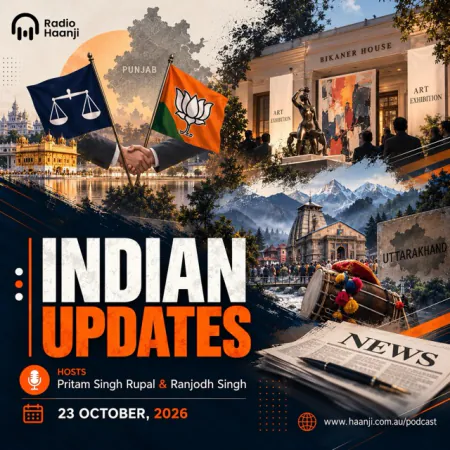






































































Indian Updates 23 Mar 2026 - Laljit Bhullar Arrest Punjab
Host:-
 Pritam Singh Rupal
 Ranjodh Singh
Pritam Singh Rupal unpacks the Bhullar arrest, Randhawa's suicide video and what it reveals about AAP's accountability crisis in Punjab. Free on Radio Haanji.
Indian Updates — 23 March 2026 | The Fall of Laljit Singh Bhullar — AAP's Accountability Crisis in Punjab — Radio Haanji
Punjab woke up on March 23, 2026 to the arrest of a sitting cabinet minister — an image that carries far heavier weight than any political statement. In today's edition of Indian Updates on Radio Haanji 1674 AM, Ranjodh Singh is joined by Senior Journalist Pritam Singh Rupal — whose decades at All India Radio Chandigarh and deep roots in Punjabi public life bring rare context to a story that is as much about institutional accountability as it is about one minister's fall from grace.
The Video That Brought Down a Minister
The story begins, as so many modern political crises do, with a video. On March 21, 2026, Gagandeep Singh Randhawa — a District Manager with the Punjab State Warehousing Corporation in Amritsar — consumed Celphos, a highly toxic pesticide, and died during treatment at a private hospital. Before taking his own life, Randhawa recorded a brief video in Punjabi. In the footage, he said simply that his friend had consumed poison out of fear of Minister Laljit Bhullar, and that he would not survive. That twelve-second recording became one of the most explosive pieces of evidence to emerge in Punjab politics in recent years.
Randhawa did not die quietly. He died having named the man he held responsible — and having ensured the world would hear it. The video spread rapidly across social media, and within hours, Punjab's political landscape had been upended entirely.
What the Investigation Has Uncovered
The complaint that triggered the FIR was filed by Randhawa's widow, Upinder Kaur, at Ranjit Avenue Police Station in Amritsar on March 22, 2026. The allegations are grave and specific. According to the complaint and a subsequent petition filed in the Punjab and Haryana High Court by Randhawa's mother, the District Manager had been subjected to sustained pressure by Bhullar and his associates to manipulate tender contracts in the Patti region — awarding mandi loading contracts to the minister's own father, Sukhdev Singh Bhullar.
When Randhawa reportedly resisted, the situation escalated dramatically. According to the family, he was summoned to the minister's residence on March 13, where he was allegedly physically assaulted, humiliated, and threatened. His family claims he was told that hired criminals were tracking his movements and those of his family, and that he was coerced into recording a video falsely implicating himself in bribery — which the family says was manufactured to blackmail him into compliance. A demand for a ten-lakh-rupee bribe was also alleged. Unable to withstand the sustained pressure, threats, and alleged humiliation, Randhawa took his own life.
The FIR names Bhullar, his father Sukhdev Singh Bhullar, and his Personal Assistant Dilbag Singh as primary accused. Randhawa's family subsequently refused to cremate the body until the FIR was formally registered — an act of quiet, devastating resolve that put the government under immediate and unmistakable public pressure. Randhawa's mother also moved the High Court seeking directions for an out-of-state postmortem to ensure an impartial examination, expressing fears that a Punjab-based process could be compromised.
Bhullar Resigns — Then Gets Arrested
The political consequences moved faster than usual. Chief Minister Bhagwant Mann accepted Bhullar's resignation on March 21 — the same day the story broke — and ordered a high-level probe led by Chief Secretary K A P Sinha. Bhullar, an AAP MLA from Patti in Tarn Taran district, denied all the allegations categorically, describing them on social media as completely baseless and false. He said he had sought a thorough investigation to reveal the truth and had requested the party to accept his resignation to avoid any embarrassment to the government.
That measured tone did not last long. By March 22, there were reports that Bhullar's whereabouts were unclear, prompting speculation that he was evading police. Bhullar pushed back publicly, insisting that he had never fled from the truth and that he had full confidence in the law and the justice system. On March 23 — the day of this broadcast — he was arrested at Mandi Gobindgarh in Fatehgarh Sahib district. The Punjab and Haryana High Court had already entered the picture, issuing notices to the Punjab government and calling for a response on the allegations and the circumstances of Randhawa's death. The High Court's intervention — including the petition seeking a neutral postmortem — signals that the judiciary is not prepared to let institutional pressure bury this case.
The Opposition's Leverage and AAP's Accountability Problem
For the opposition, this case has been a gift and a grim validation simultaneously. SAD leader Bikram Singh Majithia was among the first to demand a CBI investigation, along with a postmortem at PGI Chandigarh or AIIMS Delhi rather than at a Punjab government facility. Congress MP Gurjit Singh Aujla from Amritsar called for CCTV footage from Bhullar's residence to be seized immediately. Multiple political figures and social organisations have called for not just Bhullar's removal — which has already happened — but for an independent central investigation that removes the case entirely from any sphere of influence the AAP government might exercise.
The deeper problem for the AAP is what this case represents in the broader narrative of their Punjab tenure. Chief Minister Bhagwant Mann came to power in 2022 on an explicit promise of zero-tolerance governance — clean administration, no corruption, no political interference in public institutions. Within two months of taking office, then-Health Minister Vijay Singla was removed and arrested for allegedly demanding a bribe of sixteen crore rupees. Since then, multiple AAP-affiliated legislators in Punjab have faced serious criminal allegations — from extortion and fraud to sexual assault. The Bhullar case arrives not as a first incident but as a continuation of a pattern that the party has struggled to explain away.
For the Punjabi diaspora in Australia and around the world, who often maintain deep ties with families and institutions back home, the case raises a question that goes beyond one minister. It asks whether the structures meant to protect government officials from political coercion — the bureaucracy, the warehousing corporation, the police, the courts — have the independence they need to function honestly. When a district manager cannot resist a minister's pressure without fearing for his life, it reveals something about the environment in which Punjab's civil servants are being asked to work.
This Is Not Bhullar's First Controversy
It is worth noting — as Pritam Singh Rupal's analytical lens makes clear — that Laljit Singh Bhullar is not a first-time offender in the court of public opinion. In April 2024, he publicly apologised for derogatory remarks made against the Ramgarhia and Suniyar communities during a rally in Patti, remarks that drew immediate condemnation. There have also been prior allegations relating to land belonging to an NRI woman in his constituency. He began his political career with the Shiromani Akali Dal before moving to Congress and eventually landing with AAP — a trajectory not unusual in Punjab's fluid political landscape, but one that suggests a degree of tactical alignment rather than ideological commitment.
The questions now being asked are not merely about Bhullar. They are about the AAP government's selection criteria for ministers, its willingness to act before a situation reaches crisis point, and whether the political culture of Punjab — which has historically been susceptible to the blurring of lines between governance and personal benefit — has fundamentally changed under the current administration, or whether it has simply changed its preferred party.
Why Indian Updates on Radio Haanji Matters for the Diaspora
The Laljit Singh Bhullar case will be followed closely by Indian media for weeks. But for the Punjabi community in Australia and Singapore, the daily noise of Indian news coverage — fragmented, politically polarised, and frequently driven by partisan interests — makes it difficult to understand what a case like this actually means. That is what Indian Updates on Radio Haanji 1674 AM does differently. Ranjodh Singh and Pritam Singh Rupal do not just report what happened. They provide the institutional context, the political history, and the human stakes that turn a news item into an informed understanding.
For NRIs who care deeply about Punjab — who have family there, who send remittances, who watch the governance of their home state with a combination of hope and concern — this kind of daily analysis, available free through the Radio Haanji podcast, is a resource unlike anything else serving this community from Australian shores.
Listen to Indian Updates — Free, Every Weekday
Get the analysis that matters, delivered with integrity and depth, every weekday morning on Radio Haanji 1674 AM.
Radio Haanji 1674 AM is Austalia's Punjabi community radio station.
Listen free at haanji.com.au | Spotify | Apple Podcasts | iOS App | Android App
Serving the Punjabi community in Australia, Canada, Singapore and world wide.
What's Your Reaction?