





































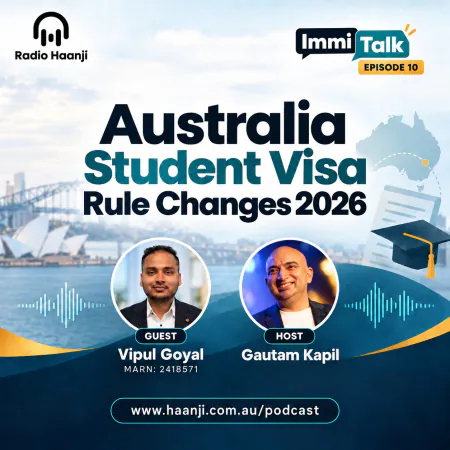

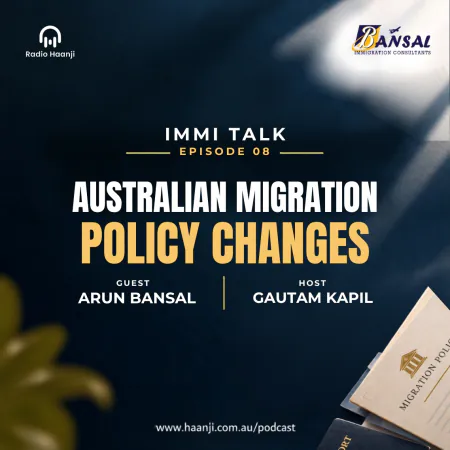















































Australian Migration Policy Changes: Immi Talk - Arun Bansal - Gautam Kapil
Host:-
 Gautam Kapil
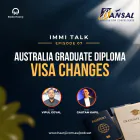
Understand Australian migration policy changes with Arun Bansal from Bansal Immigration (MARN: 2418466) on Radio Haanji 1674 AM. Listen to the episode.
Immigration rules in Australia often move in sweeping cycles, shifting between expansionary intake and tightened scrutiny in response to domestic economic pressures, political debates, and housing constraints. Navigating these Australian migration policy changes requires distinguishing between media-driven announcements and parliamentary legislation that has actually taken effect. On Episode 8 of Immi Talk, broadcast on Radio Haanji 1674 AM, host Gautam Kapil sat down with guest Arun Bansal from Bansal Immigration (MARN: 2418466) to analyze the trajectory of Australian migration and explain what the latest regulatory discussions mean for temporary visa holders.
The conversation offered a detailed review of how policy frameworks have evolved over the past decade and a half. From the dissolution of old demand lists in 2010 to the introduction of modern skill assessment structures, historical context reveals that current tightening measures are not entirely unprecedented. Understanding this broader timeline allows applicants to evaluate their status rationally rather than reacting to unverified claims circulating online.
By examining the mechanical changes in skilled migration, regional initiatives, student integrity checks, and sponsorship thresholds, Gautam Kapil and registered migration agent Arun Bansal from Bansal Immigration (MARN: 2418466) laid out a clear roadmap of where the system has been and where it is directed. Their discussion provides essential context for applicants seeking clarity in a changing immigration landscape.
Where to Listen
Catch the full broadcast of Immi Talk Episode 8 featuring host Gautam Kapil and guest Arun Bansal from Bansal Immigration (MARN: 2418466) on Radio Haanji 1674 AM. You can stream this episode and explore past discussions across the station's audio channels:
-
Spotify
-
Apple Podcasts
-
Radio Haanji Mobile App
Episode Highlights
The broadcast explored critical turning points in Australian immigration history, contrasting past regulatory overhauls with ongoing strategic updates:
-
Policy Intent vs. Enacted Law: Arun Bansal from Bansal Immigration (MARN: 2418466) explained that broad political announcements often require legislative passage or formal gazetting before taking effect, meaning publicized proposals may face delayed implementation or structural amendments.
-
The 2010–2012 Skilled Overhaul: The discussion traced the end of supply-driven pathways, such as the Migration Occupations in Demand List, and the arrival of demand-driven processing under the points-based SkillSelect framework.
-
Temporary Work Visa Evolution: The hosts examined the retirement of the long-standing Subclass 457 visa, its replacement by the Temporary Skill Shortage Subclass 482 visa, and the subsequent adjustments to baseline requirements.
-
Regional Migration Push: A review of the 2019 decentralization strategy, highlighting how policy shifted toward regional subclasses 491 and 494 while lowering metropolitan planning caps.
-
Pandemic Disruptions and Rebound: How emergency measures, unrestricted student working rights, and the subsequent 195,000-place planning level in 2022–2023 created post-lockdown dynamics that regulators are now addressing.
-
Integrity Reforms and Salary Benchmarks: Analysis of the December 2023 Migration Strategy, covering the replacement of the Genuine Temporary Entrant criterion with the Genuine Student test, the development of the Core Skills Occupation List, and elevated income thresholds.
How Do Proposed Visa Reforms Differ from Enacted Migration Law?
Proposed visa reforms represent government intent and strategic direction, whereas enacted migration law consists of legislation and formal regulations passed by Parliament and officially gazetted. Announcements cannot be enforced by case officers until the relevant legislative instruments or policy guidelines are formally implemented into law.
Public discussions surrounding immigration frequently confuse political rhetoric with active regulation. During the program, Arun Bansal from Bansal Immigration (MARN: 2418466) emphasized that government press conferences outlining stricter visa requirements or proposed caps are often statements of future intent. These concepts may be tied to future financial year cycles—such as potential rollouts targeted for July 2027—or adjusted as parliamentary scrutiny and industry feedback take shape.
When panic spreads across social networks, applicants often mistake proposed policy directions for active refusal criteria. Decision-makers within the Department of Home Affairs must assess applications against the specific legislative criteria in force at the time of decision or lodgement, depending on the visa subclass. Until statutory rules change, existing migration pathways remain governed by existing legal frameworks.
Understanding this distinction prevents temporary visa holders from making hasty, ill-advised application decisions. Staying informed on the parliamentary timeline ensures that applicants base their choices on real legal criteria rather than prospective policies that may be revised or deferred before enactment.
The Structural Shift: Tracing Reforms from 2010 to SkillSelect
To understand current compliance standards, Kapil and Bansal reviewed the major pivot that occurred under the Labor government in 2010. Prior to that period, Australia operated primarily on a supply-driven migration system. Under that model, individuals could complete targeted qualifications from broad occupational catalogs and apply directly for permanent residency, regardless of whether domestic employers actively required those skills.
On 8 February 2010, the federal government abolished the Migration Occupations in Demand List (MODL). It replaced this catalog with the more targeted Skilled Occupation List (SOL), reducing eligible occupations from around 400 down to 181. This reform removed direct independent pathways for several high-volume vocational fields, including commercial cookery and hairdressing, requiring applicants to pursue employer sponsorship or state-nominated avenues instead. The overall permanent intake for the 2010–2011 program year was subsequently managed around 160,000 to 170,000 places, with skilled stream quotas adjusted to prioritize specialized employment.
This restructuring established the foundation for the points-based General Skilled Migration model, culminating in the launch of SkillSelect in July 2012. SkillSelect eliminated direct, uninvited visa applications by mandating an Expression of Interest (EOI). From that point forward, prospective migrants had to be formally invited by the government based on competitive ranking across age, English proficiency, employment history, and educational attainment before lodging an application.
From Subclass 457 to 482: The Rise of Employer Sponsorship
The employer-sponsored category experienced its next major disruption between 2017 and 2018 under the Coalition government. The long-standing Subclass 457 visa, which had served as the primary temporary corporate sponsorship route for over two decades, was formally phased out. In its place, the government established the Subclass 482 Temporary Skill Shortage (TSS) visa.
The Subclass 482 visa Australia framework introduced targeted streams linked directly to specific occupation lists, separating eligibility into short-term and medium-term pipelines. Concurrently, baseline pass marks for general points-tested invitations were raised from 60 to 65 points, signaling an era of elevated entry criteria. Alongside the standard Subclass 482 framework, targeted pathways such as the Regional Sponsored Migration Scheme (RSMS) were refined to direct corporate hiring outside major metropolitan hubs.
By 2019, policy shifted more heavily toward regional development. The federal government lowered the overall migration planning cap from 190,000 to 160,000 places and introduced dedicated regional visas: the Skilled Work Regional (Provisional) Subclass 491 and the Skilled Employer Sponsored Regional (Provisional) Subclass 494. These regional subclasses were designed to address severe regional labor shortages while easing infrastructure pressures in Sydney, Melbourne, and Brisbane.
Why Did Australia Transition from the GTE to the Genuine Student Test?
Australia replaced the Genuine Temporary Entrant (GTE) criterion with the Genuine Student (GS) test to recognize that international students can legitimately pursue post-study pathways, while assessing applicant study intentions, academic progression, and financial capacity rather than solely measuring intent to return home.
Under the historical GTE standard, applicants were evaluated largely on their intent to complete studies and leave Australia, even as official policy simultaneously promoted post-study work rights and skilled pathways. Arun Bansal from Bansal Immigration (MARN: 2418466) pointed out on Immi Talk that this created an inherent contradiction. Many students who entered on genuine temporary premises eventually transitioned into skilled employment needed by the domestic economy.
The Genuine Student requirement, rolled out following the release of the December 2023 Migration Strategy, removed this ambiguity. Instead of evaluating whether a student plans to return home immediately, case officers now examine whether the student understands their intended course, possesses the academic and financial ability to succeed, and is choosing education for personal career development.
At the same time, this integrity overhaul established stricter assessment benchmarks across educational institutions and visa processing offices. The changes aim to curb non-genuine enrollments, prevent parallel course switching without formal release, and ensure that those entering the international education sector are committed students rather than individuals utilizing study visas solely to work.
How Are Salary Thresholds Changing Under the Core Skills Framework?
Salary thresholds under the Core Skills framework establish higher baseline income floors for employer-sponsored migrants, ensuring sponsored workers are compensated at market rates and preventing the undercut of local wages while focusing skilled migration on genuine, higher-earning workforce shortages.
During the broadcast, Gautam Kapil and Arun Bansal from Bansal Immigration (MARN: 2418466) reviewed the ongoing restructuring of employer-sponsored programs, specifically the transition toward the Core Skills Occupation List (CSOL) and tier-based processing. A key focus was the adjustment of the Temporary Skilled Migration Income Threshold (TSMIT). Having remained frozen at 53,900 Australian dollars for a decade, the threshold was updated to reflect modern wage data.
The discussion emphasized that standard employer-sponsored avenues require market salaries that align with current benchmarks, such as standard earnings tiers of 70,000 to 73,150 Australian dollars, while specialized pathways require salaries meeting higher tiers, such as 135,000 Australian dollars or more. These requirements create distinct operational challenges for businesses in service industries and hospitality.
Bansal noted that while specialized tiers provide faster processing for high-income earners, mid-tier occupations face closer scrutiny. Employers must demonstrate that compensation packages meet strict legal definitions without relying on unverified bonuses, ensuring that skilled migration complements rather than supplants the domestic workforce.
The Reality of Onshore Visa Hopping and Visitor Conditions
A central theme of the episode was the federal focus on onshore visa hopping rules. Over recent years, growing numbers of temporary migrants remained onshore for extended periods by continually shifting between visitor visas, temporary graduate visas, and lower-level vocational study programs to defer departures.
Arun Bansal from Bansal Immigration (MARN: 2418466) clarified that the enforcement tools to stop this pattern are not new inventions. Conditions such as Condition 8503 (No Further Stay), which prevents an onshore visa holder from applying for most substantive visas while remaining in Australia, have been routinely applied to tourist visas for years. The government has increasingly applied these conditions automatically to minimize onshore status cycling.
The episode highlighted that during the pandemic emergency, migration restrictions were paused. International students were granted uncapped work hours to address critical supply chain shortages, and arrivals rebounded sharply once borders reopened. In the 2022–2023 financial year, the permanent migration planning level was lifted to 195,000 places to fill the accumulated worker shortfall.
As emergency settings wind down, regulatory bodies are tightening transitions between tourist visas and student visas. The hosts emphasized that while regulatory scrutiny has increased, individuals with genuine qualifications, compliant visa histories, and demonstrable skills will still find viable, lawful migration pathways.
Key Takeaways
-
Policy announcements regarding immigration changes are statements of political intent and cannot be enforced by case officers until passed into formal law or gazetted.
-
Australia's shift from supply-driven to demand-driven skilled migration began with the abolition of the MODL in 2010 and the rollout of SkillSelect in 2012.
-
The Subclass 482 visa framework and subsequent regional subclasses (491 and 494) established targeted, employer-led pathways over broad independent entry.
-
The Genuine Student requirement replaced the contradictory GTE framework to evaluate real academic intent rather than an unrealistic expectation of departure.
-
Heightened salary requirements under the Core Skills framework aim to protect domestic wages and target migration toward verifiable skill gaps.
-
Restrictions on onshore visa hopping rely largely on existing mechanisms, such as Condition 8503, which are being enforced more consistently.
References and Further Reading
-
Migration Strategy (December 2023) — Policy roadmap outlining the Core Skills framework, Genuine Student requirement, and integrity measures in international education.
-
Department of Home Affairs Historical Planning Data — Records tracing planning levels from 160,000 places in 2010 to 195,000 in 2022–2023.
Navigating Australia's immigration system requires tuning out social media speculation and focusing on established legal requirements. As host Gautam Kapil and guest Arun Bansal from Bansal Immigration (MARN: 2418466) highlighted throughout this discussion, policy follows historical cycles of tightening and adjustment, but clear opportunities remain for skilled, compliant applicants. To hear the complete discussion, listen to Episode 8 of Immi Talk on Spotify, Apple Podcasts, or via the Radio Haanji mobile app.
Frequently Asked Questions
What was the MODL in Australian immigration?
Has onshore visa hopping been completely banned?
How does the Genuine Student test affect student visa applicants?
Can cooks and hairdressers still apply for permanent residency?
What is the purpose of the Core Skills Occupation List?
Will proposed changes apply retroactively to already submitted visas?
What's Your Reaction?