
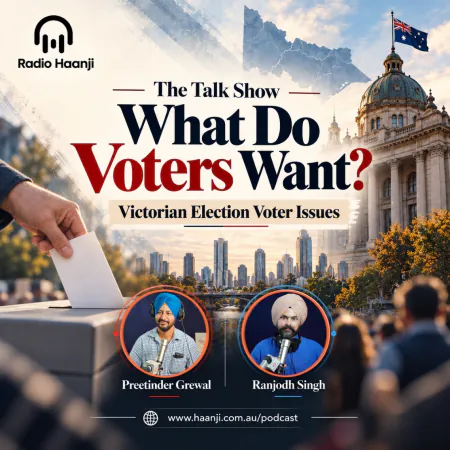


































































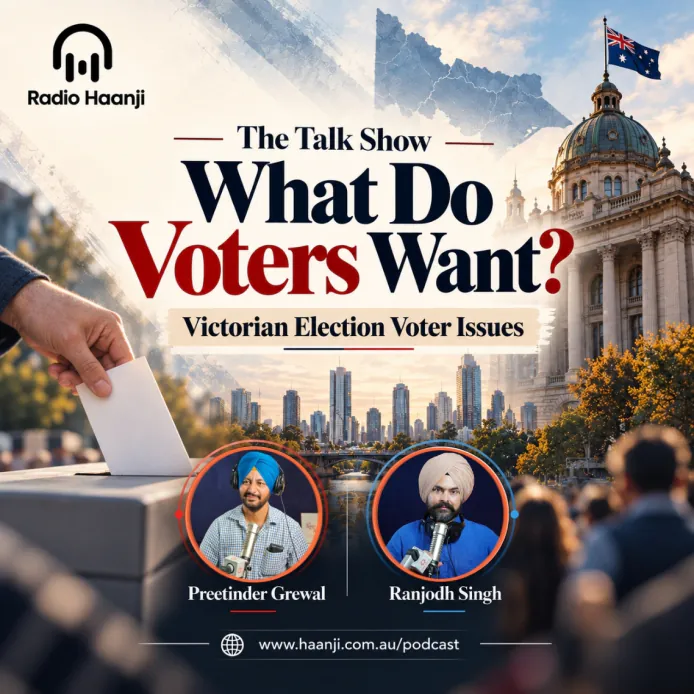
What Do Voters Want? Victorian Election Voter Issues - The Talk Show - Preetinder Grewal & Ranjodh Singh
Host:-
 Preetinder Grewal
 Ranjodh Singh
What Do Voters Want? Victorian Election Voter Issues explored via The Talk Show on Radio Haanji with Preetinder Grewal and Ranjodh Singh, from cost of living to how preferential voting works.
When election campaigns ramp up, political advertising often crowds out the genuine voices of everyday citizens. On The Talk Show, broadcast live on Radio Haanji 1674 AM, hosts Preetinder Grewal and Ranjodh Singh strip back the party slogans to examine the core Victorian election voter issues dominating community conversations. By looking closely at independent polling and practical local concerns, their discussion reveals what is genuinely motivating voters as they prepare to cast their ballots.
Whether in growing outer-suburban family corridors or across regional Victoria, residents face tangible pressures that dictate their perspective on election day. Rising power and water bills, escalating payroll costs for small businesses,community safety debates, and regional infrastructure gaps all contribute to voter sentiment. Examining these matters provides a transparent, balanced look into the choices facing the state.
Where to Listen
The Talk Show is presented by Preetinder Grewal and Ranjodh Singh on Radio Haanji 1674 AM. Catch complete broadcasts, panel discussions, and community interviews across these official streaming channels:
Episode Highlights
The program reviews the broad civic landscape across metropolitan Melbourne and regional towns, noting how local neighborhood concerns can differ significantly from government messaging. The hosts highlight that whether an individual runs a family trade, works an office job, or studies, their direct economic circumstances heavily influence their voting decisions.
The hosts also examine recent survey benchmarks, notably late-October Roy Morgan polling that quantifies community concerns into specific percentages. Alongside these economic metrics, the conversation delves into historical voting trends in Victoria, parliamentary balance across both houses, and why preference flows from minor parties often make or break candidate victories.
What Are the Main Issues in the Victorian Election?
The primary voter issues in the Victorian state election are cost of living pressures, state debt and government expenditure, community safety, and local infrastructure maintenance. According to a Roy Morgan survey conducted in late October, cost of living ranks as the top concern for 25% of voters, followed by debt and expenditure at 23%.
These numbers paint a clear picture of households feeling the weight of monthly bills. Surging electricity rates, water fees, and land tax changes put pressure on domestic budgets, while small-business operators face high operating costs.Because finances are tight, public expenditure on major infrastructure projects comes under intense scrutiny from taxpayers.
Crime and neighborhood safety stand out as another pressing priority, cited by 20% of respondents in the Roy Morgan findings. Conversations around youth offenses, car thefts, and bail enforcement remain frequent topics in suburban communities and state news. In regional communities, road maintenance, pothole patching, and transport quality account for 12% of voter concern, reflecting frustration that basic regional upkeep has lagged behind city investments.Housing affordability completes the core set of voter concerns.
How Does Preferential Voting Work in Victoria?
Preferential voting requires voters to rank candidates in order of choice rather than marking a single candidate. If no candidate achieves an absolute majority of 50% plus one vote on the first count, the candidate with the fewest votes is eliminated, and their ballots are redistributed to the remaining candidates based on subsequent preferences.
The preferential voting system in Victoria ensures that a candidate cannot take an electorate purely on a small plurality if the broader electorate rejects them. As counts progress, preferences move upward. A candidate who trails on first-preference primary votes can secure victory if they gather a healthy share of secondary preferences from eliminated minor parties or independent candidates.
As discussed on The Talk Show, many electors mistakenly assume party "how-to-vote" cards are legal rules. In practice,those cards are merely tactical recommendations prepared by parties to maximize their own advantage. Voters have the legal right to number the boxes on their ballot paper however they see fit, giving individual preference choices enormous power in tight contests.
Why Are Marginal Seats Important in Victorian Elections?
Marginal seats decide which party can form government because they are held by razor-thin margins—often less than a single percentage point. Because safe seats rarely change hands, political parties focus their campaign resources, policy announcements, and local community outreach on these volatile districts where minor vote swings shift parliamentary balance.
Several districts across Victoria showcase this high-stakes environment. Electorates such as Pakenham rest on an extremely narrow margin of roughly 0.4%, while Bass and Northcote sit on knife-edge margins near 0.2%. In regional areas, Shepparton has regularly proven to be a pivotal contest involving independent candidates and major party challengers. Other critical seats include Prahran, Richmond, Ripon, and Hastings, where preference swaps with minor parties or independents can determine the outcome.
In these battleground electorates, even slight changes in demographic patterns or voter turnout can flip the result. When first-preference margins between major parties are tight, a swing of just a few hundred votes can change the member representing the area, making marginal districts the ultimate deciders of state elections.
Victoria's Two-House Parliament: Legislative Assembly vs Legislative Council
To follow Victorian politics closely, it is essential to understand the distinction between the two houses of the state parliament: the Legislative Assembly (Lower House) and the Legislative Council (Upper House). Government is formed in the Lower House, where 88 Members of Parliament represent individual geographical districts. A political party or formal coalition must command a majority of these 88 seats to elect a Premier and govern.
The Upper House, or Legislative Council, consists of 40 members elected across broader multi-member regions, with five members representing each region. This chamber operates as a house of review. Bills introduced and passed in the Legislative Assembly must also win approval in the Legislative Council before they can officially pass into state law.
Because minor parties and independents often gain representation in the Legislative Council through proportional voting, sitting governments rarely hold an absolute majority there. As a consequence, passing legislation requires active negotiation, consensus-building, and cross-bench consultation across both chambers.
Key Takeaways
-
Cost of living represents the single largest voter concern at 25%, closely followed by government debt and public expenditure at 23% (Roy Morgan).
-
Crime and community safety remain urgent priorities, registered as a primary concern by 20% of surveyed voters (Roy Morgan).
-
Victoria's preferential voting system requires a winning candidate to secure over 50% of the vote, making minor party preference distributions decisive.
-
Marginal electorates such as Pakenham (0.4% margin) and Bass and Northcote (0.2% margins) serve as the primary battlegrounds determining government formation.
-
The Legislative Assembly determines which party forms executive government with 88 seats, while the 40-member Legislative Council acts as the reviewing house.
Decisions made at the ballot box impact local roads, household expenses, and community safety long after election night.Taking time to look past campaign slogans, evaluate local candidates, and understand preference allocations ensures that your vote carries maximum weight. For deeper breakdowns and continuous community discussions, tune in to full episodes of The Talk Show on Spotify, Apple Podcasts, or through the Radio Haanji mobile app.
Frequently Asked Questions
When are Victorian state elections held?
What is the difference between primary votes and preference votes?
What percentage of votes constitutes a marginal seat in Victoria?
Does a party need to control both houses of parliament to govern?
How do polling surveys measure voter preferences before an election?
What's Your Reaction?