





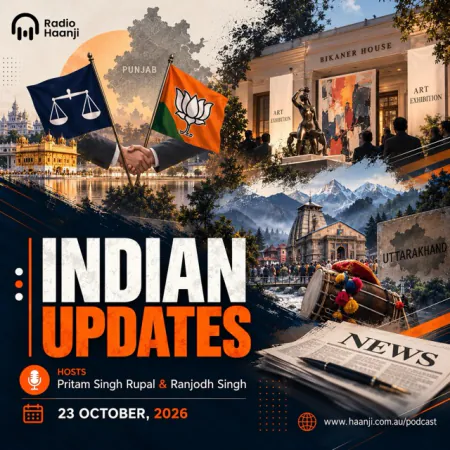
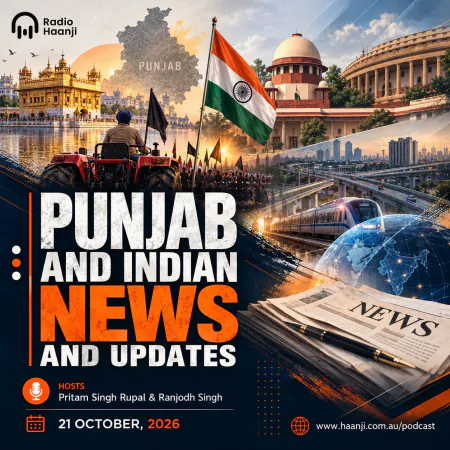
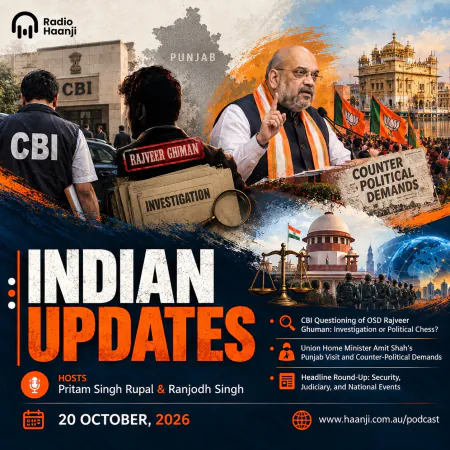







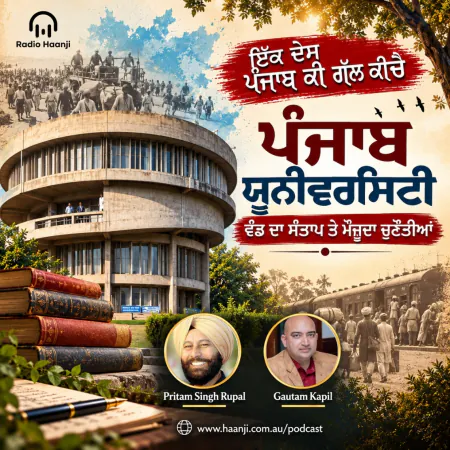




































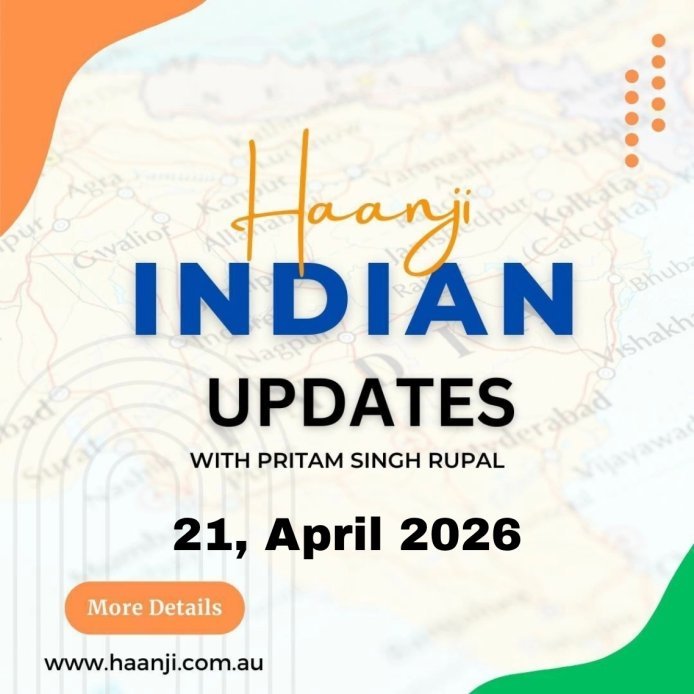


Pritam Singh Rupal analyzes Punjab's new sacrilege law and the federalism debate. Get trusted NRI news insights free every weekday on Radio Haanji.
Indian Updates — 21 April 2026 | Federalism, Punjab Be-adbi Law and the Vishwaguru Debate — Radio Haanji
In today's edition of Indian Updates on Radio Haanji 1674 AM, Ranjodh Singh is joined by Senior Journalist Pritam Singh Rupal, whose decades of experience at All India Radio and deep roots in Punjabi journalism bring a rare clarity to stories that demand more than simple headlines. As the political landscape in India shifts through legislative battles and ideological debates, our analysis focuses on the broader implications for the state of Punjab and the wider Indian diaspora.
The notification of the Jaagat Jot Sri Guru Granth Sahib Satkar (Amendment) Act, 2026, marks a definitive moment in Punjab's legal history regarding religious sanctity. By implementing life imprisonment for acts of sacrilege against the Guru Granth Sahib, the state government has fulfilled a long-standing demand of various panthic organisations. However, the political fallout is just beginning as the ruling dispensation questions the perceived silence of traditional leadership. This law does not merely increase penalties but introduces a centralised register for every Saroop, fundamentally changing how religious oversight is managed in the state.
Parallel to this legal shift is the evolving situation regarding Balwant Singh Rajoana's mercy petition. The Shiromani Gurdwara Parbandhak Committee has now deferred to the Akal Takht Jathedar to decide whether the petition should be withdrawn. This move reflects a growing tension between regional religious institutions and the central government's consistent refusal to commute the sentence. For the diaspora, this represents a critical juncture in the relationship between the community's highest temporal seat and the judicial apparatus of the state.
The recent defeat of the Constitution Amendment Bill in the Lok Sabha has reignited a fierce debate over the federal structure of India. While the government framed the bill as a necessary step for women's reservation, the opposition, led by figures like Rahul Gandhi and M.K. Stalin, viewed the link to delimitation as a threat to the representation of southern and regional states. The failure of the bill to secure a two-thirds majority is being celebrated by regional parties as a victory for federalism, preventing a potential shift in the electoral map that could have significantly diluted the political weight of diverse states.
Further complicating the national narrative is the recent critique by veteran leader Murli Manohar Joshi, who cautioned against the "Vishwaguru" label. By suggesting that India is not yet a global teacher and instead advocating for the practical revival of Sanskrit, Joshi has opened a rare internal dialogue within the ruling ideological framework. His comments on the centralization of power, alongside the Supreme Court's refusal to interfere in West Bengal's voter registration dispute, underscore a period of intense institutional friction where the balance between central authority and regional rights remains unsettled.
Why Indian Updates on Radio Haanji Is Essential for the Indian Diaspora
For the Punjabi and Indian diaspora in Australia and Singapore, keeping pace with the rapid changes in regional politics can be a daunting task. Indian Updates serves as a vital bridge, translating complex legislative moves and judicial rulings into meaningful insights. By providing deep context rather than just news bulletins, the show helps NRIs understand how changes in Punjab's laws or India's federal structure directly affect their families, properties, and community standing.
This analytical approach is particularly important in an era of polarized information. Pritam Singh Rupal’s measured perspective ensures that listeners receive a balanced view that respects the cultural and political sensitivities of the diaspora. Whether it is a debate on linguistic heritage or a shift in criminal law, Radio Haanji remains the trusted voice for those who care deeply about the future of their homeland while building lives abroad.
Listen to Indian Updates — Free, Every Weekday
The full analysis of these stories and more is available now on all major podcast platforms. Stay informed with the most trusted Punjabi news analysis in the Southern Hemisphere.
Listen free:
Radio Haanji 1674 AM — Free to listen at haanji.com.au. Serving the Punjabi community across Australia, Singapore and worldwide.
Frequently Asked Questions
What is the new be-adbi law in Punjab notified in April 2026?
The Punjab government notified the Jaagat Jot Sri Guru Granth Sahib Satkar (Amendment) Act, 2026, which mandates life imprisonment for sacrilege against the Guru Granth Sahib. The law introduces a centralised register with unique identification for all Saroops and establishes strict penalties, including fines up to Rs 25 lakh for conspiracies.
Why was the Women's Reservation Bill defeated in the Lok Sabha?
The Constitution Amendment Bill failed to secure the required two-thirds majority on April 17, 2026. Opposition parties blocked the bill primarily because it linked women's reservation to a new delimitation process, which regional leaders argued would unfairly reduce the political representation of southern and smaller states in the Lok Sabha.
What did Murli Manohar Joshi say about India being a Vishwaguru?
Veteran leader Murli Manohar Joshi stated on April 20, 2026, that India is not currently a "Vishwaguru" and cautioned against using the term. He emphasized that India should aspire to that role through development and advocated for making Sanskrit an official language and integrating it into modern fields like quantum computing.
Conclusion
The intersection of religious law, federal rights, and national identity continues to define the current political moment in India. As Punjab navigates its new legal frameworks and the centre grapples with a revitalised opposition, the need for clear, senior-level journalism has never been greater.
Join us every weekday on Radio Haanji 1674 AM as we continue to track these developments with the depth and integrity the Indian diaspora deserves.
What's Your Reaction?