












































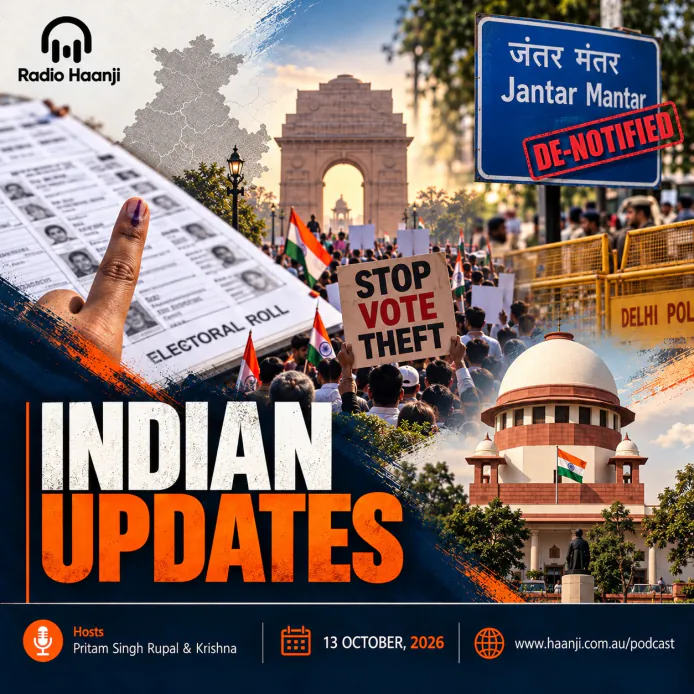
13 Oct - Punjab Voter Rolls & National Political Clashes - Pritam Singh Rupal
Host:-
 Pritam Singh Rupal
 Ranjodh Singh
Analysis with Pritam Singh Rupal & Ranjodh Singh on Punjab voter roll cleanup, Delhi political protests, and Bandi Singhs. Tune in to Radio Haanji now.
Electoral roll purges, street demonstrations, and escalating religious-political friction dominated the political radar today. On Indian Updates, senior Punjab journalist Pritam Singh Rupal sat down with Radio Haanji presenter Ranjodh Singh to evaluate the shifting power equations between Punjab and the national capital. From the quiet removal of 20 lakh voter records across Punjab to high-stakes confrontations at the Supreme Court and the Akal Takht, this broadcast unpacks the administrative logic and partisan battles behind the headlines.
Where to Listen
Catch the complete, unfiltered broadcast and ground analysis across official Radio Haanji platforms:
- Listen live and on demand: haanji.com.au
- Official Radio Haanji App: Available on iOS and Android (Download App)
- Stream on Radio Haanji on Spotify
- Subscribe on Radio Haanji on Apple Podcasts
The Core Issue: How and Why It Happened
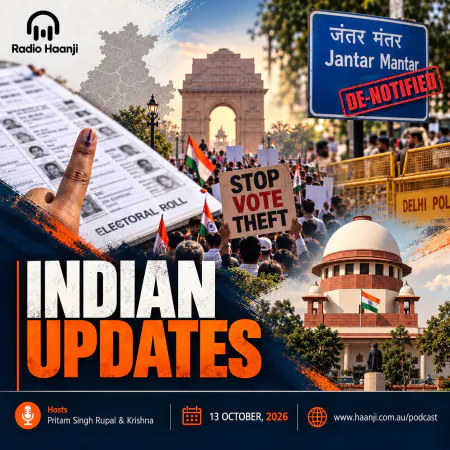
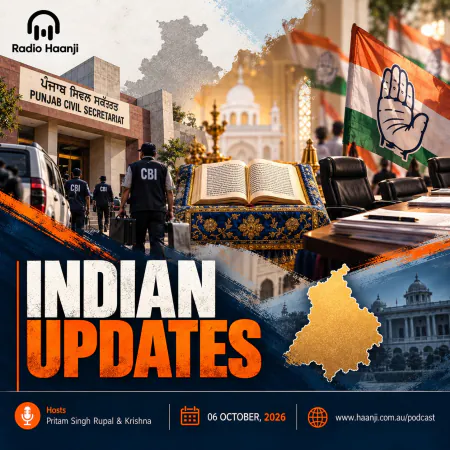
The Special Intensive Revision (SIR) process in Punjab recently concluded with an extraordinary statistic: over 2 million (20 lakh) voter entries were purged. This administrative exercise left Punjab with slightly above 20 million (2 crore) registered electors. During the broadcast, Pritam Singh Rupal highlighted a striking contrast between Punjab and states such as West Bengal, Bihar, or Delhi. While revision drives in other regions provoked public friction, targeted verifications, and accusations of profiling migrant communities, Punjab's cleanup transpired with minimal resistance. Rupal pointed out that the deletions primarily targeted deceased electors, dual registrants, and citizens who have permanently migrated abroad, rather than politically motivated disenfranchisement.
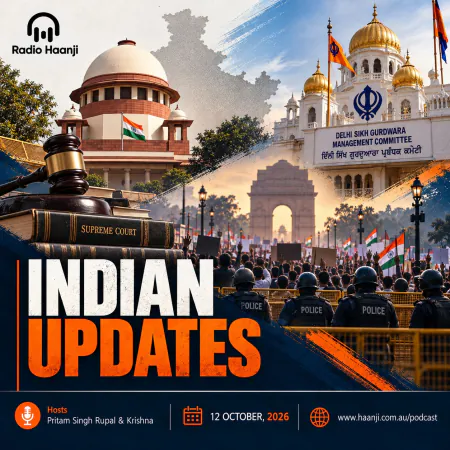
Meanwhile, the political temperature surged in New Delhi. A united opposition front led by the Congress staged an organized march from Connaught Place along Barakhamba Road toward the Supreme Court. The demonstration centered on allegations of vote theft. Rahul Gandhi demanded that Gyaneshwar Kumar step down from his post and testify as a witness in the ongoing controversy. Opposition leaders are actively building consensus on an impeachment motion, signaling a coordinated parliamentary and judicial offensive against the administration.
Ground Reality and Political Implications
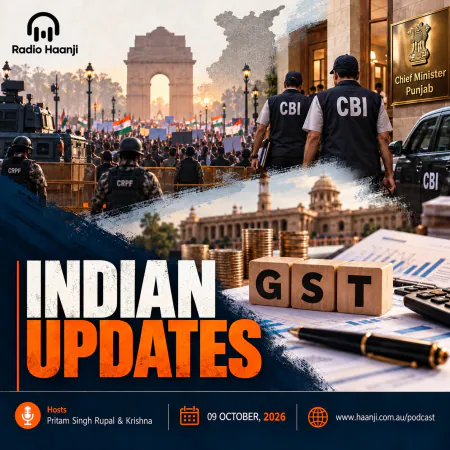
National administrative authorities have simultaneously tightened protest restrictions in New Delhi. Delhi Police de-notified Jantar Mantar as an authorized venue for public demonstrations, redirecting major gatherings to Ramlila Ground. As Pritam Singh Rupal observed on-air with Ranjodh Singh, shifting agitations away from the vicinity of Parliament and primary administrative corridors effectively reduces spontaneous crowds and dampens immediate media visibility. This administrative maneuver limits the opposition's capacity to disrupt day-to-day central government operations.
In the judicial arena, the Supreme Court provided partial relief to the Delhi Chief Minister's Officer on Special Duty (OSD), Ghuman. The bench ordered that no coercive action be taken against the official. Crucially, the apex court refused to quash the First Information Report (FIR), granting the Central Bureau of Investigation (CBI) explicit permission to proceed with its investigation. This measured ruling keeps legal pressure firmly on the Delhi administration while preventing immediate arrests.
Within Punjab, administrative controversies gave way to sensitive socio-religious friction. Aam Aadmi Party (AAP) MLAs approached the Akal Takht, demanding that the highest temporal seat of Sikh authority summon the Union Home Minister following an incident involving police personnel entering Gurdwara Bangla Sahib in New Delhi. The confrontation escalated rapidly when the Akal Takht Jathedar issued a summons directing the AAP legislators themselves to appear. This unexpected pivot placed the ruling state party on the defensive, turning a national protest into a localized theological scrutiny.
What Next: Key Forecasts
The long-standing demand for the release of Bandi Singhs (Sikh political prisoners) remains at the forefront of state affairs. Following an initial preliminary dialogue with morcha representatives, Punjab Chief Minister Bhagwant Mann publicly declared that the state administration will leave no stone unturned to secure their release. Pritam Singh Rupal emphasized that translating this pledge into reality will test state-federal dynamics, as executive pardons and premature releases require complex concurrence between state authorities, prison boards, and central ministries.
Politically, the opposition's momentum against electoral integrity concerns will face institutional barriers. While Rahul Gandhi and alliance leaders are pushing for parliamentary notices and judicial oversight, government agencies show no sign of halting investigations into opposition leaders and their administrative aides. Observers must watch how the AAP delegation responds to the Akal Takht summons, as well as whether morcha organizers accept the state government's reassurances regarding imprisoned Sikhs.
Why Were 20 Lakh Names Removed From Punjab's Voter Rolls?
Over 20 lakh voter entries were eliminated during Punjab's Special Intensive Revision (SIR) primarily due to routine administrative maintenance. Deletions addressed deceased citizens, duplicate registrations across constituencies, and electors who migrated overseas. Unlike other states experiencing community friction, the revision in Punjab proceeded without widespread dispute or targeted demographic profiling.
Pritam Singh Rupal noted that while the scale of 2 million deletions appears staggering, it aligns with demographic trends in Punjab, where high emigration rates and historic duplicate entries had inflated the rolls for years.
What Is the Dispute Over Gurdwara Bangla Sahib at the Akal Takht?
The dispute emerged after Delhi Police personnel entered the premises of Gurdwara Bangla Sahib, prompting AAP MLAs to petition the Akal Takht to summon the Union Home Minister. In response, the Akal Takht Jathedar summoned the AAP legislators themselves to explain their representations, sparking intense political debates across Punjab.
This counter-summons shifts the political spotlight back onto the elected representatives, testing how political parties engage with Sikh religious institutions during high-tension controversies.
Critical Analytical Takeaways
- Punjab's voter base now stands just over 20 million (2 crore) following the peaceful de-registration of 20 lakh invalid records.
- Unlike West Bengal or Bihar, Punjab experienced no major civil unrest during the extensive voter list revision.
- The Supreme Court shielded the Delhi CM's OSD from coercive action while keeping the CBI inquiry active.
- De-notifying Jantar Mantar as a protest site strategically confines political demonstrations away from Parliament to Ramlila Ground.
- The Akal Takht Jathedar's summons to AAP MLAs complicates their effort to target the central government over Gurdwara Bangla Sahib.
- Chief Minister Bhagwant Mann confirmed renewed state commitment to resolving the release of Bandi Singhs following preliminary stakeholder meetings.
For continuing ground analysis, legal updates, and transparent coverage of Indian and Punjab affairs, tune in to Indian Updates with Pritam Singh Rupal and the Radio Haanji presentation team every weekday. Download the Radio Haanji App or listen live across Australia and global diaspora hubs.
Frequently Asked Questions
What did the Special Intensive Revision process change in Punjab?
Why did opposition parties march to the Supreme Court from Connaught Place?
What did the Supreme Court decide regarding the Delhi Chief Minister's OSD?
Why did Delhi Police de-notify Jantar Mantar as a protest site?
What is the Punjab government's stance on the release of Bandi Singhs?
What's Your Reaction?