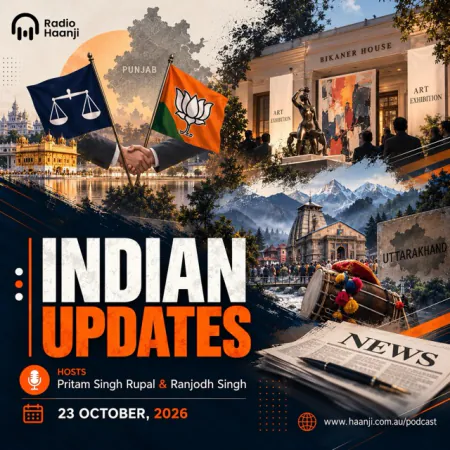










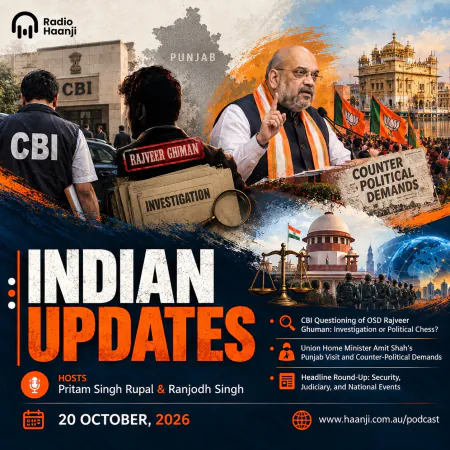




































































Indian Updates - 09 March 2026 - Punjab Budget and BJP Bengal Rally Analysis
Host:-
 Pritam Singh Rupal
 Ranjodh Singh
Preetam Singh Rupal analyses Punjab's budget, Mawan Dheean Yojana, Parliament session and BJP vs Mamata on Indian Updates, Radio Haanji 1674 AM. Listen free.
Indian Updates - 09 March 2026 - Punjab Budget, Parliament Session and BJP-Congress Power Plays - Analysis on Radio Haanji
Monday's edition of Indian Updates on Radio Haanji 1674 AM arrives with a packed political agenda that touches every major arena of Indian public life — from Punjab's state finances to the corridors of Parliament in New Delhi to the intensifying confrontation between the BJP and its rivals ahead of what promises to be a consequential month in Indian politics. Respected India-based journalist Preetam Singh Rupal brings his characteristic analytical clarity to five stories that, taken together, offer a revealing snapshot of where India stands politically at this moment.
Punjab's Budget Under the Microscope — What Harpal Singh Cheema's Numbers Will Reveal
Finance Minister Harpal Singh Cheema's presentation of the Punjab budget is one of the most significant political moments of the current season for the Aam Aadmi Party government in Chandigarh. A budget is never simply a financial document — it is a political statement, a declaration of priorities and, for a government approaching the midpoint of its term, a measure of whether the promises made to voters are being kept or quietly deferred.
Punjab's fiscal situation has been complex and, at times, challenging. The state carries a substantial debt burden inherited from previous administrations, and the AAP government has had to navigate between its ambitious welfare commitments — free electricity, improved health infrastructure, better schools — and the hard realities of limited revenue generation. The budget presented by Cheema will be scrutinised closely for how that balance has been struck.
For the Punjabi diaspora in Australia, this budget carries a particular resonance. Many members of Melbourne's Punjabi community have families in Punjab who depend directly on state-funded services. How the government allocates resources to agriculture, rural infrastructure, healthcare and education in this budget will determine the quality of daily life for millions — including the families left behind by those who built their futures abroad. The NRI community watches these developments with a mix of hope and pragmatic scepticism, having seen many budgets promise much and deliver variably.
What Preetam Singh Rupal examines on today's Indian Updates is not simply the figures presented, but the political narrative embedded within them — what the budget chooses to highlight, what it sidesteps and what it signals about the AAP's confidence heading into the second half of its term in Punjab.
Mawan Dheean Yojana — Welfare Policy or Political Signal?
The Punjab government's launch of the Mawan Dheean Yojana — a scheme specifically oriented toward the welfare of mothers and daughters — represents the AAP administration's continuing effort to build a welfare policy identity that is distinctly its own. Social welfare schemes in Indian state politics serve multiple purposes simultaneously: they address genuine need, they build electoral loyalty and they define the governing party's public character.
The scheme, announced alongside the budget period, is aimed at women and families and reflects a broader trend in Indian state-level politics of directing targeted welfare toward women as both a social and electoral priority. The success of such schemes tends to depend not merely on their design but on the effectiveness of their implementation — the gap between policy announcement and ground-level delivery has historically been a significant challenge for welfare programmes across multiple Indian states.
For Indians living in Australia who have mothers, sisters and daughters back home in Punjab, a scheme of this nature carries immediate personal relevance. The question that informed observers ask is not whether the intent is good — it generally is — but whether the administrative infrastructure exists to deliver outcomes at scale, and whether the funding committed in the budget is sufficient to make the programme meaningful rather than symbolic.
This is the kind of analytical depth that Indian Updates on Radio Haanji 1674 AM consistently brings to welfare policy stories that other platforms treat as straightforward announcements.
Parliament Reconvenes — The Second Session and What It Must Confront
The commencement of Parliament's second session today opens a legislative window that carries considerable weight given the volume of unresolved business on India's political agenda. Parliamentary sessions in India have increasingly become arenas of intense confrontation between the ruling BJP and a fragmented but energised opposition, and this session is unlikely to be an exception.
The agenda for the session will be shaped by the pressures of the moment — international developments, domestic economic concerns, unresolved legislative business from the previous session and the political calculations of a ruling party that is simultaneously managing governance and preparing for upcoming electoral contests. How productively Parliament functions during this session will be a measure of the health of India's democratic institutions at a time when that question is being asked with increasing frequency both within the country and by the Indian diaspora watching from abroad.
For the NRI community in Australia, Parliament's functioning matters in ways that are both symbolic and practical. Legislative decisions taken in these sessions — on taxation, on foreign investment frameworks, on overseas Indian affairs — can have direct consequences for the diaspora. Preetam Singh Rupal's analysis today places the session opening in its full political context, examining not just what may be discussed but what the session's dynamics will reveal about the balance of power in New Delhi.
BJP's 14 March Rally and the Modi-Mamata Confrontation in Bengal — Electoral Politics at Full Volume
The BJP's active preparation for a major rally on 14 March is a clear signal that the party is shifting into electoral mode, or at minimum, into a phase of intensive political mobilisation. Large rallies have been a defining feature of the BJP's political strategy across multiple election cycles, serving as demonstrations of organisational strength, opportunities for leadership messaging and mechanisms for energising the party base.
The context for this mobilisation is inseparable from the escalating confrontation between Prime Minister Narendra Modi and West Bengal Chief Minister Mamata Banerjee. Bengal has been one of the most fiercely contested states in Indian politics in recent years, and the tension between the BJP's central leadership and the Trinamool Congress government in Kolkata reflects a deeper struggle over the direction of the state and the loyalty of its electorate.
The clash between Modi and Mamata is not simply a personal or regional rivalry — it is a proxy for larger questions about federalism, the relationship between central and state power and the political future of non-BJP regional parties in an era of increasingly centralised national politics. For Indians in Australia who follow Indian democracy closely, this confrontation is one of the most instructive ongoing political stories in the country. It tests the boundaries of constitutional governance, the resilience of state-level political identities and the limits of the BJP's national dominance.
Preetam Singh Rupal's analysis today frames the Bengal situation not as a political drama to be watched from the sidelines, but as a significant indicator of where Indian democracy is heading — and what that trajectory means for every Indian, whether they live in Kolkata, Melbourne or anywhere in between.
Why Indian Updates on Radio Haanji Is Essential Listening for the Indian Diaspora
The Indian community in Australia is politically sophisticated, deeply connected to developments back home and genuinely hungry for analysis that matches the complexity of the events it covers. Indian Updates on Radio Haanji 1674 AM has built its reputation precisely by meeting that standard — delivering the kind of editorial depth that transforms a list of headlines into genuine understanding.
As an Indian current affairs podcast created specifically for the diaspora experience, Indian Updates understands that its listeners are not passive consumers of news. They are people with family, investments, emotional ties and cultural identity rooted in India, who need to understand not just what is happening but why it matters and what comes next. That is the analytical contract that Preetam Singh Rupal honours in every episode, and it is what makes this one of the best India analysis podcasts available to the Indian community in Australia today.
For NRIs managing the complexity of lives lived across two countries, finding a single trusted source for India political analysis is genuinely valuable. Indian Updates on Radio Haanji 1674 AM is that source — authoritative, consistent, community-aware and completely free. It is the programme that keeps the diaspora connected to the India that exists beyond the headlines, every weekday morning.
Listen to Indian Updates - Free, Every Weekday on Radio Haanji
Indian Updates is available free across all major listening platforms. Subscribe today and ensure you never miss an episode of analysis that matters.
Listen on Spotify — Follow Indian Updates on Spotify and receive every new episode directly in your library.
Listen on Apple Podcasts — Subscribe on Apple Podcasts for uninterrupted access on any Apple device.
Download the iOS app — Stream Radio Haanji live and explore the full episode archive on your iPhone or iPad.
Download the Android app — Android users can access Indian Updates and all of Radio Haanji's programming through the app on Google Play.
Radio Haanji 1674 AM | Punjabi Podcast | Broadcasting from Melbourne, Australia
Listen free at haanji.com.au | Available on Spotify & Apple Podcasts
Serving the Punjabi community across Melbourne · Sydney · Brisbane · Australia · Worldwide
What's Your Reaction?







Related Posts