


























































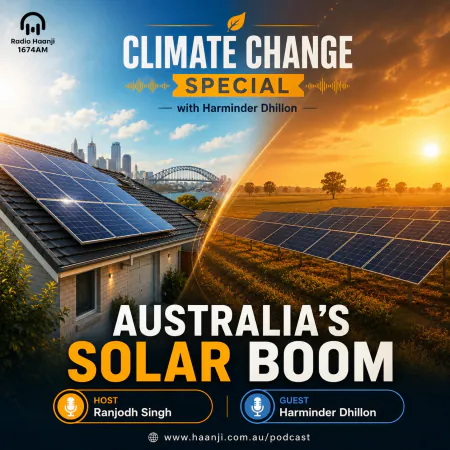


























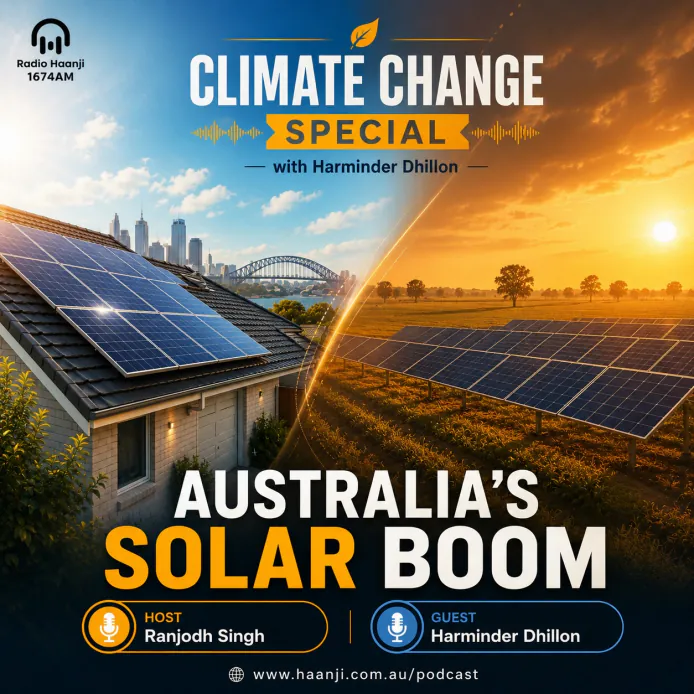
Australia's Solar Boom: Climate Change Special with Harminder Dhillon
Host:-
 Harminder Dhillon
 Ranjodh Singh
How 4 in 10 Australian homes now run on solar — and what it means for Punjab. Listen to the Climate Change Special on Radio Haanji.
Roughly four in every ten Australian homes now generate their own electricity from the sun. That single number — 4.5 million rooftops — was the starting point for a wide-ranging conversation on Radio Haanji's Climate Change Special, where host Ranjodh Singh sat down with lawyer, poet and 25-year climate advocate Harminder Dhillon to ask a simple question: what happens when a country goes all in on rooftop solar, and what does it mean for a place like Punjab that is only beginning to feel the pressure to change?
Dhillon is not a casual observer of this shift. As Board Chair of Canada's largest NGO focused on climate change, and the lead on a project installing solar power and rainwater harvesting systems at Punjab's largest historic Gurdwaras, he brings both policy fluency and on-the-ground experience to the discussion. The episode moves from Australia's grid statistics to Punjab's worsening floods and droughts to Dhillon's own all-electric household in Canada — a rare conversation that connects global clean-energy data to the everyday reality of diaspora families.
This article breaks down the key numbers and ideas from that episode, for listeners who want the details in writing and for anyone researching Australia's solar transition on its own merits.
Why Australia's Solar Numbers Matter Right Now
Australia did not arrive at its current solar adoption rate by accident. High electricity prices, abundant sunshine and years of state-level rebate programs combined to make rooftop solar one of the most attractive home investments in the country. The result is a grid that behaves very differently in 2026 than it did even five years ago.
Clean energy sources now generate roughly 36% of Australia's total electricity, with solar alone contributing anywhere from 18% to 30% depending on weather and time of day (Radio Haanji Climate Change Special, 2026). Coal, once the backbone of the national grid, has fallen to around 64% of generation. That is still a majority, but the trend line is unmistakable, and it is the backdrop against which the rest of the episode's discussion unfolds.
How Many Australian Homes Actually Have Solar Panels?
Approximately 4 in 10 Australian households — around 4.5 million homes — now have rooftop solar panels installed. This makes Australia one of the highest per-capita adopters of residential solar in the world, driven by state rebates, high daytime electricity rates and consistently strong sunshine hours across most of the country.
That figure did not emerge overnight. It reflects more than a decade of state and federal incentive programs stacking on top of falling panel costs, and it has fundamentally changed how Australian utilities plan for daytime demand. Where grids once worried about running out of power during the day, several now worry about having too much.
This is precisely the tension the episode explores next: what a grid does when solar supply outpaces daytime demand, and how that surplus is beginning to reshape household energy habits across the country.
Where Does All That Midday Solar Power Go?
Midday is now the point of maximum stress for the Australian grid, but not in the way older energy systems experienced stress. Instead of struggling to meet demand, many regions generate more solar power than homes and businesses need between roughly 11 a.m. and 2 p.m., creating a genuine oversupply problem on sunny days.
Two responses have emerged. First, government subsidies have helped around 420,000 Australian homes install battery storage systems, letting households bank their own midday surplus for use during the evening demand peak instead of exporting it to the grid for a low return. Second, several regions — including parts of New South Wales, Queensland and South Australia — now offer free or heavily discounted electricity during midday hours specifically to encourage households to shift usage, such as charging an electric vehicle, into that window (Radio Haanji Climate Change Special, 2026).
Both approaches point to the same underlying shift: the challenge is no longer generating clean electricity, but timing when people use it.
What Is Victoria's Free Midday Electricity Scheme?
Starting October 1, eligible Victorian households with a smart meter will be able to access free electricity during midday peak solar generation hours, between 11:00 a.m. and 2:00 p.m. The scheme is designed to soak up excess rooftop and grid-scale solar power that would otherwise go to waste, while giving households a direct financial incentive to shift flexible usage into daylight hours.
The mechanics are straightforward for anyone with a smart meter already installed, which is now standard across most of the state. Households do not need to change providers or install new hardware to qualify — the free window applies automatically for eligible plans once the scheme begins.
For a household weighing whether solar and a smart meter are worth the upfront cost, a scheme like this changes the calculation considerably, since it turns three hours of the day into essentially free electricity rather than just cheaper electricity.
How the Solar Homes Program Helps Households Pay for It
Cost remains the single biggest barrier to solar adoption for many families, which is why Victoria's Solar Homes Program pairs the free midday electricity scheme with direct financial support. Eligible residents earning under $150,000 annually can access rebates toward the upfront cost of a solar installation, along with interest-free loans repayable over 48 months to cover the remaining balance.
This combination — a rebate plus a no-interest repayment plan — is designed to remove the single biggest objection households raise about solar: that it pays for itself eventually, but the upfront cost is out of reach. By spreading repayment over four years while free midday power begins immediately, the program shortens the gap between installation and savings.
Programs like this are precisely the kind of policy lever Dhillon points to when discussing what a place like Punjab could eventually replicate, provided the financing structures exist to support it.
How Does Australia Compare to the Rest of the World?
Australia's household solar adoption is high, but it is not happening in isolation. China currently leads the world in total solar production capacity, powering both its domestic grid and a significant share of global panel manufacturing. Pakistan, meanwhile, has seen a 35% reduction in national diesel consumption following a rapid, largely consumer-driven rooftop solar boom of its own (Radio Haanji Climate Change Special, 2026).
These comparisons matter because they show two very different adoption paths reaching similar outcomes. Australia's shift has been driven substantially by government rebate programs and grid-level policy. Pakistan's has been driven more by consumers responding directly to unreliable and expensive grid power, installing solar independently of large-scale subsidy schemes. Both point toward the same broader trend: falling panel costs are making solar viable across very different economic and policy environments.
What Does an All-Electric Home Actually Cost to Run?
An all-electric home — combining electric vehicles, heat pumps and rooftop solar panels — can reduce net power costs to roughly $60 per month, plus standard fixed connection fees, based on Harminder Dhillon's own experience running such a household in Canada. This figure reflects the combined effect of self-generated solar power offsetting most household and vehicle charging needs.
Dhillon shared this example on the episode not as a theoretical projection but as a lived result, describing how the combination of solar generation, a heat pump for heating and cooling, and electric vehicles replaced what would otherwise be several separate utility bills. For listeners used to thinking of solar, EVs and heat pumps as three unrelated purchases, the episode frames them instead as one integrated system.
The number is notable partly because Canada's climate and electricity pricing differ meaningfully from Australia's, suggesting the underlying math — solar generation offsetting electrified transport and heating — holds up across very different grids and weather patterns.
Why Punjab Is Watching This Conversation Closely
None of these numbers exist in a vacuum for Radio Haanji's audience. The episode repeatedly returns to Punjab, where the same carbon emissions driving Australia's push toward clean energy are already producing visible consequences: erratic flooding, prolonged droughts, and wildfire seasons that increasingly echo what North America and Australia have experienced in recent years, including recent fires across Quebec, Washington State and Australia itself.
This is the backdrop for Dhillon's rainwater harvesting and solar power project at Punjab's largest historic Gurdwaras — an effort to bring the same clean-energy and water-security thinking discussed in an Australian policy context to some of Punjab's most significant religious and cultural sites. The project treats solar and rainwater infrastructure not as an imported Western solution, but as a practical response to conditions Punjab is already living through.
For a diaspora audience with family and roots in Punjab, the episode's throughline is direct: the policies and technologies reshaping Australian rooftops are not abstract international news, but a preview of decisions Punjab will likely face as climate pressures intensify.
Key Takeaways
- Approximately 4 in 10 Australian households, or roughly 4.5 million homes, currently have rooftop solar panels installed.
- Clean energy generates about 36% of Australia's total electricity, with solar contributing between 18% and 30% depending on the day.
- Government subsidies have enabled around 420,000 Australian homes to install battery storage to manage midday solar surplus.
- Eligible Victorian households with smart meters will receive free electricity from 11 a.m. to 2 p.m. starting October 1.
- Victoria's Solar Homes Program offers rebates and 48-month interest-free loans to residents earning under $150,000 annually.
- China leads global solar production capacity, while Pakistan has cut national diesel consumption by 35% through rapid solar adoption.
- An all-electric home combining solar, EVs and a heat pump can bring net power costs down to roughly $60 per month, based on Harminder Dhillon's experience in Canada.
Australia's solar numbers are more than a domestic energy story — they are a preview of the choices communities everywhere, including Punjab, will increasingly face as climate pressures grow. Listen to the full Climate Change Special episode with host Ranjodh Singh and guest Harminder Dhillon on Radio Haanji, and share it with anyone back home who's wondering whether the switch to solar is really worth it.
Frequently Asked Questions
Is rooftop solar actually worth it for the average Australian household?
Do I need a battery to benefit from solar panels?
Why is electricity sometimes free in parts of Australia?
How is Punjab affected by the same climate pressures discussed in the episode?
What makes an all-electric home different from a regular solar-powered home?
Who is Harminder Dhillon?
Is Australia's solar boom unique, or is this happening elsewhere too?
What's Your Reaction?