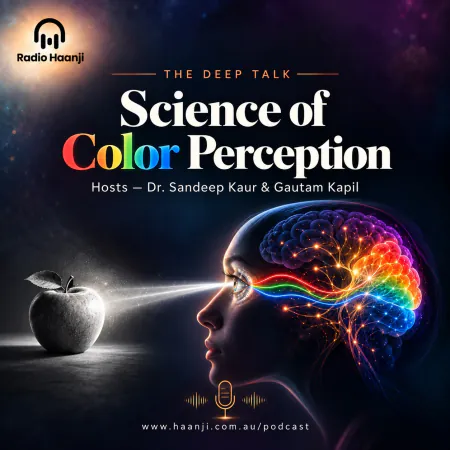





























































































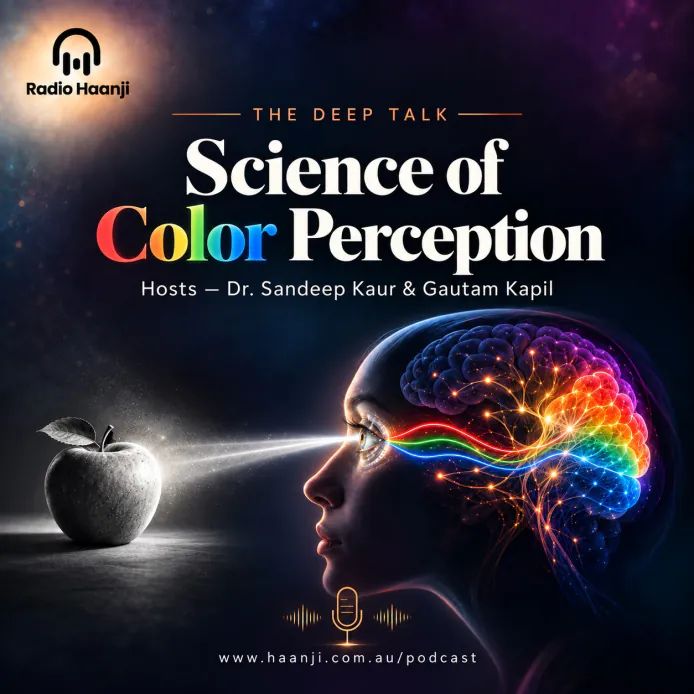
Science of Color Perception - The Deep Talk - Dr. Sandeep Kaur - Gautam Kapil
Host:-
 Dr. Sandeep Kaur
 Gautam Kapil
Explore the science of color perception with Dr. Sandeep Kaur on The Deep Talk. Discover how light, eyes, and the brain create color. Listen now on Haanji.
The colors that define daily life feel like unshakeable facts embedded within the physical world. Leaves are green, the open ocean appears deep blue, and a fresh apple presents a vivid red skin. Yet modern optical physics and sensory physiology reveal that reality outside the skull contains no inherent paint, tint, or shade. What humans experience as vibrant hues is an internal biological interpretation constructed from reflected radiation.
On an episode of The Deep Talk broadcast on Radio Haanji 1674 AM, host Gautam Kapil joined Dr. Sandeep Kaur to investigate the science of color perception. Moving beyond everyday aesthetic assumptions, their discussion unpacked how electromagnetic energy emitted by the sun travels across space and gets translated by ocular receptors and neural pathways into our subjective visual spectrum.
Understanding this pathway requires connecting planetary atmospheric physics with cellular neurobiology. By examining how wavelengths scatter across air molecules, how surface chemistry dictates absorption, and how photoreceptors relay electrical impulses, the episode showed that color is not an objective property of the universe, but a perceptual bridge built between physics and cognition.
Where to Listen
Catch the full broadcast of The Deep Talk hosted by Gautam Kapil with featured guest Dr. Sandeep Kaur on Radio Haanji 1674 AM. Stream the conversation on your preferred listening service:
-
Spotify: https://open.spotify.com/show/5fhykpM6TPzerC2Yr2J1eQ
-
Apple Podcasts: https://podcasts.apple.com/at/podcast/radio-haanji-podcast/id1687047958?l=en-GB
-
Download Radio Haanji App: https://haanji.com.au/download-our-app
Episode Highlights
The broadcast explored how visible color originates within the broader electromagnetic spectrum, tracing light rays from solar emission down into Earth's atmosphere. Dr. Kaur outlined how sunlight contains waves ranging from high-frequency gamma rays and ultraviolet radiation down to radio transmissions, with human eyes capable of detecting only a narrow band.
Atmospheric interactions explain why terrestrial skies shift drastically between midday and twilight. The conversation addressed how gaseous particles scatter shorter wavelengths across the daylight dome, while lower solar angles at dawn and dusk force beams through denser atmospheric depths, leaving longer red and orange wavelengths to dominate the human field of view.
Transitioning from atmospheric optics to matter, the episode detailed how chemical pigments and microscopic physical arrangements govern the light reflected off everyday objects. The discussion clarified why black materials absorb light while white surfaces reflect it, contrasting pigmentary color like plant chlorophyll with structural coloration such as peacock plumage.
The final segment compared human biological mechanics against the visual systems of other species. Dr. Kaur explained retinal cones and rods, the differing sensory ranges of creatures like bees and owls, and concluded with the geometry of rainbows, detailing how water droplets refract, reflect, and split sunlight into circular spectra.
Why Is the Sky Blue During the Day but Red at Sunset?
The sky appears blue during midday because shorter light wavelengths scatter across atmospheric gases more intensely than longer wavelengths. At sunrise and sunset, sunlight travels through a thicker layer of atmosphere, scattering away most blue light before it reaches human eyes and allowing longer red and orange wavelengths to dominate.
Sunlight emitted by the sun arrives at Earth's atmosphere as white light, an integrated mixture containing all visible wavelengths. It takes roughly eight minutes for these solar rays to reach our planet. As this incoming energy penetrates the atmosphere, it collides directly with gas molecules and suspended microscopic particles.
Because shorter wavelengths around 300 to 400 nanometers—such as violet and blue—scatter far more easily upon impact with these atmospheric particles, they disperse widely across the overhead dome, creating the blue appearance seen during the day. Longer wavelengths pass through with far less lateral disruption.
When the sun approaches the horizon at dawn or dusk, the physical path light must traverse to reach an observer increases significantly. Over this extended atmospheric distance, the shorter blue light scatters away almost entirely out of the line of sight. The surviving wavelengths that reach human eyes are the longer, less scattered red and orange bands near the 700-nanometer end of the visible spectrum.
Do Physical Objects Have Inherent Color?
Physical objects do not possess inherent color. Instead, objects have molecular compositions that absorb specific wavelengths of light and reflect others back into the environment. The color observed by a viewer is simply the unabsorbed light bouncing off the object's surface and entering the eye.
When daylight strikes an object, its atomic structure interacts directly with the incoming spectrum. An apple appears red because its surface pigments absorb the majority of visible wavelengths—such as blue and green—while rejecting and reflecting the red wavelengths. If that same red apple is placed into a sealed room illuminated solely by blue light, it will reflect no red light, appearing dark grey or black to human eyes.
Similarly, plant foliage appears green because chloroplasts containing chlorophyll absorb light for photosynthesis across blue and red wavelengths while reflecting green light away. In other flora, pigments like xanthophylls or carotenoids absorb alternative frequencies, leaving yellows and oranges visible.
Color also manifests without chemical pigments through a process known as structural coloration. In peacock feathers, the brilliant shimmering hues are generated by microscopic physical surface structures that manipulate, scatter, and reflect light rays through interference rather than chemical absorption. Grinding such a feather into a powder destroys these microstructures, causing the perceived coloration to disappear entirely.
Surface behavior also explains thermodynamic reactions to light. A pure black surface absorbs nearly the entirety of visible light striking it, converting that radiant energy into heat. In contrast, a white surface reflects almost all incoming wavelengths equally without significant absorption, keeping the material cooler and preventing individual hues from being distinguished.
How Does the Human Brain Process Color Compared to Animals?
The human brain processes color by evaluating electrical signals sent from retinal photoreceptor cells called cones. Incoming light wavelengths stimulate three types of cones, which transmit data to the brain to construct specific hues. Animals with different cone counts or rod densities perceive entirely different visual spectrums.
Visual perception begins when reflected light passes through the eye's outer structures, controlled by the iris expanding or contracting the pupil to regulate light volume. The light lands on the retina, where two primary varieties of photoreceptors await: rods and cones. Rods provide sensitivity to light intensity and movement in dim conditions, while cones specialize in deciphering spectral wavelength differences.
Humans possess three distinct types of cones sensitive to varying wavelength ranges within the visible spectrum, spanning from approximately 300 nanometers up to 700 nanometers. When light triggers these cells, the resulting impulses travel along neural pathways to the visual cortex, where the brain synthesizes the comparative firing rates into the perception of a single unified color.
Across the animal kingdom, sensory equipment diverges sharply based on evolutionary niche. Certain insects, including bees, possess four distinct cone types and can detect ultraviolet wavelengths invisible to human vision, allowing them to locate nectar guides within flower petals. Conversely, nocturnal predators like owls feature retinas packed with light-sensitive rods—roughly thirty times more sensitive than human eyes—allowing them to navigate and hunt in deep darkness where human color perception fails.
The Atmospheric Physics of Rainbow Formations
Rainbows are optical phenomena that form when sunlight enters airborne water droplets suspended in the atmosphere following rain. As white light enters each droplet, it refracts, reflects off the inner surface of the drop, and refracts again as it exits, separating into its individual spectral wavelengths.
Every raindrop acts as a microscopic optical prism. When light transitions from ambient air into the denser medium of liquid water, its propagation speed slows down, bending the light ray at an angle determined by its wavelength. Shorter wavelengths bend more sharply than longer ones, initiating the spatial separation of colors.
Once inside the droplet, the light reflects off the internal back wall and exits back toward the observer. Because each observer stands at a distinct spatial angle relative to the sun and the falling precipitation, no two individuals ever witness the identical rainbow. Each person observes an optical arc produced by a unique set of raindrops aligned with their specific line of sight.
From high altitudes, such as inside an airplane, a rainbow can be observed as a full, uninterrupted 360-degree circle. Observers on the ground see only the upper arc because the planetary horizon and the ground physically interrupt the lower half of the circle. When double rainbows appear, the secondary, outer band is produced by light reflecting twice within the water droplets, losing kinetic energy and producing a noticeably fainter, color-inverted reflection.
Key Takeaways
-
Color is an internal neurological interpretation produced by the brain, not an intrinsic physical trait of matter.
-
Visible light occupies a narrow band of the electromagnetic spectrum, falling roughly between 300 and 700 nanometers.
-
Midday skies appear blue due to the intense scattering of shorter wavelengths across atmospheric gases, while sunrise and sunset skies shift red because light must traverse a longer path that filters out blue light.
-
Surfaces show color by absorbing select wavelengths and reflecting others, though physical microstructures can also generate color without chemical pigments.
-
Human eyes utilize three cone types to perceive visible light, whereas species like bees access ultraviolet light and owls possess roughly 30 times greater low-light sensitivity.
-
Rainbows are dynamic optical events formed by light refracting, reflecting, and dispersing inside suspended water droplets, creating full circles that appear as arcs from ground level.
Understanding the mechanisms of vision transforms how we perceive our surroundings, showing that the colors of nature are sensory impressions synthesized inside our minds. To hear the complete discussion on optical physics, biological perception, and visual science, listen to this episode of The Deep Talk on Radio Haanji 1674 AM via Spotify, Apple Podcasts, or the Radio Haanji mobile app.
Frequently Asked Questions
What is the visible light spectrum?
What is the true color of sunlight?
Why do black objects get hotter than white objects?
What causes structural coloration in nature?
Why do double rainbows look fainter than primary rainbows?
What's Your Reaction?