































































































The Science of Meditation: History & Brain Benefits - Dr. Sandeep Kaur & Gautam Kapil
Host:-
 Dr. Sandeep Kaur
 Gautam Kapil
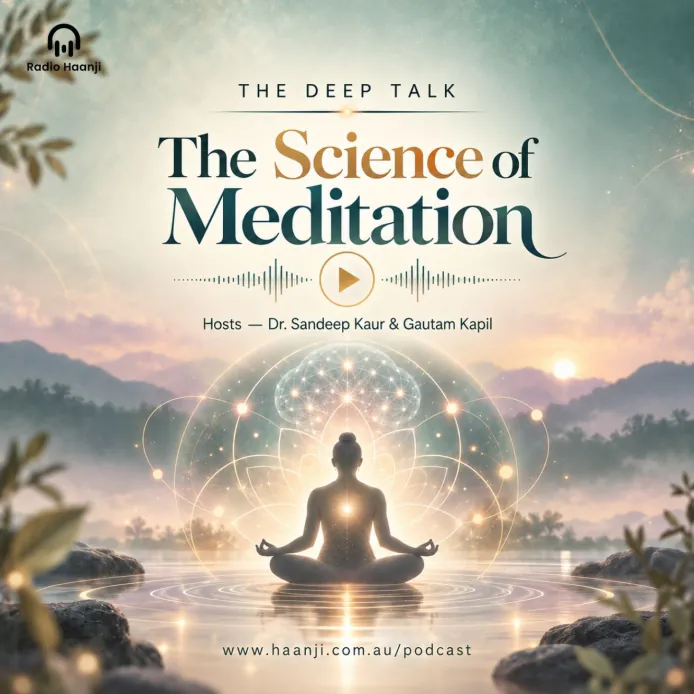
Explore the science of meditation, its ancient roots, and how it physically changes your brain's gray matter in this Deep Talk podcast episode. Listen now.
Meditation is often misunderstood as a purely mystical or magical cure-all, reserved exclusively for yogis or spiritual retreats. In reality, the practice is a practical, highly effective method for training focus and processing everyday stress. In a recent episode of The Deep Talk on Radio Haanji 1674 AM, hosts Gautam Kapil and Dr. Sandeep Kaur unpack the science of meditation. By examining its ancient roots alongside modern neurological research—including notable findings from Harvard University—the episode grounds mindfulness in empirical evidence, proving that sitting quietly does far more than just calm the nerves; it actively reshapes the human brain.
Where to Listen
Tune in to this episode of The Deep Talk with Gautam Kapil and Dr. Sandeep Kaur on Radio Haanji 1674 AM. You can stream the full discussion and explore more episodes across major platforms:
Episode Highlights
The Historical Evolution The practice of focusing the mind is far from a modern wellness trend. The episode explores how meditation traces its origins back to India between 5000 and 3500 BC, with its earliest documentation found in foundational texts like the Vedas and the Upanishads. What began as a tool for yogis seeking a deeper divine connection gradually integrated into broader philosophical frameworks. Siddhartha Gautama brought it to the forefront of Buddhism, while it simultaneously found a home in Jainism and Chinese philosophies like Taoism. It wasn't until the late 19th century—catalyzed heavily by Swami Vivekananda's address in 1893—that these Eastern practices truly began to permeate Western awareness.
The Neurological Evidence Moving from history to clinical evidence, the conversation shifts to the science of meditation. The scientific community first began formally measuring meditation in 1936, using early EEG technology to track brain wave activity during practice. Today, modern neuroscience focuses heavily on neuroplasticity—the brain's ability to physically alter its structure and forge new neural connections. The hosts highlight research from Harvard University demonstrating that regular meditation actively increases gray matter in the brain, directly enhancing a person's memory, learning capacity, and emotional regulation.
Modern Practicality In today’s hyper-connected environment, the episode positions meditation as an essential defense against digital distraction. It is framed as an accessible tool that requires only a few minutes a day, rather than an isolated retreat. Listeners are encouraged to integrate it into daily life, whether through walking, sitting quietly, or listening to music. Beyond mental fatigue, the discussion notes that medical professionals now frequently recommend meditation as a supplementary approach to holistic health, aiding in physical pain management and supporting patients through severe medical treatments.
Where Did Meditation Originate?
Meditation originated in ancient India between 5000 and 3500 BC. The earliest written records of the practice are found in ancient texts, specifically the Upanishads and the Vedas. Initially used by yogis, it later expanded into Jainism, Buddhism, and Chinese philosophies like Taoism.
Understanding this ancient lineage provides crucial context for how meditation has survived and evolved. Long before clinical trials existed, early practitioners recognized the profound impact of directed focus on the human condition. It was a methodology designed to bridge the gap between the physical and the spiritual.
When Swami Vivekananda introduced these concepts to the West in 1893, he translated thousands of years of Eastern philosophy into a framework that Western audiences could begin to understand. This pivotal moment set the stage for the eventual secularization and scientific study of mindfulness that we see today.
How Does Meditation Change the Brain?
Meditation changes the brain through a process called neuroplasticity. Scientific research, including studies from Harvard University, reveals that consistent practice physically alters brain structure by increasing gray matter. This biological change improves vital cognitive functions, including memory, emotional regulation, and the capacity for learning.
The scientific validation of meditation began decades ago. As early as 1936, researchers were attaching EEG monitors to practitioners to observe real-time changes in brain wave activity. This marked the transition of meditation from a purely philosophical pursuit into a measurable, physiological intervention.
By proving that the brain is not a static organ, neuroplasticity completely changes how we view mental health. When a person meditates, they are not just temporarily escaping stress; they are essentially weightlifting for the brain, building thicker neural pathways that make them more resilient to future anxiety and emotional turbulence.
How Can Meditation Help with Digital Distraction?
Meditation helps combat digital distraction by training the brain to sustain focus. In a world where smartphones and algorithms constantly fragment our attention spans, taking a few minutes daily to meditate acts as a mental reset, helping to restore cognitive endurance and concentration.
The modern application of this ancient practice does not require moving to a mountaintop. The Deep Talk emphasizes that effective meditation is highly adaptable. It can be performed while walking, sitting at a desk, or actively listening to music. The goal is simply to anchor the mind to the present moment.
Furthermore, this improved focus translates into broader holistic health benefits. By regaining control over fragmented attention, individuals experience reduced mental fatigue. This is why clinical professionals increasingly prescribe mindfulness as a complementary practice for managing chronic physical pain and navigating the stress of severe medical treatments.
Key Takeaways
-
Meditation was first documented in India between 5000 and 3500 BC in texts like the Vedas and Upanishads.
-
The practice gained significant Western awareness following Swami Vivekananda’s 1893 address.
-
The first scientific observation of meditation occurred in 1936 using EEG technology to study brain waves.
-
Harvard University research confirms that meditation increases gray matter, enhancing memory and emotional regulation.
-
Through neuroplasticity, regular meditation physically alters the brain's structure and neural connections.
-
Meditation can be easily integrated into daily life in just a few minutes, through sitting, walking, or listening to music.
Take control of your focus and understand the profound biological benefits of mindfulness by tuning in to the complete discussion. Listen to the full episode of The Deep Talk on Spotify, Apple Podcast, or by downloading the Radio Haanji App.
Frequently Asked Questions
Is meditation just a spiritual practice?
What is neuroplasticity in the context of meditation?
Do I need a lot of time to meditate?
Can meditation help with physical pain?
When did scientists first start studying meditation?
What's Your Reaction?