





























































































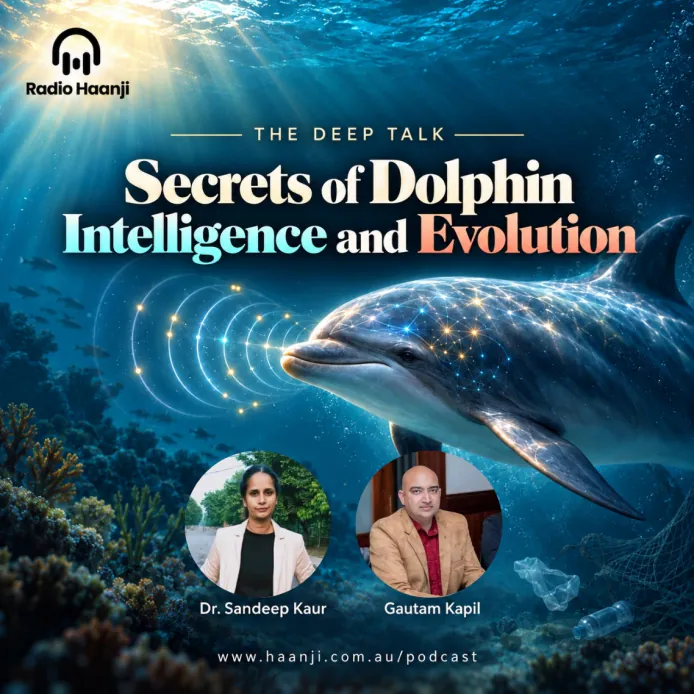
Secrets of Dolphin Intelligence and Evolution - The Deep Talk - Dr. Sandeep Kaur - Gautam Kapil
Host:-
 Dr. Sandeep Kaur
 Gautam Kapil
Host Gautam Kapil and expert guest Dr. Sandeep Kaur explore the fascinating biology, high intelligence, evolutionary journey, and conservation challenges of dolphins on Radio Haanji.
Beneath the ocean surface lives an animal group whose cognitive processing and social complexity closely rival our own. While dolphins glide effortlessly alongside sharks and tuna, their evolutionary path, respiratory system, and neurological development separate them entirely from fish. Understanding dolphin intelligence and biology requires looking beyond their streamlined bodies to examine how mammalian physiology adapted to open aquatic environments over tens of millions of years.
On The Deep Talk Show, broadcast on Radio Haanji 1674 AM, host Gautam Kapil sat down with guest Dr. Sandeep Kaur to break down the science of these marine creatures. Their dialogue explored everything from the mechanics of aquatic mammalian respiration to advanced communicative whistles, complex team hunting strategies, and the critical conservation crises impacting wild populations today.
By analyzing the physiological structures that allow dolphins to thrive in both ocean depths and freshwater river basins, listeners gain a realistic look at how these animals navigate, rest, problem-solve, and face accelerating ecological pressures across the globe.
Where to Listen
Catch the full conversation on dolphin biology, sensory adaptations, and conservation on The Deep Talk Show with Gautam Kapil and Dr. Sandeep Kaur, broadcast via Radio Haanji 1674 AM. Stream the audio on demand across major podcast directories or through the station platform:
-
Spotify: [PLATFORM LINK]
-
Apple Podcasts: [PLATFORM LINK]
-
Radio Haanji App: [PLATFORM LINK]
Episode Highlights
The discussion traversed several foundational topics regarding aquatic mammals, beginning with biological classification and evolutionary history. Dr. Kaur explained that dolphins are warm-blooded mammals that evolved from land-dwelling ancestors roughly 50 million years ago, gradually adapting their limbs into fins and nostrils into blowholes positioned atop the skull. The discussion noted that approximately 36 marine species exist today, alongside specialized freshwater species residing in major river systems like the Amazon and the Ganges.
Moving into cognitive capabilities and daily physiological survival, the conversation highlighted the unique sensory and neurological traits dolphins possess. Topics included their remarkable brain-to-body mass ratio, mirror self-recognition, unihemispheric sleep patterns, and the acoustic precision of echolocation. The episode concluded with an examination of conservation concerns, outlining how human activities, climate shifts, and traditional hunts have placed populations like New Zealand's Māui dolphin and regional river dolphins under severe survival threats.
Why Are Dolphins Considered Mammals and Not Fish?
Dolphins are classified as mammals rather than fish because they are warm-blooded, give birth to live calves instead of laying eggs, nurse their young, and breathe atmospheric air using lungs. Unlike fish, which extract dissolved oxygen through gills, dolphins must regularly surface to inhale air through a blowhole.
While fish regulate their internal body temperature based on the surrounding water, dolphins maintain a stable internal temperature regardless of external marine conditions. Their reproductive biology further reinforces this classification. Mothers carry developing calves internally and give birth in the water, nursing them with milk produced by mammary glands.
Evolutionary biology reveals that dolphins returned to the sea around 50 million years ago after an ancestral terrestrial phase. As their bodies adapted to marine environments, front limbs developed into pectoral fins for steering, rear limbs receded internally, and the nasal passage shifted to the top of the skull as a blowhole. At birth, newborn calves even retain trace hairs along their beaks, an anatomical remnant of their mammalian ancestry that sheds shortly after entering the world.
How Do Dolphins Sleep Without Drowning?
Dolphins sleep through unihemispheric slow-wave sleep, resting one brain hemisphere at a time while keeping the opposite hemisphere active and alert. This adaptation ensures the dolphin remains conscious enough to regularly surface for air, monitor surroundings for predators, and maintain essential movement without sinking or suffocating.
Because dolphins are voluntary breathers, an automated subconscious breathing reflex like that found in land mammals does not occur during deep rest. Complete unconsciousness would lead directly to drowning. By alternating rest between the left and right hemispheres of the brain, dolphins let one side recover while the other maintains muscular motion and vigilance.
During these rest cycles, the eye connected to the sleeping hemisphere stays closed, while the eye linked to the active half stays open to observe potential environmental threats. In the wild, dolphins generally maintain a lifespan ranging from 30 to 50 years, with females often living slightly longer than males. This resting mechanism allows them to safely sustain their breath-holding capacity, which typically spans five to ten minutes between surface visits.
How High Is Dolphin Intelligence Compared to Other Animals?
Dolphins possess an exceptionally high brain-to-body mass ratio of approximately 5.3, ranking second only to humans, who measure around 7.5. This neurological scale surpasses great apes like chimpanzees (2.5) and gorillas, translating into advanced problem-solving, emotional bonding, rapid associative learning, and demonstrable self-awareness in behavioral experiments.
In laboratory and field studies, scientists evaluate cognitive self-awareness through the mirror self-recognition test. When researchers place non-harmful physical markings on dolphins' bodies, the animals spend significant time positioning themselves in front of reflective surfaces to inspect the altered areas. This reaction indicates an understanding that the reflected image represents their own physical body rather than a foreign individual.
Beyond self-recognition, their social behavior demonstrates pronounced emotional processing. Pod members exhibit protective behaviors, assist injured peers to the surface for air, and mourn dead calves, with mothers observed carrying deceased young for extended periods.
Echolocation and Communication: How Dolphins Navigate Murky Waters
Dolphins use echolocation to construct detailed mental maps of their environment by projecting high-frequency sound clicks through an acoustic fatty organ called the melon. These sound waves travel through the water, bounce off objects, and return as echoes that the dolphin receives through specialized fat deposits in the lower jaw.
This biological sonar operates with extreme precision. The returning acoustic signals inform the dolphin of an object's distance, size, density, shape, and internal structure. The system functions so accurately that dolphins can detect non-biological internal anomalies, such as surgical metal pins or rods placed inside human swimmers, distinguishing dense materials from surrounding muscle and water.
For social interaction, dolphins produce an array of clicks, burst pulses, and frequency-modulated whistles. Every individual develops a unique "signature whistle" early in life that functions much like a personal name. Pod members use these distinct acoustic markers to identify, locate, and call to specific individuals across long distances, retaining memory of specific whistles for decades.
Coordinated Hunting: The Mud Ring Technique
To capture swift fish schools in shallow coastal areas, pods execute coordinated hunting behaviors that rely on strategic teamwork. One specialized method is the "mud ring" technique, where a designated dolphin circles low along the seabed, beating its tail fluke to create a dense plume of suspended sediment around a targeted school of fish.
As the circular mud plume rises toward the surface, it forms an opaque acoustic and visual barrier that traps the fish inside. Disoriented and unable to swim through the dense wall of silt, the fish attempt to escape by leaping out of the water above the ring.
Other pod members position themselves strategically outside the perimeter, catching the airborne fish in their open mouths. The animals take turns generating the ring and feeding, demonstrating cooperative planning, role assignment, and calculated resource distribution within the group.
Major Environmental Threats Facing Modern Dolphin Populations
Dolphin populations worldwide face compounding survival threats, including fishing gear entanglement, climate-driven habitat changes, chemical pollution, and industrial river development. Entanglement in commercial gillnets and discarded fishing gear, known as bycatch, accounts for significant annual mortalities among oceanic, coastal, and riverine species.
Warming surface water temperatures driven by climate shifts force cold-water prey fish into deeper layers. Because dolphins rely on surface oxygen, they must travel greater vertical distances to hunt, resulting in nutritional deficits and reduced reproductive success. Simultaneously, ocean pollution from plastics, toxic industrial runoff, and oil spills damages their internal organs and suppresses immune defenses.
Specific populations face critical endangerment:
-
Māui Dolphin: Native to the coastal waters of New Zealand, this subspecies has declined to fewer than 60 remaining individuals.
-
Atlantic Humpback Dolphin: Found along the coast of West Africa, with fewer than 1,500 mature individuals remaining in the wild.
-
South Asian River Dolphins: Inhabiting the Ganges and Indus river basins, these freshwater populations face habitat fragmentation caused by dams, irrigation networks, and heavy agricultural runoff.
-
Amazon River Dolphin (Pink Dolphin): Subject to targeted poaching and habitat degradation across northern South American river systems.
What Is World Dolphin Day and Why Was It Established?
World Dolphin Day is observed annually on September 12 to raise global awareness about dolphin conservation, biological intelligence, and the ecological dangers threatening aquatic mammals. Established in 2022 by marine conservation organizations, the day promotes environmental stewardship and policy reforms to halt mass slaughters and habitat destruction.
The international observance was created following a specific event on September 12, 2021, when over 1,400 dolphins were driven into shallow bays and killed in a single day during traditional hunts in the Faroe Islands. The unprecedented scale of the cull caused global public outcry and prompted conservation groups, led by Sea Shepherd, to formalize a dedicated day for species defense.
Unlike regional holidays such as National Dolphin Day in the United States, World Dolphin Day serves as a coordinated worldwide platform. It educates communities on the realities of marine captivity, plastic accumulation, commercial bycatch, and the urgent necessity of legal protections for endangered cetaceans.
Key Takeaways
-
Dolphins are warm-blooded, air-breathing mammals that evolved from land-dwelling creatures roughly 50 million years ago.
-
To avoid drowning while resting, dolphins utilize unihemispheric sleep, keeping one brain hemisphere awake to regulate breathing and watch for predators.
-
A high brain-to-body mass ratio of 5.3 supports self-awareness, rapid learning, and mirror self-recognition.
-
Every dolphin produces a distinct signature whistle that acts as an acoustic identifier, enabling individual recognition throughout its lifetime.
-
Echolocation allows dolphins to evaluate the size, shape, distance, and density of objects, including internal dense materials like metal rods.
-
Critically low populations, including New Zealand's Māui dolphin with fewer than 60 individuals remaining, face pressing extinction risks from fishing bycatch and habitat loss.
Understanding dolphin intelligence and biology underscores our collective responsibility toward marine stewardship. From their high-level problem solving to complex collaborative feeding and vocal identity markers, dolphins demonstrate a tier of social and intellectual life that demands active habitat protection. To explore the full conversation and hear detailed scientific insights directly from the broadcast, listen to the complete episode of The Deep Talk Show on Radio Haanji 1674 AM through Spotify, Apple Podcasts, or the official station app.
Frequently Asked Questions
Are dolphins fish or mammals?
How do dolphins sleep without drowning?
What is a dolphin signature whistle?
How many dolphin species exist?
What is the largest species of dolphin?
What's Your Reaction?







Related Posts