




























































































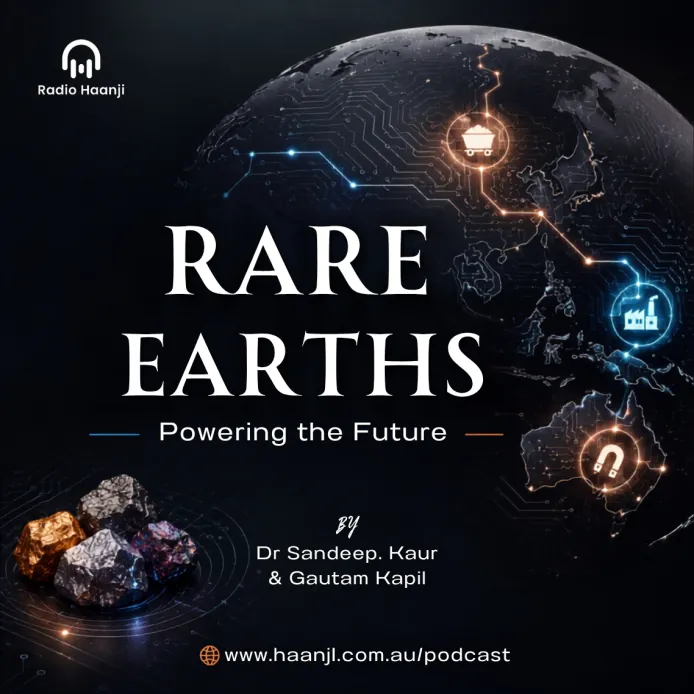
Rare Earth Metals Global Supply Chain: Risk & Monopoly - The Deep Talk
Host:-
 Dr. Sandeep Kaur
 Gautam Kapil
Explore the rare earth metals global supply chain, China's dominance, environmental costs, and global races for alternative critical minerals.
They are embedded inside your smartphone's haptic engine, the drive motors of electric vehicles, guided missile systems,and offshore wind turbines. Though rarely seen, the rare earth metals global supply chain forms the quiet foundation of 21st-century civilization. Despite their name, these 17 chemical elements—comprising the 15 lanthanides plus scandium and yttrium—are relatively abundant in the Earth's crust. Cerium, for instance, is more common than copper.
The true scarcity lies not in finding these minerals, but in refining them. Unlocking these metals from raw ore requires complex, highly toxic chemical separation processes that few nations have historically been willing to undertake.According to data from the International Energy Agency (IEA, 2025), a single country controls over 85% of global rare earth refining capacity, creating one of the most fragile single-point dependencies in modern industrial history.
As energy transitions accelerate and geopolitical tensions rise, this concentrated supply chain has evolved from a quiet trade dynamic into a defining technological bottleneck. Understanding where these elements come from, why refining is so exceptionally difficult, and how alternative technologies are emerging is critical to anticipating the future of green tech,consumer electronics,
What Are Rare Earth Metals Used For in Modern Technology?
Rare earth metals are used in modern technology primarily to manufacture high-strength permanent magnets, advanced optics, electronics display phosphors, catalytic converters, and defense systems. Elements like neodymium, dysprosium, and praseodymium enable lightweight, ultra-efficient magnetic fields essential for electric vehicle motors, wind turbine generators, micro-speakers, and defense guidance technology.
While consumer electronics account for millions of units annually, green energy technologies demand much higher volumes. A single direct-drive offshore wind turbine can require up to two metric tons of rare earth permanent magnets. In these applications, neodymium permanent magnets technology provides an unmatched torque-to-weight ratio, allowing motors and generators to operate at high efficiencies without excessive mass.
Beyond magnets, elements like europium and terbium produce the precise red and green colors in digital screens, while lanthanum makes up a third of advanced camera lenses due to its high refractive index. Erbium acts as a signal amplifier inside fiber-optic cables, carrying digital information across ocean floors. Without these 17 elements, modern miniaturized electronics would instantly revert to larger, vastly less efficient designs.
The Chemistry of Scarcity: Mining vs. Refining
Digging rare earth ores out of the ground is only the first—and easiest—step. Because these elements share nearly identical ionic radii and oxidation states, they naturally bind tightly to one another in mineral deposits such as bastnäsite and monazite. Separating them into individual, pure metallic elements requires hundreds of stages of liquid-liquid solvent extraction.
This process consumes vast quantities of acids, organic solvents, and water. A rock face might contain 3% total rare earth oxides, but individual high-value elements like dysprosium or terbium may represent less than 0.1% of that fraction. Processing facilities must process hundreds of thousands of tons of rock to yield commercially viable quantities of heavy rare earth elements.
This heavy chemical requirement creates severe barrier-to-entry costs for new market entrants. Capital expenditures for processing infrastructure frequently run into billions of dollars, and mastering the multi-stage chemical balance requires specialized industrial expertise that takes decades to develop.
Why Does China Control the Rare Earth Metals Market?
China controls the rare earth metals market due to decades of strategic industrial planning, lower domestic environmental compliance costs during the 1990s and 2000s, state-backed financial subsidization, and technical mastery over complex chemical refining processes. This infrastructure allows China to process over 85% of global rare earth ores, regardless of where they are originally mined.
The foundation for this monopoly was laid in the late 20th century. While Western nations closed processing facilities due to environmental liabilities and low margins, Chinese state planners prioritized the entire value chain—from raw mining up to magnet manufacturing. The consolidation of state-owned enterprises into centralized entities like China Rare Earth Group further streamlined pricing power and production quotas.
This concentration introduces significant critical minerals geopolitical risk for importing nations. Major mining operations outside China, including the Mountain Pass mine in California, have historically relied on Chinese facilities for final separation and refining. Until domestic or allied midstream processing infrastructure matures, mining raw rock elsewhere does not fully resolve supply dependencies.
What Is the Environmental Impact of Rare Earth Metal Mining?
The environmental impact of rare earth metal mining includes radioactive wastewater generation, toxic acid tailing leaks, soil erosion, and severe groundwater contamination. Rare earth deposits frequently co-occur with radioactive elements like thorium and uranium. Refining one ton of rare earth oxides can generate hundreds of cubic meters of toxic, acidic tailing liquid.
In historical mining centers, untreated leaching ponds contaminated surrounding agricultural soil and local aquifers. In situ leach mining—where acid is injected directly into subsoil layers to dissolve clay-bound elements—often caused landslides and long-term ecosystem degradation if containment measures failed.
Modern regulatory pressures are pushing mines toward closed-loop water treatment systems and safer tailing storage facilities. However, remediating historic sites remains incredibly costly, emphasizing the urgent need for cleaner extraction methods and stricter international standards across the mining sector.
How Are Nations Reducing Reliance on Rare Earth Elements?
Nations are reducing reliance on rare earth elements by funding alternative rare earth deposits exploration, developing iron-nitride and ferrite magnet substitutes, investing in advanced recycling technologies, and incentivizing domestic midstream refining infrastructure. Government policies in North America, Europe, and Asia now offer heavy subsidies to establish fully localized, end-to-end processing supply chains.
Automotive manufacturers are leading the charge in material substitution. Electric vehicle producers have introduced drive units that use induction or wound-rotor motors, eliminating permanent magnets entirely from select models. Simultaneously, material scientists are testing iron-nitrogen and manganese-bismuth alloys as potential mid-performance magnetic alternatives.
Concurrently, commercial investment is accelerating around rare earth recycling technologies. Extracting magnet alloys directly from end-of-life electronics, wind turbines, and industrial motors uses up to 80% less energy than primary mining while bypassing liquid-liquid separation hazards. Paired with fresh exploration of domestic deposits, these multi-pronged strategies aim to establish resilient, circular material ecosystems over the coming decade.
Key Takeaways
-
The primary vulnerability in the rare earth supply chain is chemical refining and separation capacity, not the physical availability of raw ore in the ground.
-
China maintains market dominance primarily by controlling midstream processing infrastructure, handling over 85% of global separation and magnet manufacturing.
-
Neodymium, dysprosium, and praseodymium are vital components in high-efficiency permanent magnets used in electric vehicles, wind turbines, and defense systems.
-
Mining and refining rare earth elements carries severe environmental liabilities, notably the generation of radioactive thorium tailings and toxic acid waste.
-
Diversification efforts focus on engineering permanent magnet alternatives, deploying closed-loop recycling systems, and expanding domestic processing facilities outside Asia.
References and Further Reading
-
International Energy Agency (IEA) — Global Critical Minerals Outlook Report — Comprehensive data on critical mineral market shares and processing centralization.
-
U.S. Geological Survey (USGS) — Mineral Commodity Summaries: Rare Earths — Annual statistics on global reserve estimates, mine production, and trade flows.
-
Journal of Cleaner Production — Lifecycle Assessment of Rare Earth Element Processing — In-depth academic analysis of environmental impacts and chemical extraction footprints.
Frequently Asked Questions
Are rare earth metals actually rare?
Which industries are most vulnerable to rare earth supply disruptions?
Can rare earth metals be recycled efficiently?
What is the difference between light and heavy rare earth elements?
How long does it take to build a new rare earth processing facility?
The global race to secure rare earth supply chains is no longer just an economic consideration—it is a cornerstone of national energy security and technological independence. As research into cleaner extraction methods and alternative materials continues to accelerate, building a resilient, transparent material supply chain will require international cooperation, innovation, and long-term investment.
What's Your Reaction?