



































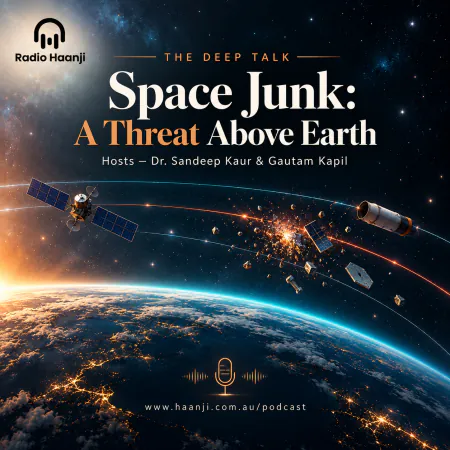























































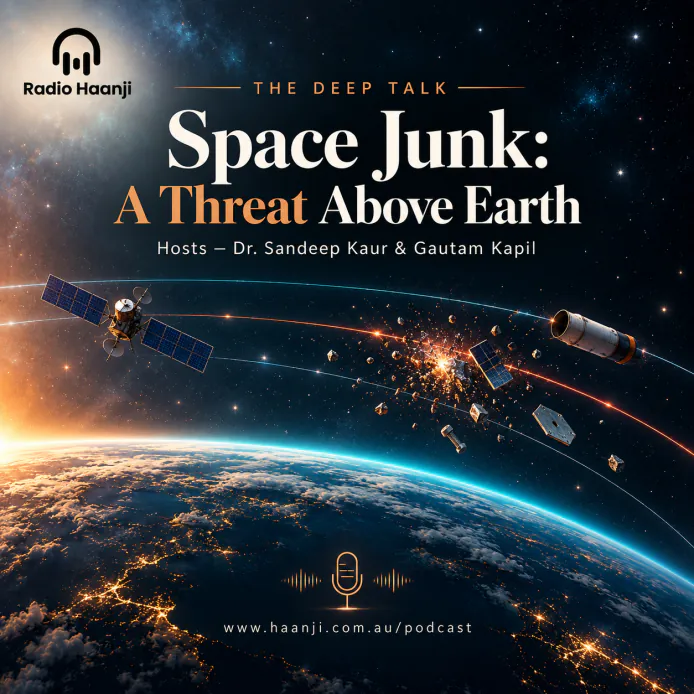
Space Junk: A Threat Above Earth - Thee Deep Talk - Dr. Sandeep Kaur & Gautam Kapil
Host:-
 Dr. Sandeep Kaur
 Gautam Kapil
Understand critical space debris dangers with Dr. Sandeep Kaur on Thee Deep Talk. Discover removal tech and environmental risks. Listen now.
Thousands of defunct objects circle Earth at extreme velocities, turning the lower orbital boundaries into an unpredictable minefield. On Thee Deep Talk, broadcast on Radio Haanji 1674 AM, host Gautam Kapil joined researcher Dr. Sandeep Kaur to analyze the accelerating space debris dangers that threaten both modern digital communications and terrestrial environments. The broadcast framed orbital pollution not as an abstract, distant curiosity, but as an urgent technological liability driven by decades of unchecked launches.
Every operational satellite providing cellular connectivity, banking verification, weather observation, and maritime tracking shares its flight corridor with discarded rocket stages and collision shards. Drawing from the latest space monitoring frameworks and real-world incidents, the conversation underscored why discarded human-made hardware creates risks that humanity can no longer safely ignore.
Understanding the dynamics of orbital wreckage requires examining how spent boosters, abandoned platforms, and minuscule metal flecks behave once left behind in zero gravity. Through expert insights from Dr. Kaur, the discussion mapped out the mechanical chain reactions, terrestrial wildlife disruptions, and international legal stalemates currently preventing orbital recovery operations.
Where to Listen
Tune into the full discussion on Thee Deep Talk featuring Dr. Sandeep Kaur and Gautam Kapil on Radio Haanji. You can access this episode across major streaming directories or directly via official broadcaster channels:
Episode Highlights
The broadcast explored orbital debris by grouping real-world observations and scientific concepts into distinct conversational focus areas:
-
The Reality of Man-Made Space Pollution: Gautam Kapil introduced the topic by referencing a large metallic object discovered along the coastline at Jurien Bay in Western Australia, suspected to be third-stage debris from an Indian Polar Satellite Launch Vehicle (PSLV). The hosts established that space debris consists strictly of anthropogenic objects rather than natural celestial bodies like meteoroids.
-
Velocity, Fragment Scales, and Kessler Syndrome: Dr. Kaur explained that hardware abandoned in orbit travels at thousands of kilometers per hour—up to seven times faster than a fired bullet. The discussion detailed how these extreme speeds mean that collisions multiply rapidly, producing thousands of fragmented shards that trigger cascading orbital strikes under the Kessler Syndrome framework.
-
Everyday Earth Reliance and Environmental Costs: The hosts detailed humanity's structural dependence on functioning satellites for GPS, climate monitoring, and disaster forecasting. They also addressed the environmental footprint of launches on Earth, detailing habitat disruption, chemical burns, acoustic noise that harms nesting birds like the snowy plover, and maritime waste falling into the world's oceans.
-
Remediation Techniques and Geopolitical Blockades: Potential solutions were reviewed, including orbital robotic capture arms, ground-based lasers, and deployable titanium netting. However, Dr. Kaur pointed out that international law prevents any sovereign state or private entity from de-orbiting or tampering with another country’s space property without explicit consent, creating a critical legal impasse.
What Is Space Junk and How Does It Form?
Space junk refers exclusively to discarded, non-functional human-made objects left in Earth orbit. This includes spent rocket booster stages, defunct satellites whose operational lifespans have expired, and structural fragments produced during past in-space collisions. It does not encompass natural celestial bodies such as asteroids or meteoroids.
During the broadcast, Dr. Kaur explained that space exploration inherently generates discarded mass. Multistage rockets drop expended fuel casings as they climb toward orbital insertion. While lower booster stages often fall back immediately, upper stages and deployment brackets remain trapped in free fall around the planet. Over decades of satellite deployments, hundreds of active payloads have simply run out of station-keeping propellant, leaving multi-ton hulks drifting uncontrolled along crowded orbital pathways.
Compounding this problem is the emergence of massive mega-constellations launched by private entities and national space agencies. As thousands of small satellites enter low Earth orbit, the probability of unexpected hardware failures increases dramatically. When dead hardware remains untracked, it transforms from an asset into an unpredictable kinetic threat to every vehicle operating in the same altitude band.
How Does Kessler Syndrome Increase Space Debris Dangers?
Kessler Syndrome is an orbital dynamic where the density of objects in low Earth orbit reaches a threshold where a single collision creates a cascading chain reaction of catastrophic fragmentations. This geometric increase in hypervelocity debris can render specific orbital bands unusable for generations by continuously destroying operational satellites.
As detailed on Thee Deep Talk, orbital debris does not remain stationary. Objects circle Earth at velocities exceeding thousands of kilometers per hour—speeds approximately seven times greater than a bullet fired from a firearm. At these kinetic energy levels, an impact from an abandoned fragment measuring less than a single centimeter carries enough destructive force to breach pressurized satellite modules or shatter communication arrays entirely.
This threat was initially formulated by NASA scientist Donald J. Kessler, who warned that unchecked launches would eventually make orbital collisions self-sustaining. Each impact shatters large components into tens of thousands of jagged metal shards. These newly formed micro-fragments disperse into adjacent orbits, exponentially raising collision risks for commercial stations, scientific arrays, and human spaceflight missions.
How Does Space Junk Affect Life on Earth and Terrestrial Ecosystems?
Space junk compromises essential Earth systems by threatening satellite-based weather tracking, emergency communication arrays, climate monitoring platforms, and global GPS navigation. When debris de-orbits, surviving structural components fall into oceanic ecosystems or terrestrial zones, while initial launches introduce localized acoustic, thermal, and chemical stress to vulnerable wildlife habitats.
Dr. Kaur clarified that while approximately 70 percent of Earth’s surface is covered by oceans—meaning most uncontrolled re-entries drop into deep waters—this does not eliminate terrestrial ecological harm. Ocean water sustains intricate marine ecosystems, and discarding heavy metallic alloy assemblies into marine troughs introduces unnatural waste into aquatic food chains. In instances where large components survive atmospheric re-entry, debris pieces can land on coastal strips or populated landmasses, as seen in Western Australia.
Beyond orbital re-entry, the industrial footprint of space exploration impacts coastal wildlife reservations. Launch pads situated near national parks and nature preserves generate massive acoustic shockwaves, ground-level heat, and toxic exhaust fumes during lift-off. Dr. Kaur noted that these launch stresses severely disturb local wildlife, citing instances where nesting shorebirds like the snowy plover abandon breeding sites and nests due to localized environmental pressures.
What Are the Modern Active Debris Removal Methods?
Active debris removal methods utilize specialized engineering systems designed to capture, divert, or destroy uncontrolled orbital junk. Leading technical proposals include robotic capture arms mounted on cleanup spacecraft, ground-based lasers that alter fragment trajectories, and deployable titanium or fiber nets designed to snare drifting wreckage for controlled atmospheric re-entry.
On Thee Deep Talk, the hosts examined how active remediation strategies differ based on the target object's physical dimensions. For massive dead payloads, such as derelict rocket stages, robotic arms modeled after those used on the International Space Station can secure the body and execute a retro-burn, ensuring the vehicle burns up safely over designated oceanic zones.
Dealing with tiny, untrackable shrapnel requires fundamentally different physics. Because fragments smaller than one centimeter cannot be reliably ensnared, engineers are evaluating laser redirection systems. By firing concentrated laser pulses at incoming debris, thermal pressure can nudge the fragment’s orbital path downward into Earth's upper atmosphere, where atmospheric drag burns it up completely.
Why Is It Illegal to Clean Up Another Nation's Space Debris?
Under international space law, every launched object remains the sovereign property and jurisdiction of its registering nation in perpetuity. Consequently, capturing, tampering with, or de-orbiting another country's derelict satellite or rocket booster without explicit diplomatic authorization constitutes an illegal act under established space governance conventions.
During the episode, Gautam Kapil and Dr. Kaur addressed the complex legal questions surrounding orbital salvage operations. Even when a satellite has been non-operational for decades, it remains under the strict sovereign jurisdiction of the state that funded and deployed it. Removing another country's orbital property without mutual consent carries significant geopolitical risks, particularly given the dual-use nature of removal technologies like robotic capture arms and lasers, which could be misconstrued as counter-space weapons.
The hosts stressed that resolving this bottleneck requires binding global accountability mechanisms. Just as environmental frameworks on Earth increasingly apply the "polluter pays" principle, global space agencies must establish unified legal mandates. Without standardized operational rules that require launch operators to clean up after themselves, commercial and state actors will continue treating low Earth orbit as a consequence-free dumping ground.
Key Takeaways
-
Space junk consists exclusively of non-functional, human-made artifacts orbiting Earth, distinct from natural celestial bodies like asteroids.
-
Orbital fragments travel at velocities reaching thousands of kilometers per hour, carrying kinetic energies capable of disabling functioning spacecraft upon micro-impact.
-
Kessler Syndrome represents an exponential collision tipping point, where cascading orbital strikes threaten to render operational altitudes hazardous for generations.
-
Space exploration introduces environmental costs on Earth, ranging from oceanic debris accumulation to acoustic and chemical disruption of coastal wildlife habitats.
-
Remediation technologies like robotic capture arms, laser deflection, and titanium netting face substantial economic and legal bottlenecks under international space law.
References and Further Reading
-
Jurien Bay Debris Incident — Western Australia coastal recovery of suspected PSLV third-stage space hardware.
-
Kessler Syndrome Theoretical Framework — Model conceptualized by Donald J. Kessler addressing self-sustaining orbital fragmentation cascades.
-
Coastal Wildlife Impact Observations — Field monitoring of avian habitat disruptions, including nesting snowy plovers near orbital launch infrastructure.
Modern orbital infrastructure remains one of humanity's greatest technical achievements, yet the unchecked accumulation of kinetic shrapnel places our global communications network at constant risk. To hear the complete discussion on space pollution, emerging clean-up technologies, and international policy hurdles, tune into the full episode of Thee Deep Talkwith Dr. Sandeep Kaur and Gautam Kapil on Radio Haanji. Listen across Spotify, Apple Podcasts, or the Radio Haanji mobile app, and join the conversation by sharing your thoughts on the future of orbital preservation.
Frequently Asked Questions
What happens if a piece of space debris hits an active satellite?
Why don't all discarded space objects burn up in the atmosphere?
What is the primary cause of small orbital debris?
How does space debris threaten daily life on Earth?
Can space junk be collected and recycled in orbit?
What is the "polluter pays" principle in space exploration?
What's Your Reaction?







Related Posts