






























































































How Habits Shape the Brain: Aristotle Meets Neuroscience - Dr Sandeep Kaur - Gautam Kapil
Host:-
 Dr. Sandeep Kaur
 Gautam Kapil
Discover how Aristotle's theory of habit lines up with modern neuroscience — neurons, neuroplasticity, and brain myths explained. Read the full breakdown.
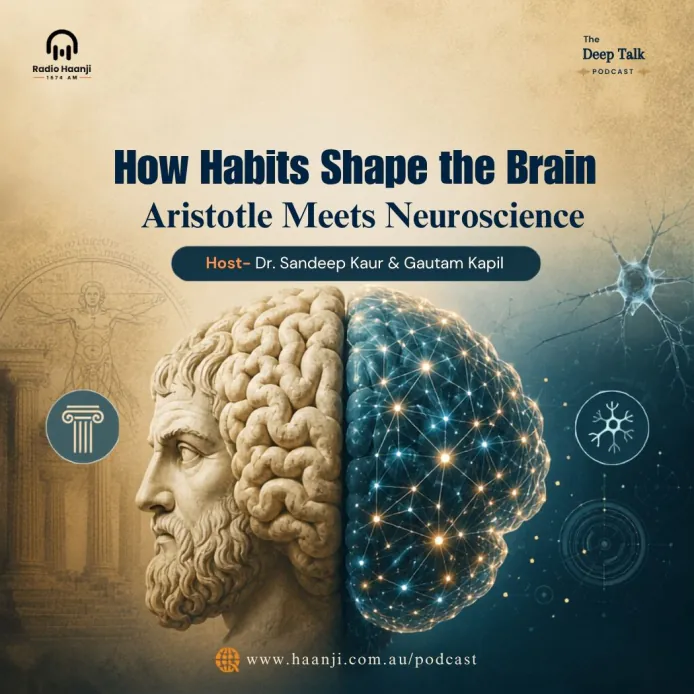
Aristotle never saw a synapse. He had no way to measure electrical activity in a neuron or scan a living brain. And yet, more than two thousand years before the invention of the MRI, he wrote a line that modern neuroscience has spent the last few decades quietly proving correct: we are what we repeatedly do. On a recent episode of Radio Haanji's Deep Talk Show, host Gautam Kapil sat down with neuroscience expert Dr. Sandeep Kaur to unpack exactly how that ancient claim holds up against what we now know about brain anatomy, neuroplasticity, and the biology of habit.
The conversation moved from philosophy to hard science and back again, and what emerged was a genuinely useful way of thinking about how habits shape the brain — not as a metaphor, but as a physical, measurable process happening inside roughly three pounds of tissue between your ears. This article walks through the key ideas from that discussion: the scale of the brain's internal architecture, the myths that still circulate about how it works, and the science of why repetition is the single most powerful lever you have over your own character.
By the end, you'll understand not just that habits matter, but precisely what is happening at a cellular level every time you repeat an action — and why that gives Aristotle's 2,300-year-old advice more scientific weight than most self-help writing manages today.
Why an Ancient Philosopher Still Matters to Neuroscience
Aristotle is often remembered as a philosopher, but Dr. Kaur made the case during the episode that he functions more like an early scientist. He studied biology, catalogued animal behaviour, and built his ethical theories on careful observation of human conduct rather than abstract speculation alone. That observational instinct is what led him to a conclusion neuroscience now confirms with hard data: character isn't fixed at birth, and it isn't purely a product of environment either. It's built through repeated action.
Aristotle's central claim was that virtue — and by extension, character — is not something we're born with, but something we develop through practice, much like a skill. A person becomes courageous by repeatedly acting courageously, and becomes honest by repeatedly choosing honesty, even in small moments. This is the philosophical seed of what neuroscience today calls habit formation through synaptic strengthening.
There's also a well-being dimension to this that the episode touched on. Aristotle argued that a life oriented around a clear purpose — what he called eudaimonia, often translated as flourishing — produces a deeper and more durable form of well-being than the pursuit of pleasure alone. Modern psychological research on purpose and mental health broadly supports this link, with a sense of direction correlating with better long-term brain health outcomes.
How Many Neurons Does the Human Brain Have?
The human brain contains approximately 86 billion neurons, connected by as many as 100 trillion synapses. For comparison, the Milky Way galaxy is estimated to hold between 100 and 400 billion stars — meaning the brain's internal network of connections is, in raw number terms, more complex than a galaxy.
This comparison isn't just a fun statistic; it's the frame Dr. Kaur used to describe the brain as an "internal universe." Each neuron doesn't just connect to one neighbour — it can connect to thousands of others, forming a web of possible pathways that is constantly being built, reinforced, or allowed to fade depending on how it's used.
That web is also remarkably efficient. The brain runs on roughly 20 watts of power — less than most household light bulbs — yet generates enough electrical and chemical signalling to coordinate everything from your heartbeat to your ability to read this sentence. In terms of raw information capacity, researchers estimate the brain can store the equivalent of about 2.5 petabytes of data, comparable to roughly three million hours of video or audio content.
What Is the Brain Actually Made Of?
Physically, the brain is a surprisingly fatty organ: roughly 60 percent of its composition is fat, with the remaining 40 percent made up of water, proteins, carbohydrates, and salts. That fat content isn't incidental — it's essential to the insulation of neural pathways and the speed at which signals travel.
Structurally, the brain relies on two main types of tissue. Gray matter is where information gets processed and interpreted — it's the "thinking" tissue packed with neuron cell bodies. White matter, by contrast, is the transmission network, carrying processed signals between regions so the body can coordinate a response. Think of gray matter as the decision-makers and white matter as the wiring that carries the decision outward.
Three major regions do most of the heavy lifting. The cerebrum, the largest structure, handles higher-order thinking, reasoning, speech — including specialised areas like Broca's and Wernicke's regions — sensory processing, and voluntary movement. The cerebellum, tucked at the back of the brain and often nicknamed the "little brain," governs balance, posture, and motor coordination, and current research increasingly points to it also playing a role in social cognition and emotional processing. Beneath both sits the brainstem, which quietly regulates the autonomic functions that keep you alive — breathing, heart rate, and basic reflexes — without requiring any conscious thought at all.
Do Humans Only Use 10 Percent of Their Brain?
No. This is one of the most persistent myths in popular science, and it is false. Brain imaging shows activity across virtually the entire brain, even during rest, with different regions activating depending on the task. There is no dormant 90 percent waiting to be unlocked.
The myth likely persists because it offers a seductive idea — that untapped potential is just one hack away. But the real story, as Dr. Kaur explained, is more interesting: intelligence and cognitive ability aren't about how much of the brain you're using, but about how efficiently and strongly your neural connections are built. Two people can use the exact same brain regions for a task, but the one with more developed, well-practised pathways in that domain will perform better.
This reframes the entire idea of "smartness." Rather than being a fixed trait some people are born with and others aren't, cognitive strength in any given area is largely a product of how much that specific pathway has been exercised — which loops directly back to Aristotle's argument that ability, like character, is built through repetition rather than granted at birth.
How Does Neuroplasticity Work in Adults?
Neuroplasticity is the brain's ability to reorganise itself by forming new neural connections throughout life — not just in childhood. When you repeat a thought, skill, or behaviour, the synaptic pathway involved gets physically strengthened, making that action easier and more automatic each time. This is the biological mechanism behind every habit you've ever built or broken.
This is where the episode's philosophy-meets-science framing lands most powerfully. Aristotle argued that repeated action shapes character; neuroscience explains this literally at the level of synaptic connections. Every time a behaviour is repeated, the relevant neural pathway becomes more efficient — requiring less conscious effort to execute the next time. This is why a habit that once took willpower eventually becomes automatic: the brain has physically rewired itself to make that pathway the default.
Neuroplasticity is most dramatic in early childhood, when synaptic connections grow exponentially — from around 2,500 connections per neuron at birth to roughly 15,000 per neuron by age three. This explosive period underlines why active engagement, rather than passive screen exposure, is considered so important in early development; the brain is quite literally building its architecture based on the input it receives during this window.
But plasticity doesn't switch off in adulthood — it slows and becomes more selective, but it never disappears. This is also the mechanism behind much of the brain's recovery after injury, where undamaged regions can sometimes take over functions previously handled by a damaged area, a phenomenon that continues to reshape how clinicians think about rehabilitation.
Can the Brain Really Grow New Cells After Childhood?
Yes. Contrary to older medical assumptions, science now confirms that neurogenesis — the formation of new neurons — continues throughout adult life, particularly in regions associated with memory and learning. This overturns decades of textbook teaching that treated the adult brain as a fixed, unchanging structure incapable of producing new cells.
The discovery of adult neurogenesis has significant implications beyond biology trivia. It means that the brain retains a genuine, ongoing capacity for renewal and adaptation well into later life, provided it continues to receive the right kind of stimulation. This is part of why mental engagement — learning new skills, tackling unfamiliar problems, staying socially active — is now understood as directly protective rather than simply "good advice."
It also reinforces the episode's central thesis in a very literal way: the brain isn't a static organ you're issued at birth and stuck with. It is, at every stage of life, actively building and rebuilding itself based on how it's used — which is essentially Aristotle's theory of habit, translated into cell biology.
Protecting the Brain for the Long Run
If habits and repetition build the brain's pathways, the natural follow-up question is how to protect that infrastructure over a lifetime. Two factors came up repeatedly in the discussion: mental stimulation and diet.
Continued learning — picking up new skills, engaging with unfamiliar ideas, exercising the mind deliberately rather than passively — builds what researchers call cognitive reserve. This reserve acts as a buffer, giving the brain more redundant pathways to draw on if age or illness begins to affect certain regions, which is one reason cognitively active individuals often show more resilience against conditions like dementia and Alzheimer's disease.
Diet plays a complementary role. Foods rich in omega-3 fatty acids, along with leafy greens, berries, walnuts, and olive oil, are consistently associated with better long-term cognitive outcomes. None of these are a guarantee against decline, but together with ongoing mental engagement, they form a practical, evidence-aligned approach to long-term brain health — one that fits neatly alongside Aristotle's broader point that flourishing is built through consistent daily choices, not occasional effort.
Key Takeaways
- The human brain contains approximately 86 billion neurons and up to 100 trillion synaptic connections, a network more numerically complex than the Milky Way's estimated 100–400 billion stars.
- The "humans only use 10 percent of their brain" claim is a myth; brain imaging confirms activity across virtually the entire brain.
- Neuroplasticity allows the brain to form new neural connections throughout life, not only during childhood, with synaptic density peaking at around 15,000 connections per neuron by age three.
- Neurogenesis — the creation of new neurons — continues into adulthood, overturning older assumptions that the adult brain could not generate new brain cells.
- The brain is composed of roughly 60 percent fat, with gray matter handling processing and white matter handling signal transmission between regions.
- Aristotle's theory that character is built through repeated action aligns directly with the modern neuroscience concept of synaptic strengthening through habit repetition.
If this conversation between ancient philosophy and modern neuroscience left you thinking differently about your own daily habits, that's exactly the kind of dialogue Radio Haanji's Deep Talk Show set out to spark. Tune in to the full episode with Gautam Kapil and Dr. Sandeep Kaur on 1674 AM or the Radio Haanji app, and share this piece with someone who could use a scientific reason to finally stick with a good habit.
Frequently Asked Questions
What part of the brain is responsible for habits?
Is it true that it takes 21 days to form a habit?
Did Aristotle actually say "we are what we repeatedly do"?
Why does the brain feel most changeable in childhood?
Can bad habits be "unwired" from the brain?
Does mental decline with age happen to everyone equally?
What is the difference between neuroplasticity and neurogenesis?
What's Your Reaction?